


Kevin Warsh’s Jackson Hole speech did not change the Federal Reserve’s regime. It sharpened the measure. PCE inflation remains above target, M2 is still growing, financial conditions are not tight, and the next rate decision falls on September 15-16.
At the end of the seventeenth century an English shilling was twelve pence by law and often less by metal. Coins were struck with a hammer. The rim was clipped, the shavings melted down, and the light shilling still passed at full face value. Full-weight pieces fled to Amsterdam and Paris. What remained in circulation were the light coins and the counterfeits.
Parliament refused to legalise a lighter pound and ordered a recoinage at the old weight, with a milled edge. While the old coin was no longer accepted and the new one was not yet in hand, trade slid back toward barter and the bank stopped paying in metal.
In May 1696 Isaac Newton took the Mint in earnest, raised output and pursued the clippers. By 1698 England had a new circulation and an honest edge - at a heavy loss to the Treasury. The flight into gold remained. Newton did not repair the nature of the metal. He repaired the lie at the rim.
Federal Reserve Chair Kevin Warsh did the same thing in words on Friday at Jackson Hole. He said money matters. He did not weigh it. The rim now is easy credit, rising M2 and the long end of the yield curve, which the Treasury is already touching.
What Warsh said at Jackson Hole
The market heard a hawk. The more precise reading is different. It heard a chair who put numbers on his unease and still refused to bind the next move on rates. This is a sharper version of the July Warsh, not a new Fed doctrine. Jackson Hole likes to turn a nuance into an epoch. The difference matters.
What changed after the July meeting
On July 29 the Federal Open Market Committee left the federal-funds target range at 3.50-3.75 per cent on a 9-3 vote. Three members already wanted a hike. Warsh said there is no soft target above 2 per cent, that five years above target are not cured in nine weeks, and that the committee would not hesitate. The prepared text was hard. The answers that followed were softer. The market left with two readings of one speech.
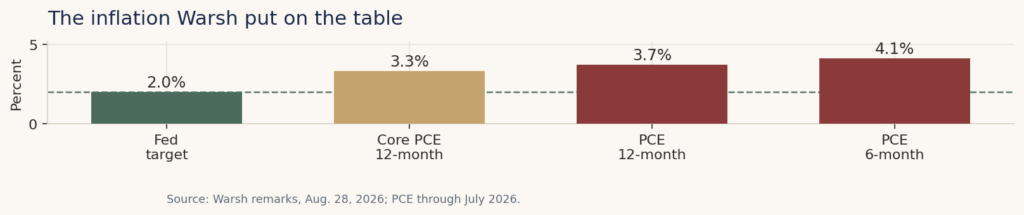
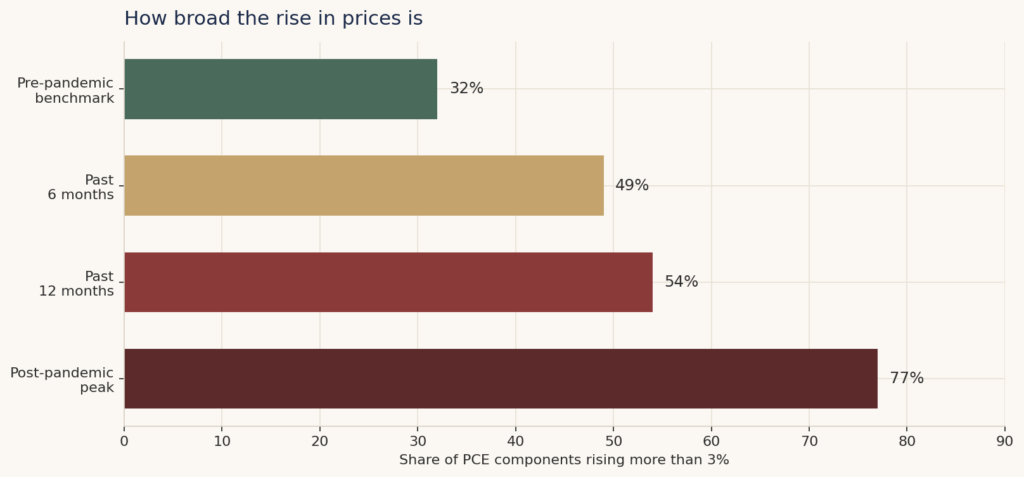
On Friday the diagnosis did not change. The sharpness did. Twelve-month PCE inflation is 3.7 per cent; the six-month rate is 4.1 per cent. The summer prints were better than expected and still do not show a lasting slowdown. In the basket, 54 per cent of items have risen more than 3 per cent over twelve months and 49 per cent over six. And there was a sentence July did not quite put this way: broad financial conditions are hard to describe as restrictive. Credit spreads are tight. New debt issuance is ample. Bank standards on business loans sit in the easier part of the historical range.
July already had a hard 2 per cent PCE target, a refusal of regular forward guidance and three votes for a hike. Friday added the concrete inflation measures, the admission that credit is not tightening, and the test: confidence that inflation is moving toward the target clearly and fast enough. Otherwise there is work to do. Policy will change if the funds rate and credit change, not if the mountain hears a better text. In Wyoming one man speaks. In September the committee decides.
He called the 2 per cent PCE objective a hard and fixed target. The gesture is Locke’s: the name of the measure is left untouched even when money in the market already weighs something else. Policy then pays the gap between the inscription and the circulation.
PCE inflation: not one number, several weights
Inflation does not weigh like a single coin. In July PCE rose 0.2 per cent on the month; so did the index excluding food and energy. On a twelve-month basis core inflation is 3.3 per cent, against 3.7 per cent for the headline. Services hold the level. Housing in the CPI looks tame because of hotels, while rent and owners’ equivalent rent accelerated. In PCE, housing weighs less and health care and financial services weigh more. Anyone who reads only the easing in CPI shelter is reading another measure.
Two more reliable weights follow. The first is lagging housing costs, on which the policy rate still works. The second is services tied to wages and health care, on which it works more slowly. In July core goods prices in the CPI returned to a 0.2 per cent monthly rise, with a sharp jump in computers and home assistants. One month does not make a trend. Until the August data this is a signal - possible pass-through of tariffs and hardware into final prices, or noise.
If the market raised the odds of a hike, it is not because one tightening gathers every price back to 2 per cent. A higher funds rate can cool housing and part of demand. It will not repeal a tariff, the building of data centres or the budget deficit. Higher real short-term rates are more likely than a new cheap-credit cycle, because that is the instrument in the committee’s hands.
The labour market: 4.1 per cent unemployment and the other numbers
The inscription on labour is 4.1 per cent unemployment and low new claims. Warsh also reads low job-to-job movement as a legacy of the post-pandemic reshuffle: with weak growth in the labour force, few new hires do not automatically mean deterioration. That column exists. So does the other. In July employers cut 23,000 jobs. Revisions took another 103,000 out of May and June. The jobless rate fell because 264,000 people left the labour force. The participation rate dropped to 61.4 per cent, the lowest since February 2021. Among 16- to 24-year-olds, unemployment is 9.1 per cent. The saving rate is 3.0 per cent. Real personal consumption barely moved in July. Part of the July decline in payrolls may be seasonality and education. Part does not look like seasonality.
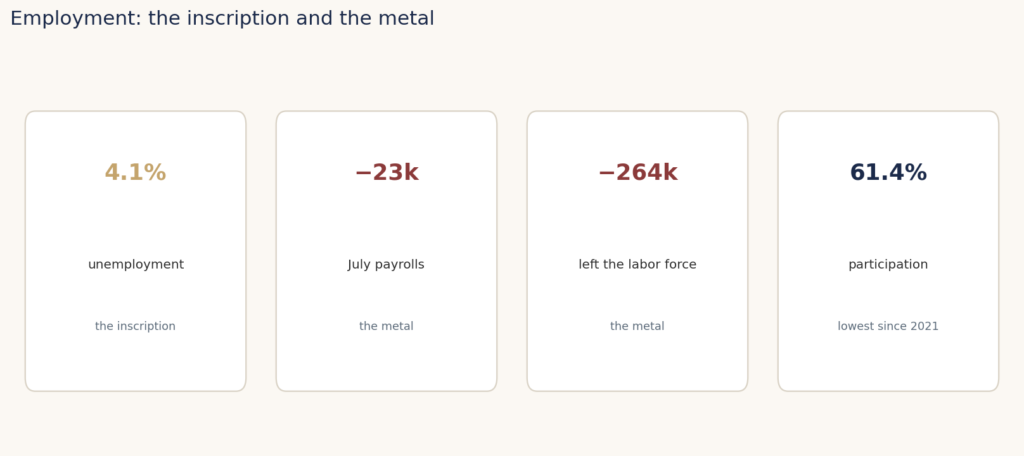
The two columns stand side by side. If August again shows fewer new jobs and lower participation, the focus on prices ceases to be mere order in the dual mandate. It becomes a choice to tighten when employment is no longer quiet.
“Money matters”: what M2 and velocity show
The scale the speech asked for is this. M2 in July is about $23.2 trillion and is growing about 5.4 per cent a year, the fastest pace since mid-2022. M2 velocity in the second quarter is 1.415, against 1.395 a year earlier. In the late 1990s it was about 2.2; in 2020, about 1.1. Money is turning a little faster than at the trough, far from the old rhythm. Real balances are not shrinking: the aggregates are growing faster than prices. The Fed’s balance sheet is about $6.7 trillion. The policy rate has been unchanged since December. Credit is easy. Spreads are tight. The official rate speaks of restriction; credit speaks of something else.
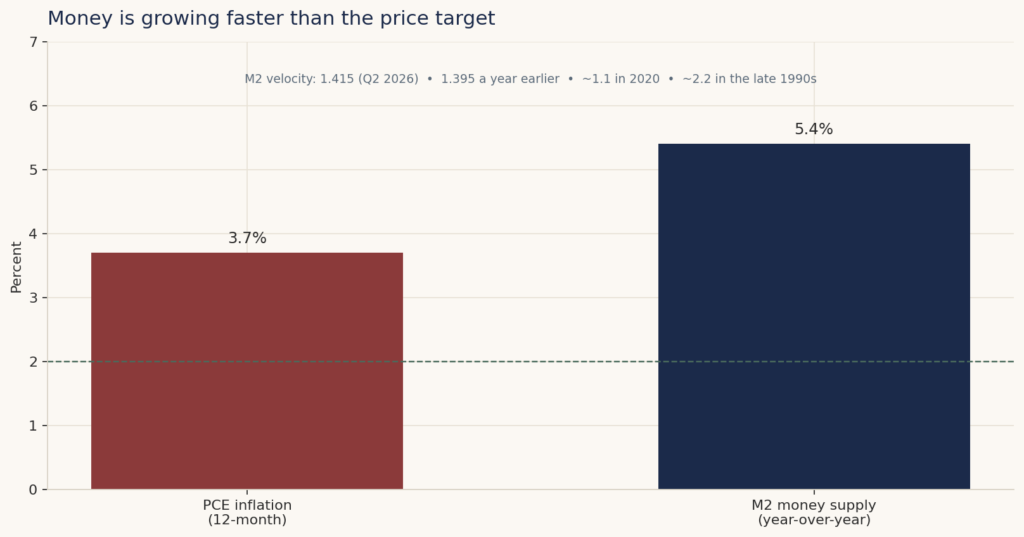

A large stock of money that sits does not raise prices. A large stock that passes through corporate credit into power, chips and concrete can raise prices exactly where the July index twitched if August confirms the signal. The dollar here is a global reserve system, not only Friday’s print. Surplus seeks a scarce real resource both in the United States and outside it.
Bessent, the yield curve and Fed independence
Friday’s market did not speak with one voice. Two-year Treasury yields rose about 10 basis points. The long end held or even eased. The dollar strengthened, gold fell and equities closed almost unchanged. That is a reassessment of near-term policy, not a jump in the inflation premium across the curve.
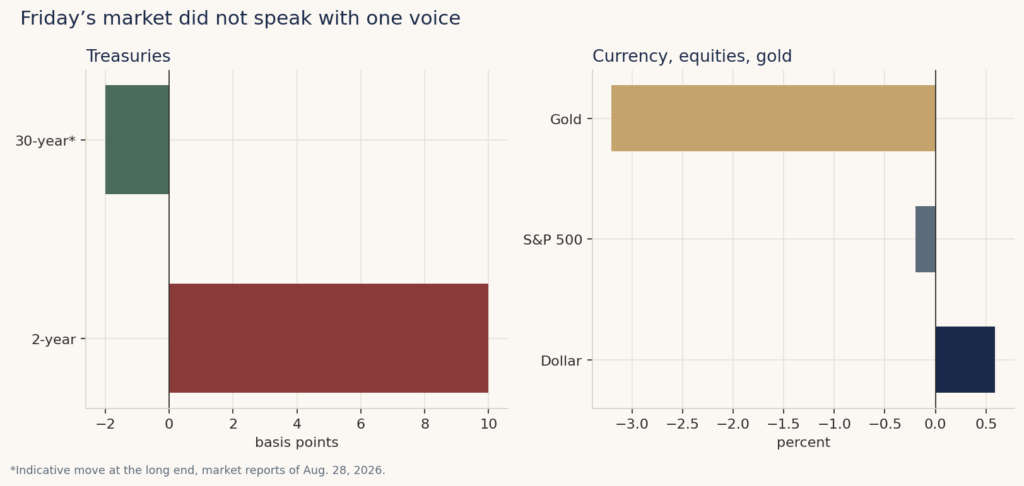
The curve is no longer clean. A week earlier Treasury Secretary Scott Bessent said buybacks of long-dated nominal Treasuries would at least double, to $4 billion per operation, from September 9 to November 4. He is not cutting the face amount. He is pressing the price of long government debt. Warsh asked for the cleanest possible market signal. The Treasury is already changing that signal. If the buybacks pull long yields down, the chair will see easier conditions than his policy rate creates. Central-bank independence is then a question of who touches the scale when the August data are mixed and the three who voted for a hike in July ask for a move.

Warsh is not Jerome Powell of August 2022. That chair said the adjustment would be painful and imposed it until conditions actually tightened. This one said the work exists, admitted that conditions are not tight and has left the rate unchanged since December. Friday is an inventory of the position.
Artificial intelligence, investment and the theme the forum passed over
The Jackson Hole meeting was convened for payments and tokenisation. Warsh used it as an entry to artificial intelligence and to the right to speak less. On settlement he barely spoke. The “tokens” he named were not payment units but fees for access to the labs’ models - more than $100 billion a year, at a run rate, for the two leaders. On the technology he was cautious: it is not known whether productivity will appear, or when. The working group is a reasonable step. Its findings have no bearing on the present rate decision.
Investment in machinery, equipment and intangibles is growing about 9 per cent; more than half of that, he said, is tied to the build-out around artificial intelligence. Demand is here. Productivity comes later. The remainder is the same as in 1698: a milled edge, and metal that still flees toward another price - then silver into gold, now power, chips and the fiscal deficit toward the short rate.
What the speech means for rates in September
Friday may have been misread as follows: that “work” means a September hike, not a condition until the September 15-16 meeting; that a quieter Fed reduces uncertainty rather than shifting it onto the next prints; that one rise in the funds rate repairs easy credit if the long end is held down; that stable inflation expectations are a licence to stand still; that July’s rebound in goods prices is already a lasting trend.
Higher real short-term rates are more likely than a new cheap-credit cycle, because that is the instrument the FOMC acknowledges. The long end depends at least as much on Bessent. Housing is under pressure even without another hike. Tight credit spreads alongside easy lending are either a plausible valuation or a risk not yet in the price. If tightening arrives on already weak jobs, the Fed will not have brought the whole system back to 2 per cent. It will have used the instrument it holds.
A recoinage does not succeed by a declaration from the mountain. Warsh asked for a clean signal in the week another department pressed the long end of the curve. M2 is growing faster than the inflation target. Velocity has lifted from the trough; it has not returned to the old rhythm. Financial conditions are not tight. Employment carries two inscriptions.
If money matters, the next six weeks are a weighing. Newton did not win by explaining silver. He won by counting it - and still left the arbitrage in peace. The Fed still holds the inscription. Part of the metal lies outside its authority.
Questions after the speech
Does the speech mean a rate hike in September?
No. It means a condition: confidence that inflation is moving toward 2 per cent clearly and fast enough. Before the FOMC meeting on September 15-16 come the August jobs and prices reports. The market raised the odds of a hike because expectations of a cut faded. If payrolls and participation soften again, the same move will meet the already thinner side of the dual mandate.
What does “money matters” weigh, given that Warsh cited no figures?
A principle, not yet a rule. M2 is growing about 5.4 per cent with inflation at 3.7 per cent and credit still easy. Velocity is 1.415 - a little above last year, far below late-1990s levels. If the principle enters the reaction function, Friday is harder than the tone. If it remains a phrase, it is empty weight.
Why do Bessent’s buybacks change the reading of the speech?
Because Warsh asked for the yield curve to be a clean signal, and the Treasury will buy long-dated bonds from September 9. If long yields fall for that reason, the chair will see easier financial conditions than his policy rate creates.
Was Jackson Hole 2026 a regime change?
No. July already had a hard target, a refusal of regular forward guidance and three votes for a hike. Friday added sharper inflation measures and the admission that broad financial conditions are not tight. A clearer message, not a new regime.
Which data carry the argument to mid-September - and where does the Newton comparison end?
The share of items rising more than 3 per cent; prices of services excluding housing; whether the rebound in hardware has a second month; whether participation and payrolls fall again.
The comparison ends where authority over the metal ends. Newton stopped the lie at the rim and left silver to flee into gold. Warsh can raise the short rate and leave the budget, tariffs, the investment boom and an already uneven labour market to run.
Important notice
This article is for information and education only. It is not financial advice, an investment recommendation or professional advice of any kind. The views expressed are the author’s personal opinions and are not recommendations to buy, sell or hold securities, assets or investments. Investing involves substantial risk, including the possible loss of all capital. Past performance is not a guarantee of future results. Each reader should conduct independent research, consult a qualified financial adviser and weigh financial circumstances, risk tolerance and investment objectives before taking any decision. The author and borsite.net accept no liability for any loss arising from the use of the information in this article.