


Why markets were frightened by the same thing on Wednesday

In 1881 Ferdinand de Lesseps, the builder of the Suez Canal, began construction in Panama of a canal that was to connect the Atlantic and Pacific oceans. His company sold shares and bonds on the market and raised hundreds of millions of francs, because the need for such a route was real and obvious. Construction started with enthusiasm, but the terrain proved harder, disease claimed tens of thousands of lives, and costs rose far faster than the capital raised. By 1889 the company was insolvent. The canal was not completed by those who had started it. Later the Americans finished it under a different financing structure and with stronger backing.
On Wednesday markets saw the same logic at work. Demand for computing power remains real, as shown by TSMC’s record results and Anthropic’s revenue of $16.8 billion for the quarter. But some of those building the capacity rely on debt and leasing in a way that resembles the French company of the 1880s more than the later American phase. When the cost of capital changes, the question is no longer whether the canal is needed, but who can continue digging it under the new conditions.
On the same day, U.S. consumer-price data for September showed annual acceleration to 3.7 percent, while some of CoreWeave’s bonds traded at yields near 15 percent. The two pieces of news do not appear connected at first glance, but together they wiped roughly a trillion dollars off the market value of U.S. equities and triggered the sharpest drop in the Korean market in months. This is not another correction in technology stocks. It is the point at which the price of capital and the financing of computing capacity met under new conditions, after the Federal Reserve had already begun raising rates.
What happened on Wednesday and why it is not an isolated shock for rates and technology stocks
On Wednesday the September consumer-price index rose 0.6 percent from the previous month and reached 3.7 percent year-on-year, above the expected 3.6 percent. Core inflation, which excludes food and energy, accelerated to 2.6 percent. Immediately after the release, federal-funds futures lifted the probability of another rate increase at the 27-28 October meeting above 50 percent (53.7 percent according to CME FedWatch), although the next day it fell back to about 27 percent. The yield on two-year U.S. Treasury notes jumped nearly 18 basis points in the first minutes before reversing when equity sell-offs brought buyers into government debt. The Nasdaq lost 1.9 percent, the semiconductor index fell more than 4 percent, and in Asia the Kospi crashed more than 7 percent and briefly halted trading.
The reaction is not without logic. In September the Federal Reserve raised the target range for the federal funds rate to 3.75-4.00 percent - the first increase in three years. The minutes of that meeting showed that most participants considered another increase by year-end probable. The September price data did not change the situation. They tested whether the path the committee had already drawn remained valid.
At the same time Anthropic told prospective investors that its third-quarter revenue had reached $16.8 billion, an increase of about 45 percent from the previous quarter, and that the company had reported adjusted profit for a second consecutive quarter as well as positive free cash flow. TSMC reported a record quarterly profit and said it saw no ceiling on demand for artificial-intelligence chips. The numbers show that demand for computing power is still there. The question the market asked on Wednesday was different: who will finance those who must buy, install and maintain that capacity, and at what price.
Table 1. Key figures from Wednesday, 14 October 2026 - inflation, rates and market reaction
| Indicator | Value | Meaning |
|---|---|---|
| September CPI (year-on-year) | 3.7% | Above the expected 3.6% |
| Core inflation | 2.6% | Acceleration |
| Probability of rate hike (CME FedWatch, peak after release) | 53.7% | Next day: about 27% |
| Yield on CoreWeave bonds | near 15% | Sharp rise in credit risk |
| Nasdaq decline | 1.9% | Worst day since July |
| Kospi decline | above 7% | Semiconductors and AI |
Why higher rates hit technology-stock valuations
Higher rates reduce the present value of future cash flows, and therefore press the valuations of companies whose growth is expected further ahead. Discounting converts expected future receipts into today’s price by reducing each cash flow by a percentage for every year that separates it from the present. That percentage - the discount rate - reflects both the time value of money and risk. When rates rise, the discount rate rises and distant cash flows lose more present value than near-term ones. Technology stocks are especially exposed because a large share of their value typically comes from cash flows expected years ahead. A company already generating stable cash has shorter duration and is less affected; a company whose value rests on later growth has longer duration and loses more for the same move in rates.
At the same time higher rates make the debt used to build data centres more expensive. The largest technology names have enormous balance sheets and generate enough cash to cover capital expenditure from internal sources or to borrow at relatively low cost. Players outside that circle lack this protection. CoreWeave, which rents computing power to companies such as Microsoft and Anthropic, carries tens of billions of dollars in debt and leasing contracts. At a yield on its bonds near 15 percent, creditors are no longer saying the stock is expensive. They are saying they believe the company may have difficulty servicing its obligations at the new price of money.
Table 2. How to distinguish the sensitivity of technology stocks to interest rates
| Criterion | Less sensitive | More sensitive |
|---|---|---|
| Timing of cash flows | Significant portion now or in the near years | Large portion after more than five years |
| Financing of growth | Own cash or cheap debt | Rely on external debt and leasing above $30 billion |
| Example | Largest technology balance sheets | CoreWeave and similar infrastructure players |
| Reaction to higher rates | More moderate | Stronger, especially on their liabilities |
To distinguish the effects on different technology stocks, three things must be compared. First, how large a share of the current market valuation comes from cash flows expected more than five years out. Second, what free cash flow is after capital expenditure and whether it covers the business’s needs without external financing. Third, what the debt structure is and at what price the company can refinance it. When all three indicators point to distant flows and dependence on external capital, the stock is more sensitive to rising rates. With nearer cash flows and mainly internal financing, sensitivity is lower, even if the company operates in the same sector. Precisely this difference explains why on Wednesday the largest technology names lost less than the more leveraged infrastructure players.
The market already made a similar distinction in 2022, when rates rose quickly and growth-stock valuations compressed more sharply than those of companies with stable cash flows. At that time, however, the absolute scale of demand for computing power was considerably smaller and the financing structure less dependent on specialised debt for data centres. Now TSMC and Anthropic confirm that demand remains strong and is growing in absolute numbers, but the cost of the capital that finances the build-out of capacity has changed. The difference is not whether growth exists, but how much it costs to sustain.
What the market punished and what is still not clearly visible in AI-infrastructure financing
The market is punishing not a decline in growth, but disappointment in its pace. Anthropic’s revenue continues to grow in absolute numbers and the company is already on a path toward annual revenue that would have looked unthinkable two years ago. But the increase from the first to the second quarter was nearly 150 percent, while from the second to the third it fell to about 45 percent. At valuations built on the expectation of almost continuous acceleration, any slowdown is read as a warning stronger than the adjusted profit itself.
The adjusted profit Anthropic reports usually excludes stock-based compensation, one-off costs and certain non-cash items and therefore does not necessarily match free cash flow after all capital needs. The company says it generated positive free cash flow during the quarter, but the reader still does not see the full picture of how much of that flow covers real computing costs and how much remains after them. For a player preparing a large initial public offering with a valuation that could reach two trillion dollars, this difference matters, and the market reacts more sharply to the slowdown in growth because it calls into question the very expectations on which the valuation was built.
A large part of artificial-intelligence capacity is being built not only with public bonds such as CoreWeave’s, but with private loans and leases whose terms do not appear immediately in exchange prices. At CoreWeave public debt alone already exceeds thirty billion dollars, and total obligations, including leases, are considerably larger. Private creditors financing similar projects usually demand higher rates and stricter coverage conditions when yields on public bonds rise sharply. If they begin to tighten access or raise the price of new loans, the effect on the pace of data-centre construction will appear more slowly than the one-day equity drop, but will be more lasting, because it will affect projects that have not yet started.
Part of the initial reaction in bond yields reversed after the equity sell-offs. The market is simultaneously afraid of higher rates and seeking shelter in them. This is not a classic risk-off in which everything risky falls, but a split between the creditors and the shareholders of the same companies. Shareholders sell because they expect higher discount rates and more expensive capital. Creditors buy government bonds and demand higher yields on corporate debt because they want compensation for the risk they now see more clearly.
What this means for the technology-stock investor
For someone holding global equities the implication is direct. Higher long-term yields in the United States usually press growth-company valuations everywhere and make defensive sectors and bonds relatively more attractive. The question is not whether to sell Nvidia tomorrow. The question is whether part of this year’s rise in the technology sector was supported by an expectation of endlessly cheap capital. If the Federal Reserve raises rates once more this year and creditors - both public and private - continue to demand higher compensation from infrastructure players, part of capital expenditure will be deferred or shifted onto the largest balance sheets that can bear it without paying 15 percent.
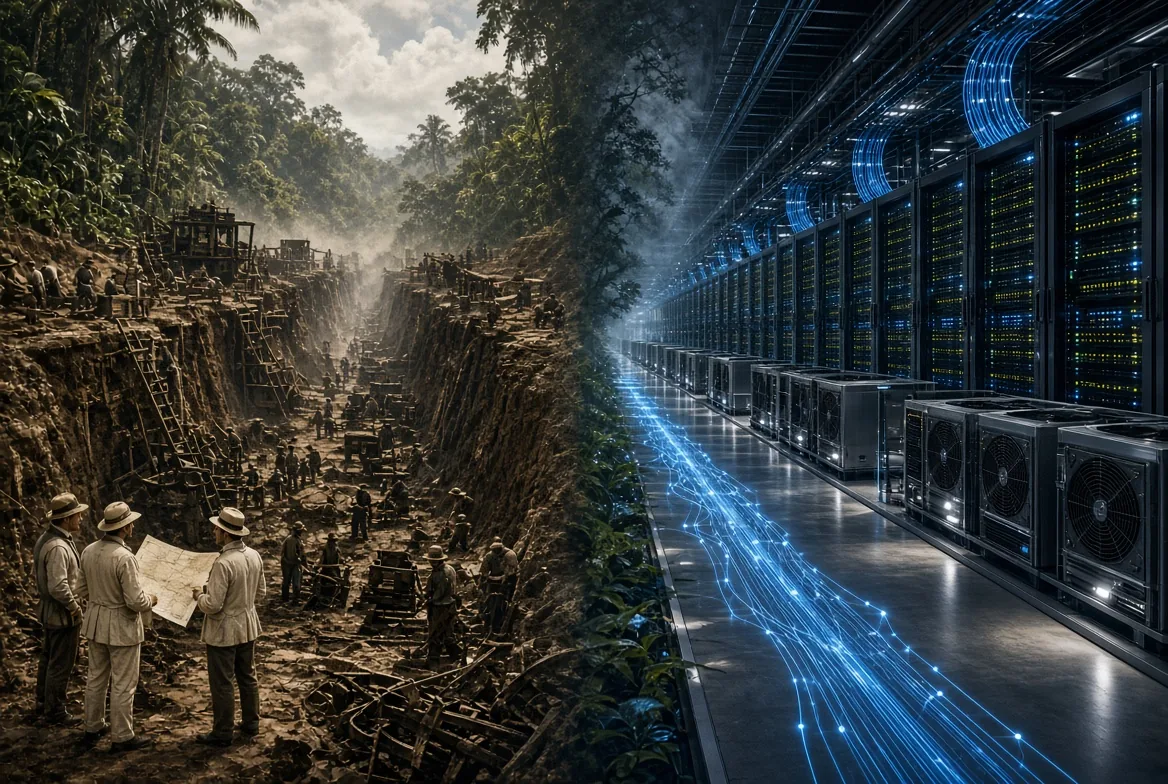
The canal in Panama was eventually built. The need for it does not disappear when the French company fails. What changes is only who finishes it and at what price. The same applies now. The market was not frightened by the possibility that artificial intelligence stops growing. It was frightened by the possibility that some of those building it with debt may not be able to continue at the new cost of capital, and that construction may shift onto those with stronger balance sheets. The criterion for the next two weeks is simple. If on 27-28 October the Federal Reserve raises rates and yields on the bonds of infrastructure players remain above 12 percent, the pace of new capital expenditure will slow and part of the projects will pass into the hands of the largest companies. If the committee postpones the increase and that yield falls below 10 percent, pressure on financing will ease, but valuations of companies with distant cash flows will remain sensitive to any new acceleration in inflation. Retail-sales and employment data before the meeting will show which of the two paths is more likely.
Frequently asked questions (FAQ)
Why do higher rates hit technology stocks harder than others?
Because a large part of the value of technology companies comes from cash flows expected years ahead. When the discount rate rises, those distant flows lose more of their present value than the flows of companies that already generate stable cash today.
What does it mean that CoreWeave’s bonds are trading at yields near 15 percent?
It means creditors are demanding significantly higher compensation for risk than when they bought the same bonds earlier. This is a signal that the market doubts the company’s ability to service its debt at the new cost of capital, even if contracted revenues remain large.
Why is Anthropic’s adjusted profit not enough to calm the market?
Because adjusted profit usually excludes stock-based compensation, one-off costs and some non-cash items. The market reacts more strongly to the slowdown in growth from nearly 150 percent to about 45 percent, because valuations were built on an expectation of continued acceleration, not only on current adjusted profit.
What is the difference between the largest technology companies and infrastructure players such as CoreWeave in this situation?
The largest companies can finance a large part of their capital expenditure from their own cash or borrow at relatively low cost. Infrastructure players rely more heavily on debt and leasing; at CoreWeave public debt alone exceeds $30 billion. When the price of that debt rises sharply, the former absorb the blow more lightly than the latter.
What should we watch over the next two weeks and under what conditions does the market situation change?
U.S. retail-sales and employment data, as well as the Federal Reserve’s decision on 27-28 October. If rates are raised and yields on infrastructure-company bonds remain above 12 percent, pressure on new capital expenditure will intensify and the thesis of projects shifting onto stronger balance sheets will be confirmed. If the increase is postponed and that yield falls below 10 percent, pressure on financing will ease and part of the thesis of immediate transfer will weaken, although valuations of companies with distant cash flows will remain sensitive to inflation.
Important notice
This article is for information and education only. It is not financial advice, an investment recommendation or professional advice of any kind. The views expressed are the author’s personal opinions and are not recommendations to buy, sell or hold securities, assets or investments. Investing involves substantial risk, including the possible loss of all capital. Past performance is not a guarantee of future results. Each reader should conduct independent research, consult a qualified financial adviser and weigh financial circumstances, risk tolerance and investment objectives before taking any decision. The author and borsite.net accept no liability for any loss arising from the use of the information in this article.
Leave a Reply
Трябва да влезете или да се регистрирате, за да публикувате коментар.