

Isambard Kingdom Brunel was born in 1806 in Portsmouth, the son of the engineer Marc Isambard Brunel. His father was already working on large infrastructure projects, including the Thames Tunnel, and the son grew up among drawings, machines and conversations about materials and loads. He completed his technical education in France, then returned to England and from an early age worked alongside his father. His profession was that of an engineer - bridges, tunnels, railways and ships - and he practised it at a time when the Industrial Revolution promised a new era, yet materials, power and terrain still imposed their limits.
His achievements were concrete. He designed the Clifton Suspension Bridge in Bristol, the Thames Tunnel, the Great Western Railway and the steamships Great Western, Great Britain and Great Eastern. Great Eastern was the largest ship of its time and was built to withstand long ocean passages. Brunel did not lead the Industrial Revolution. He decided where the iron would hold, where the water would stop and where the engine would not deliver enough power for the weight. His structures outlasted the enthusiasm of the moment because they were made within real constraints, not in spite of them.
A similar discipline is applied by Gavin Baker to artificial intelligence. He does not buy the trend. He looks for the places where demand collides with a real shortage of components, of electricity and of connectivity. Brunel knew a steamship would not sail if the hull was weak or the engine underpowered; Baker applies the same test to artificial intelligence.
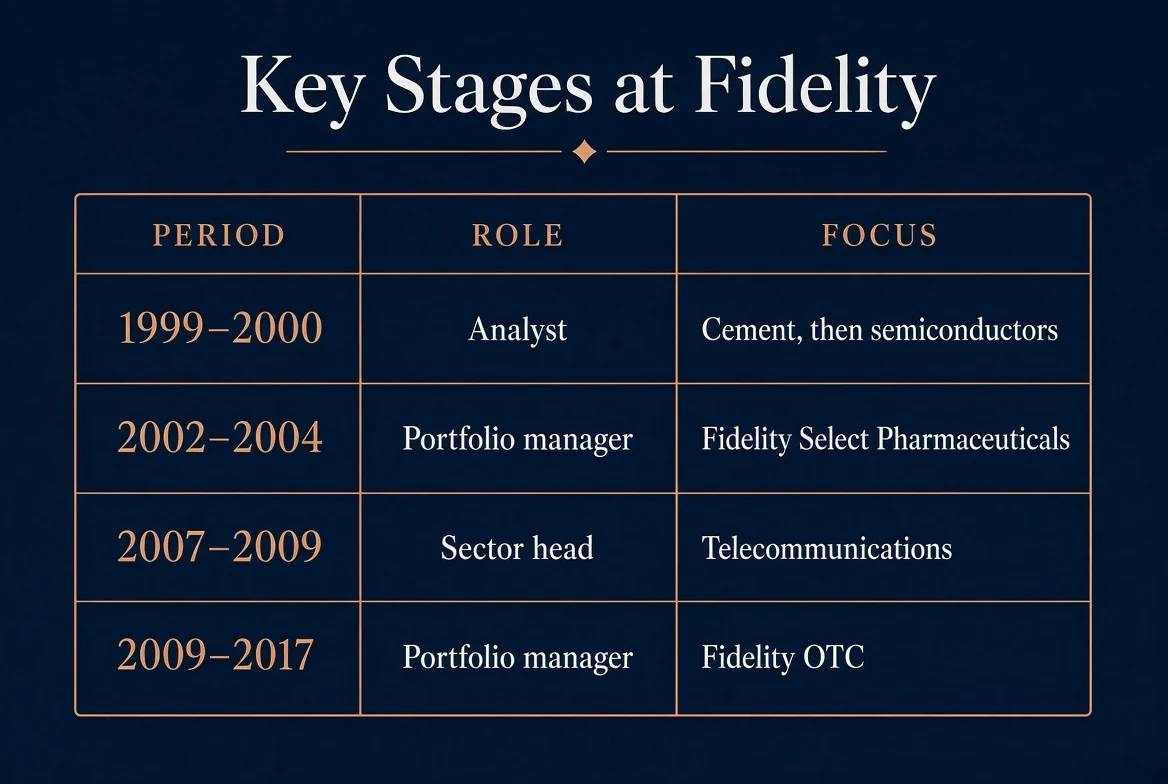
Baker was born in the late 1970s in Houston, Texas, to a family of two lawyers. His childhood was spent among books on ancient civilisations. His interest in long historical cycles explains why he later thinks in supercycles and why he is prepared to hold a position even when the market punishes it. He graduated from Dartmouth College in 1999 with majors in economics and history. His interest in investing appeared during an internship at Donaldson, Lufkin & Jenrette. In September 1999 he joined Fidelity and began analysing cement producers; at the start of 2000 he moved to the semiconductor sector. As a young analyst he was among the first to see the build-up of imbalances before the technology bubble burst.
He later covered pharmaceuticals, retail and telecommunications. From 2007 he was sector head of telecommunications trading, and his fund outperformed comparable exchange-traded funds during the 2008-2009 bear market. From 2009 to 2017 he managed the Fidelity OTC fund, with assets of around $17 billion. Over the eight years the fund outperformed more than 99 per cent of its peers according to Morningstar, delivered a net annualised return of around 19.3 per cent and won six Lipper awards. In 2014 The Boston Globe named him portfolio manager of the year.
Key stages at Fidelity
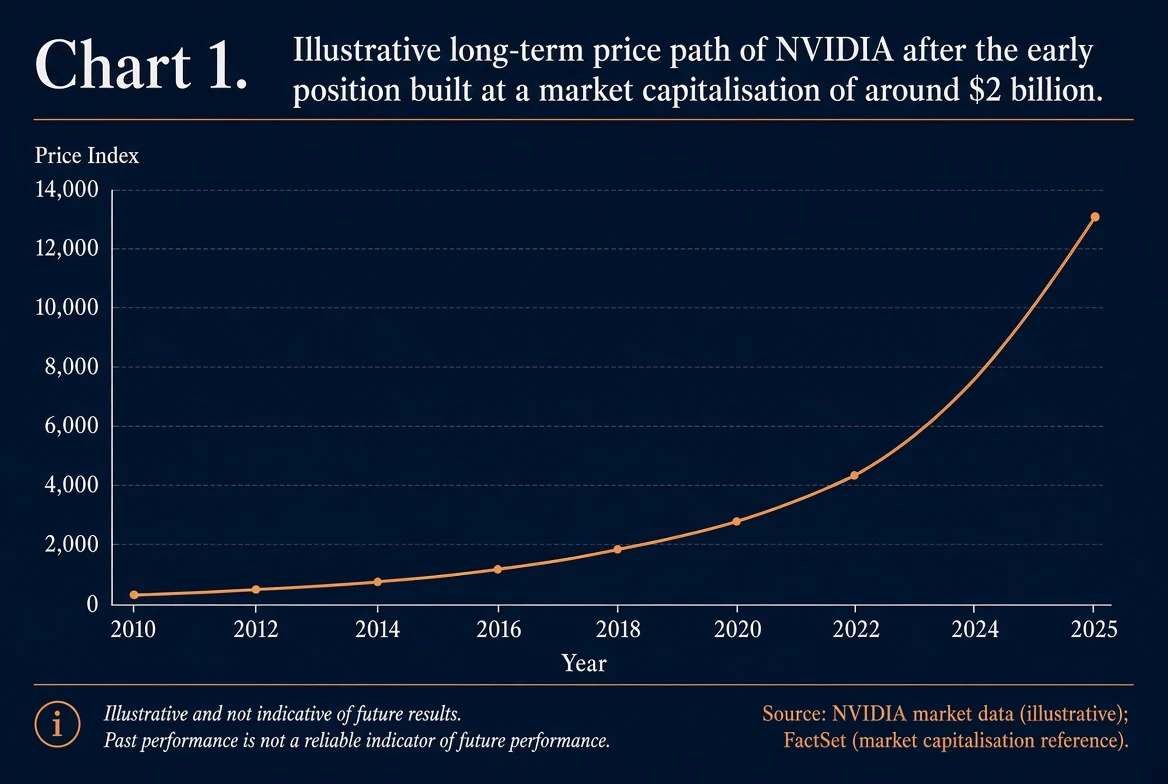
The positions in NVIDIA and Tesla, built when each company had a market capitalisation of around $2 billion, show the weight he was prepared to take. When NVIDIA’s market capitalisation was around $2 billion, Fidelity held about 15 per cent of the company. Even as a young analyst Baker spoke with Jensen Huang for an hour or two every week. He explains the decision by the fact that he saw demand for graphics processors not only for games but for computation that would later become the foundation of accelerators for artificial intelligence. Later his fund became the largest shareholder in Tesla at a similar market capitalisation. The decision rested on the combination of product, vertical integration and a manager with vision that was missing at the other car companies. He paid for that conviction in the years when both companies were still niche and when the market regarded accelerators as specialised hardware and electric cars as a niche product. Baker held the positions because the data on orders and capacity did not contradict his initial assessment.
While at Fidelity he participated in the firm’s venture investments in SpaceX, Uber and Twilio. He entered SpaceX as an institutional investor while the company was still private. For him it solves several physical constraints at once - launch capacity for payload, the ability to reuse vehicles and, later, access to orbital computing and connectivity on a scale that terrestrial infrastructure struggles to achieve.
In January 2019 he founded Atreides Management in Boston. Atreides is a fund that invests simultaneously in publicly traded and private companies. It is not limited either to shares on the exchange or to stakes in unlisted companies. It holds positions on both sides and uses information from one to form a view on the other. From private companies it obtains information through participation in financing rounds and through direct contact with management. From public companies it obtains information through filings and through conversations with investors. Comparing the two allows it to check whether the capacity that private laboratories are reserving corresponds to the spending and utilisation that public customers are reporting.
Baker has repeatedly said in public that constraints on TSMC’s capacity and on electricity reduce the risk of a classic bubble of the 2000 type, because the large cloud providers are companies with strong cash flows rather than ones dependent on debt.
At Atreides the largest position is in SpaceX. Baker sees the company as more than a launch provider; it can supply computing capacity and connectivity when terrestrial electricity and manufacturing capacity become insufficient. After SpaceX come positions in Micron, Cerebras Systems, Astera Labs and Ciena. Micron addresses the shortage of high-bandwidth memory without which the training and inference of models slows. Cerebras supplies specialised chips that handle certain workloads more efficiently than standard graphics processors. Astera Labs and Ciena address the links between chips and between data centres, which fall behind when computing power grows faster than the ability to move data. At the same time Baker holds hedging positions against a broad technology index, because even when specific constraints remain, the overall market valuation of the sector can decline.
Main positions in Gavin Baker’s portfolio and the logic behind them
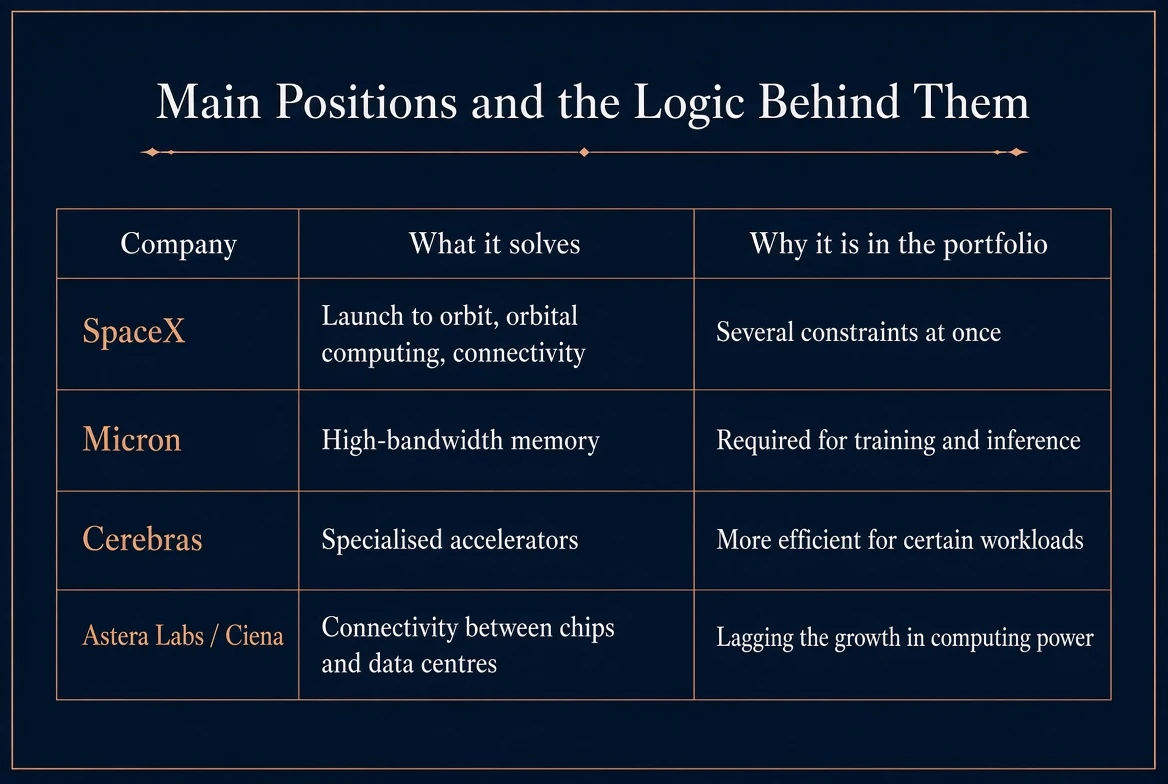
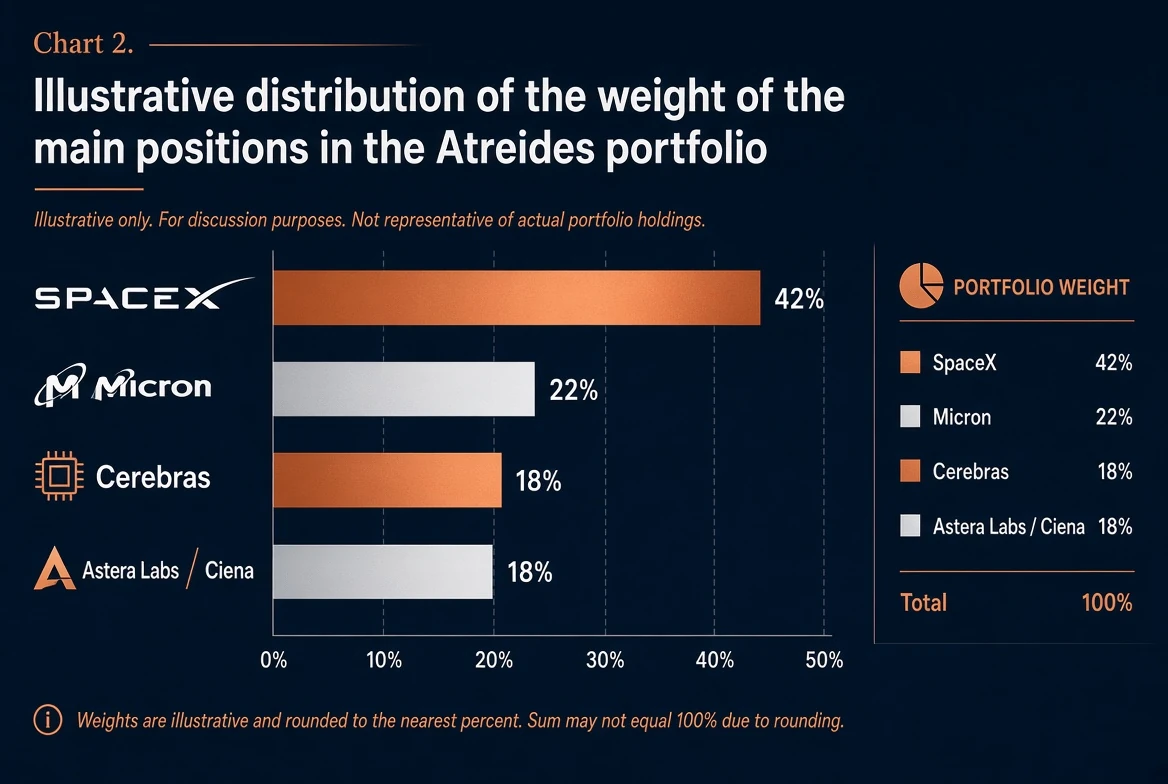
The deals follow his core logic. Baker does not buy the artificial-intelligence trend. He buys the companies that solve a real shortage within it - of accelerators, of memory, of connectivity, of launch capacity or of electricity - and holds the position until the data on orders, on capacity utilisation and on customers’ capital expenditure contradict the initial assessment.
The reports from Microsoft, Alphabet and Amazon this week will show whether Baker’s portfolio remains consistent with the data. If the companies maintain high capital expenditure - both in absolute terms and as a share of revenue - and if at the same time they report growth in cloud-services revenue, stable or rising capacity utilisation and resilient margins in that segment, his assessment is confirmed. In that case the positions in Micron, Astera Labs and Ciena continue to match the demand for memory and connectivity. For SpaceX confirmation would be the continued demand for launch capacity and for computing outside terrestrial constraints. If, however, the companies sharply cut their capital-expenditure guidance and cite weakening demand, a drop in capacity utilisation or pressure on margins as the reason, the assessment weakens and the same positions require review.
Gavin Baker’s investment strategy and philosophy
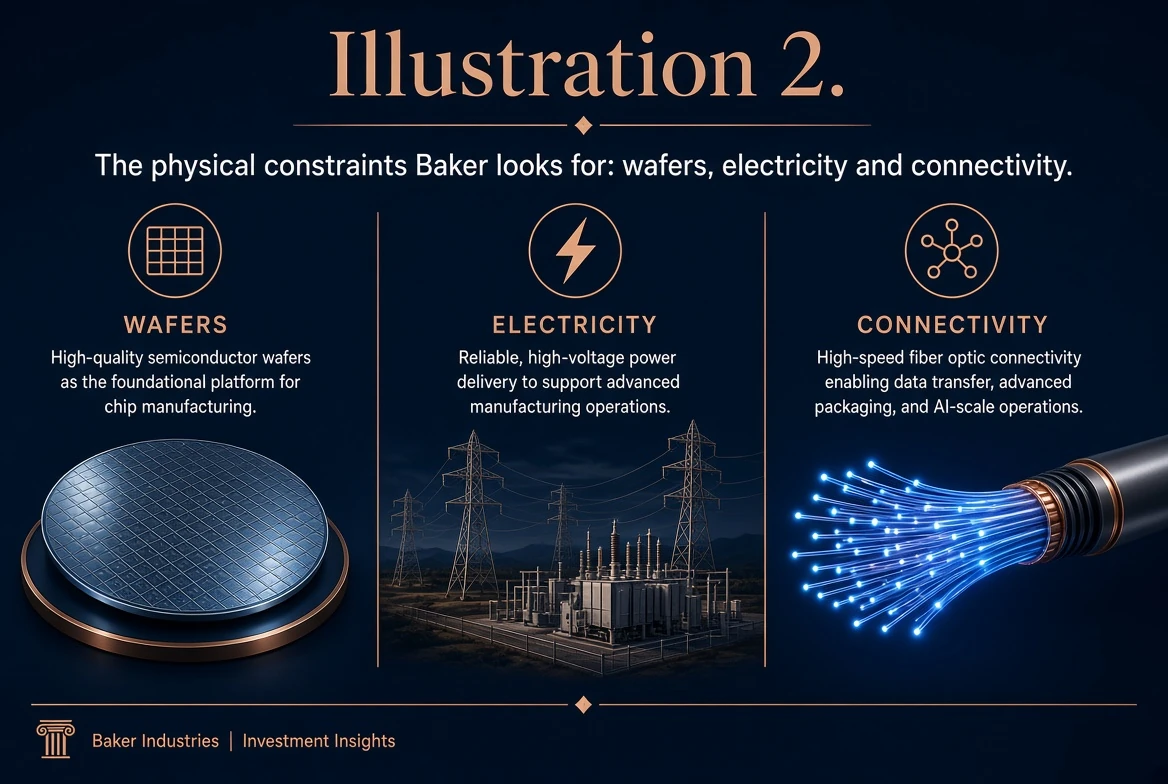
Baker’s strategy is to invest where there is a real shortage in the technology cycle, not where the market has already accepted the story as given. He looks for companies that solve shortages of electricity, of wafers, of memory, of specialised chips or of connectivity, and holds the positions until the data contradict the initial assessment. For him an assessment must be capable of being disproved; knowledge from the public and private markets must be used together; and high conviction is justified only when the risks are known in advance. He does not buy “artificial intelligence”. He buys the places where demand collides with a physical constraint, and he sells or hedges when the constraint turns out to be easier to overcome than he had expected, or when customers begin to reduce spending because of insufficient returns.
Brunel and Baker share a willingness to think in constraints rather than in promises. Brunel accepts the limits of metals, of nature and of energy and designs so that the structure will hold. Baker accepts the limits of components, electricity and connectivity and invests where those limits determine how far the technology can go. What they have in common is the discipline of verification. Brunel does not trust the drawing until he sees how the material behaves under load. Baker does not maintain his initial assessment until he sees the data on capital expenditure, on capacity utilisation and on margins. This week’s reports will show whether those constraints are still binding or are already easing.
Frequently asked questions about Gavin Baker and Atreides
What exactly makes Atreides Management different from other technology funds?
Atreides invests simultaneously in publicly traded and private companies and compares what it learns from one with what the other reports. When a private laboratory contracts capacity for training, that changes the assessment of the public memory manufacturers and of the companies that provide connectivity. If the filings of public customers show weaker utilisation of existing capacity, expectations for the private suppliers of computing power also change.
Why does Baker hold such a large position in SpaceX?
In his view SpaceX solves several constraints at once: launch capacity for payload into orbit, the possibility of orbital computing, and access to electricity and connectivity on a scale that terrestrial infrastructure struggles to achieve. The position will remain part of his portfolio until demand for that capacity weakens.
What is his view of the capital expenditure of the large technology companies?
According to Baker the current cycle does not resemble the bubble of 2000, because the large cloud providers have strong cash flows and do not depend on external capital. His assessment is tested against the size of capital expenditure, against its share of revenue, against the growth of cloud-services revenue, against the utilisation of existing capacity and against margins in that segment. If the data confirm continued demand, the positions in memory manufacturers and connectivity companies remain justified. If they show a decline, the same positions must be reviewed.
How does Baker decide how long to hold a losing position?
Baker takes the risks into account when the position is first built. If the price falls for a reason he has already considered and which does not change the original logic of the investment, he keeps the position. If new data affect the company’s potential, he reviews the decision.
Where is Baker’s method most vulnerable and what would make him change the allocation?
The method is most vulnerable if, over the next two or three quarters, the customers of capacity reduce spending permanently rather than temporarily, and if utilisation of existing capacity declines on a sustained basis. A temporary drop in one quarter does not disprove the assessment. If demand weakens on a lasting basis, the original logic of the investment is no longer confirmed and the positions in the companies that rely on that shortage must be reviewed.
Important notice
This article is for information and education only. It is not financial advice, an investment recommendation or professional advice of any kind. The views expressed are the author’s personal opinions and are not recommendations to buy, sell or hold securities, assets or investments. Investing involves substantial risk, including the possible loss of all capital. Past performance is not a guarantee of future results. Each reader should conduct independent research, consult a qualified financial adviser and weigh financial circumstances, risk tolerance and investment objectives before taking any decision. The author and borsite.net accept no liability for any loss arising from the use of the information in this article.
Leave a Reply
You must log in or register to leave a comment.