

When Ferdinand of Aragon and Isabella of Castile married in 1469, their contemporaries saw more than a dynastic alliance. Castile brought greater population, administrative capacity and land-based power. Aragon brought commercial networks and Mediterranean reach. The union promised a strength neither kingdom could achieve alone. The terms, however, were not equal. Castile entered as the larger partner; Aragon retained its institutions only so far as the new crown chose to tolerate them. An empire emerged, yet the question of whose interest would prevail remained open.
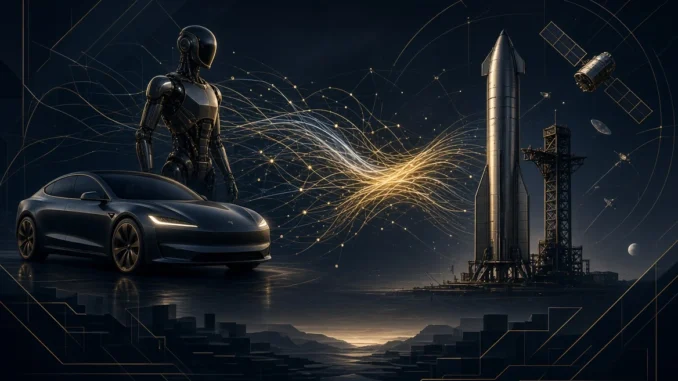
The same question now faces the shareholders of Tesla and SpaceX. One company brings manufacturing scale, robotics and energy systems. The other brings rockets, a satellite constellation and computing infrastructure. A combination promises vertical integration neither can achieve alone. The promise will not decide the outcome; the terms on which the smaller party enters, the size of any premium paid to Tesla shareholders, and who retains control will.

Market values, Musk’s stake and approval thresholds
By mid-October 2026 Tesla’s market capitalisation stood at roughly $1.5 trillion and SpaceX’s at roughly $2 trillion. Musk holds approximately 20 per cent of Tesla and about 48 per cent of the economic equity in SpaceX, while super-voting shares give him 82-85 per cent of the votes in SpaceX.
| Metric | Tesla | SpaceX |
|---|---|---|
| Market capitalisation (Oct 2026) | ~$1.5 trn | ~$2.0 trn |
| Musk’s economic ownership | ~20 % | ~48 % |
| Musk’s voting control | ~20 % | 82-85 % |
| Approval threshold | 50 % of all shares | Controlling-shareholder approval |
Special independent committees have been formed and Musk has been formally recused from the talks, yet SpaceX retains the requirement for controlling-shareholder approval. Tesla requires a vote of 50 per cent of all outstanding shares. That threshold alone limits the expected value of any transaction and gives institutional investors real weight.
Motives, synergies and capital allocation
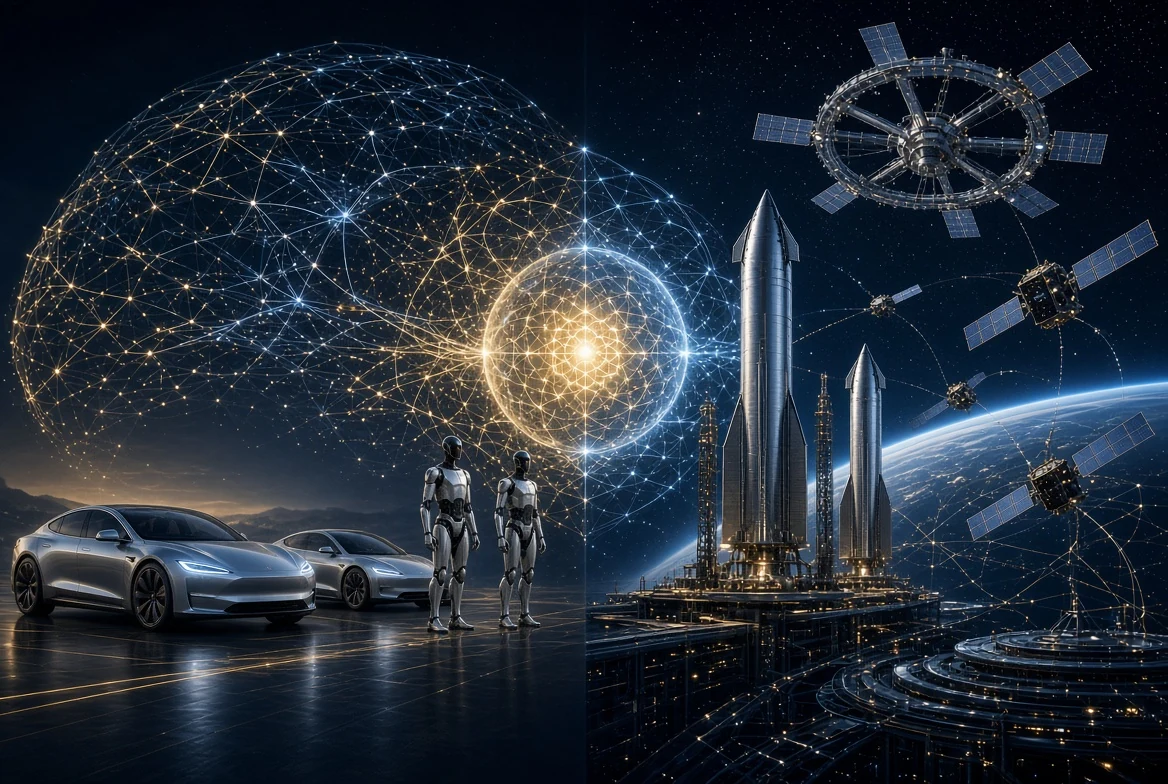
The stated motive is to accelerate vertical integration where the companies already overlap: software for artificial intelligence, chip design and production through Terafab, robotics, Starlink connectivity and potential orbital data centres. Collaboration already exists. Real economic benefit depends on the speed and scale of cost savings relative to the exchange ratio. If synergies materialise slowly, the combined entity may trade at a lower multiple than the weighted average of the two stand-alone businesses. SpaceX has higher capital requirements for rockets, satellites and data centres; Tesla generates more stable free cash flow. In an all-stock transaction Tesla’s free cash flow can be redirected toward longer-dated and less certain projects. When control is concentrated, multiple compression becomes the main way value is lost rather than a side effect.
Who gains from the premium
At current valuations SpaceX is the more expensive company. If it acquires Tesla, its shareholders benefit more from a low or moderate premium.
| Premium range for Tesla | SpaceX shareholders | Tesla shareholders | Principal risk |
|---|---|---|---|
| 0-15 % | Stronger starting position | High dilution risk | Adverse dilution for Tesla |
| 15-30 % | Balanced, depends on synergies | Larger stake, still conditional | Multiple compression |
| Above 30 % | Greater risk of overpayment | Better compensation | Overpayment by SpaceX |
At a 0-15 per cent premium SpaceX shareholders receive Tesla at a valuation close to, or below, its current level relative to SpaceX’s growth. Between 15 and 30 per cent the balance shifts, but still depends on whether the market capitalises synergies above the sum of the parts. Above 30 per cent Tesla shareholders are better compensated while SpaceX shareholders bear more of the overpayment risk. Without a clearly agreed premium, a position taken in either stock solely because of the merger offers limited advantage.
Legal durability, entire fairness and minority protection

The mere existence of special committees and Musk’s formal recusal are not sufficient if the process fails the entire-fairness standard applied by Delaware courts in transactions involving a controlling or dominant shareholder. Committees must have genuine power to negotiate, retain their own advisers and reject the deal. SpaceX’s retention of controlling-shareholder approval means its committee does not function as a fully independent body. Musk’s public comments in favour of the combination further weaken the independence argument; courts treat such statements as evidence that the process was influenced. Tesla’s 50-per-cent-of-all-shares threshold provides real protection because non-voting shares count as votes against. This increases the leverage of institutional investors. In an all-stock deal an independent fairness opinion and detailed documentation of the negotiations and alternatives considered are also required. Without them the risk of a successful challenge rises, particularly if the exchange ratio does not adequately compensate Tesla’s minority shareholders for the higher risk profile and the concentration of control.
Structure, regulatory conditions and path to completion
The most likely structures are an all-stock acquisition of Tesla by SpaceX or a merger under a new holding company. A new holding company may ease regulatory approvals but requires additional corporate steps. An acquisition by SpaceX preserves greater concentration of control. A transaction of this scale would normally include conditions for regulatory clearances covering Tesla’s China exposure, SpaceX’s defence contracts and potential antitrust review, together with a right to terminate on a material adverse change. The process remains early. The high voting threshold means even moderate institutional opposition can block the deal.
Red flags
The principal risks are the conflict of interest and the SolarCity precedent, insufficient real independence of the committees given retained controlling-shareholder approval, Musk’s public comments, the high voting threshold, multiple compression under concentrated control and high capital expenditure, and the redirection of Tesla’s cash flow. At a low premium SpaceX shareholders are the more likely beneficiaries. At a moderate premium the outcome depends on the market’s assessment of synergies. At a high premium Tesla shareholders are better compensated. Short-term speculators remain exposed to delay or rejection.
Conclusion
The union of Castile and Aragon produced an empire not because the crowns were joined, but because the terms allowed the new entity to exceed the sum of its parts. Most such combinations remain formal. Markets rarely value founder-controlled technology conglomerates at more than the sum of the parts, because concentrated control makes it difficult to demonstrate that synergies will accrue to both sides. Institutional investors in Tesla have a clear incentive to block the deal even if they believe in the synergies: the voting threshold gives them the power to demand a premium that compensates for the risk of cash-flow redirection and a lower multiple. That incentive, more than any stated synergy, is what will determine whether the transaction closes on terms that create value. Future attempts by Musk to combine assets will be judged on the same basis-not on the promise of integration, but on whether minority shareholders receive compensation that justifies the loss of independence.
Frequently asked questions
What is the most likely structure?
An all-stock transaction in which SpaceX acquires Tesla, or a merger under a new holding company. SpaceX retains controlling-shareholder approval; Tesla requires a vote of 50 per cent of all shares.
Who benefits more at a low premium?
At 0-15 per cent SpaceX shareholders have the stronger position. Tesla’s minority shareholders bear most of the dilution and capital-allocation risk.
Why does the voting threshold matter?
Requiring 50 per cent of all shares means non-voting shares count against the proposal. This gives institutions real ability to block the deal or extract a higher premium.
What are the main legal risks?
Insufficient real independence of the committees, retained controlling-shareholder approval at SpaceX, Musk’s public comments, and the risk that the process fails the entire-fairness standard. The SolarCity precedent sharpens these concerns.
Is it worth buying Tesla or SpaceX solely for the merger?
A position taken solely because of the merger offers limited advantage. Optionality is already partially priced, the exchange ratio is unknown, and the voting threshold plus litigation risk constrain the probability of a quick positive outcome. The position is better viewed as an option on a fair exchange ratio than as a reliable catalyst.
Want the weekly market review in your inbox? Subscribe →
Leave a Reply
You must log in or register to leave a comment.