


CPI, the labor market, mortgages, and what to expect
A king’s command does not halt the tide
September 17, 2026 · Pavel Bandilov
Toward the end of the 1020s, Cnut the Great was king of England, Denmark, and Norway. His courtiers repeated that nothing could stand against him.
Henry of Huntingdon recorded the scene a century later in Historia Anglorum. Cnut ordered his throne set on the shore. The tide came in. The king commanded the water not to wet his feet or his clothes. The sea did not obey. The water covered him without regard for rank or person. Cnut stepped back and said the line that kept the story in history: a king’s command is nothing against the law that moves heaven, earth, and sea.
The lesson is not that the king was a fool. The fools were the flatterers. The sea does not obey a royal command. It does not obey the man who has taken the throne in order to look all-powerful.
That is how Wednesday’s decision at the Federal Reserve should be read.
On September 16, 2026, the Federal Open Market Committee raised the target range for the federal funds rate by 0.25 percentage point, to 3.75-4 percent. The vote was 12-0. It was the first increase since July 2023.
Donald Trump wants a one-percent rate. Kevin Warsh wants the Federal Reserve to look firm in the fight against inflation. Their wishes diverge. The data on employment, on consumer and producer prices, and on the ten-year Treasury yield do not follow the will of either the president or the chair.
In July the same Fed had split into two camps: 9 against 3. This time the decision was unanimous.
What the Fed decided on September 16, 2026
Table. FOMC decision snapshot
| Indicator | Value |
|---|---|
| Decision | +0.25 pp |
| Federal funds rate | 3.75-4.00% |
| Vote | 12 in favor, 0 against |
| Previous meeting, July 2026 | 9-3 |
| Last increase before this one | July 2023 |
| Median for year-end 2026 | 4.1% |
| Participants seeing at least one more hike in 2026 | 16 of 18 |
Source: FOMC statement and Summary of Economic Projections, September 16, 2026.
Inflation in August 2026: CPI, core, PPI, and energy
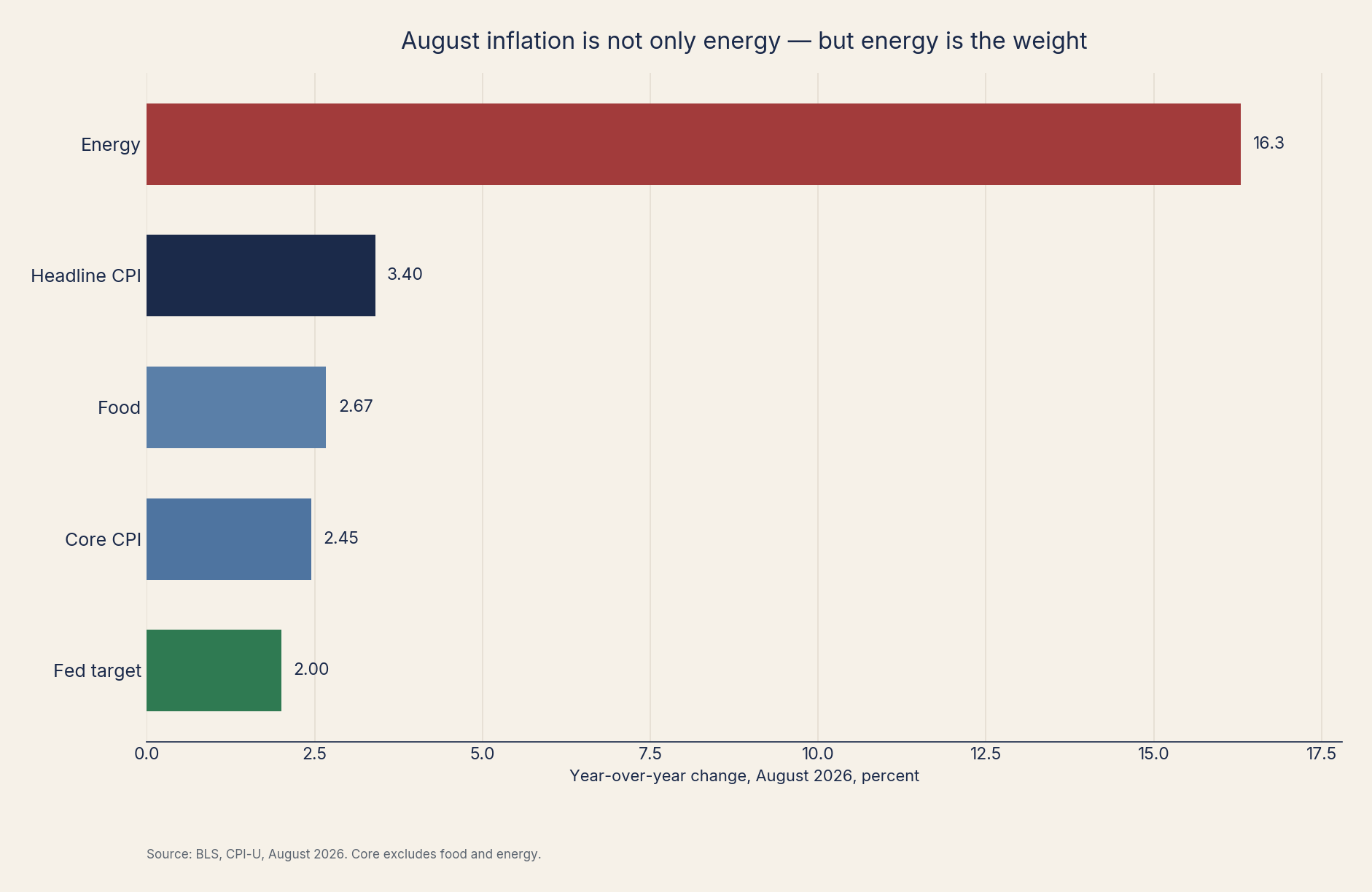
In August the consumer price index rose 0.4 percent from July. On a year-over-year basis CPI held at 3.4 percent. Gasoline rose 3.9 percent on the month and accounted for more than a third of the monthly increase in CPI. Energy stands 16.3 percent above its level a year earlier; gasoline, 27.4 percent.
Core CPI, excluding food and energy, slowed to about 2.45 percent year over year. That is its lowest reading since 2021. On a monthly basis, however, it accelerated to about 0.3 percent. Shelter costs turned up again. The producer price index also rose 0.4 percent.
Headline inflation is high because of oil. Core inflation is close to the 2 percent target, but it has not reached it. Monetary policy does not set the price of fuel. The months in which the Committee treated the supply shock as temporary did not bring the headline index down. With data of this kind, leaving the rate unchanged would have been a political choice.
Table 1. U.S. annual inflation, August 2026
| Measure | Year-over-year change, % |
|---|---|
| Fed target | 2.00 |
| Core CPI | 2.45 |
| Food | 2.67 |
| Headline CPI | 3.40 |
| Energy | 16.30 |
Source: Bureau of Labor Statistics, CPI-U, August 2026.
The U.S. labor market in August 2026
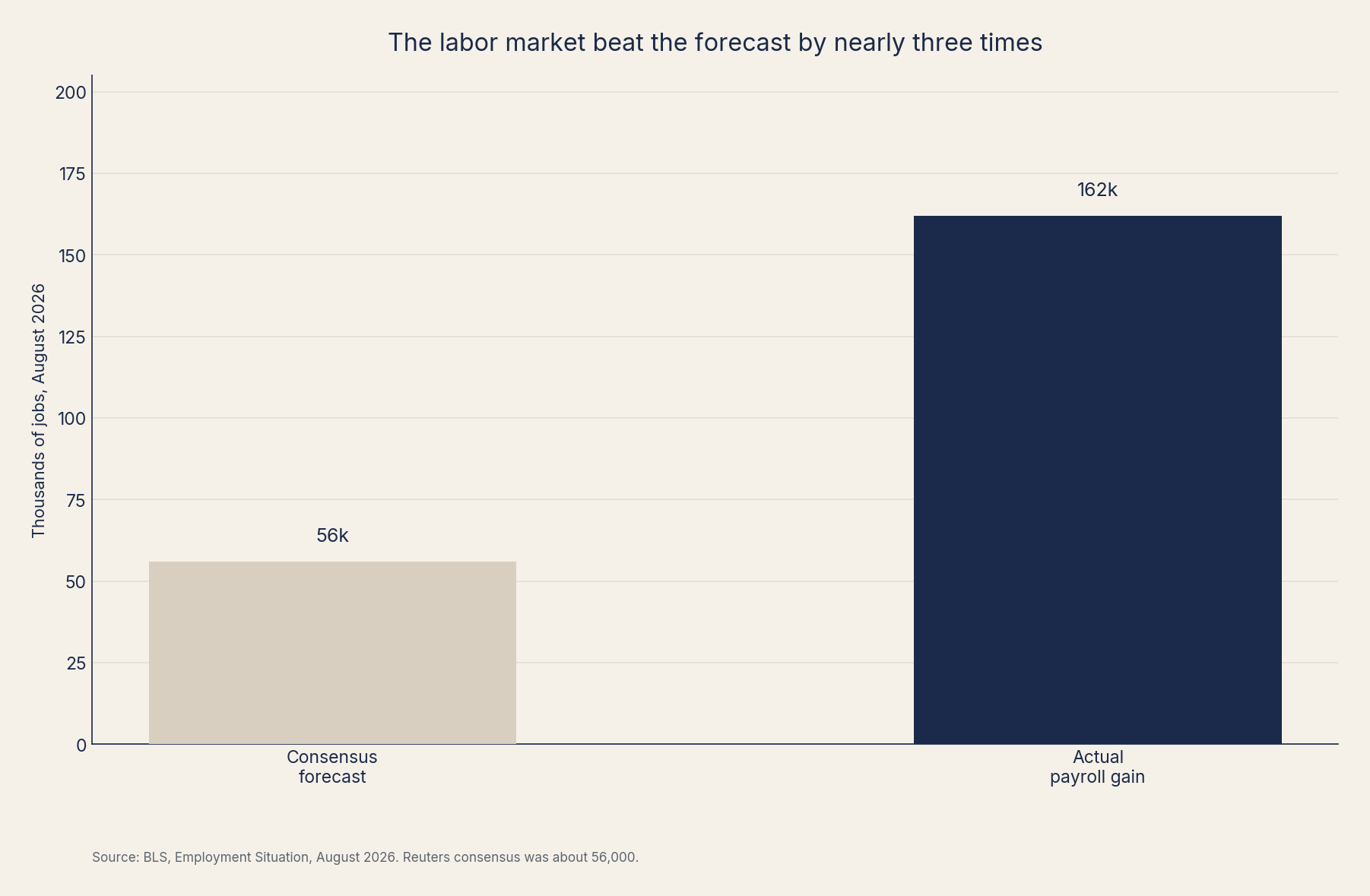
The labor market gave no case for easing. In August firms added 162,000 jobs against a forecast of about 56,000. The unemployment rate held at 4.1 percent. The labor-force participation rate returned to 61.6 percent. Average hourly earnings are rising 3.1 percent a year. One month of data is not enough for a serious reading. The durable gauge is unemployment, and it has not risen. Weak hiring would have given an argument to those who want lower rates. The August report did not.
Bond yields before the Fed meeting
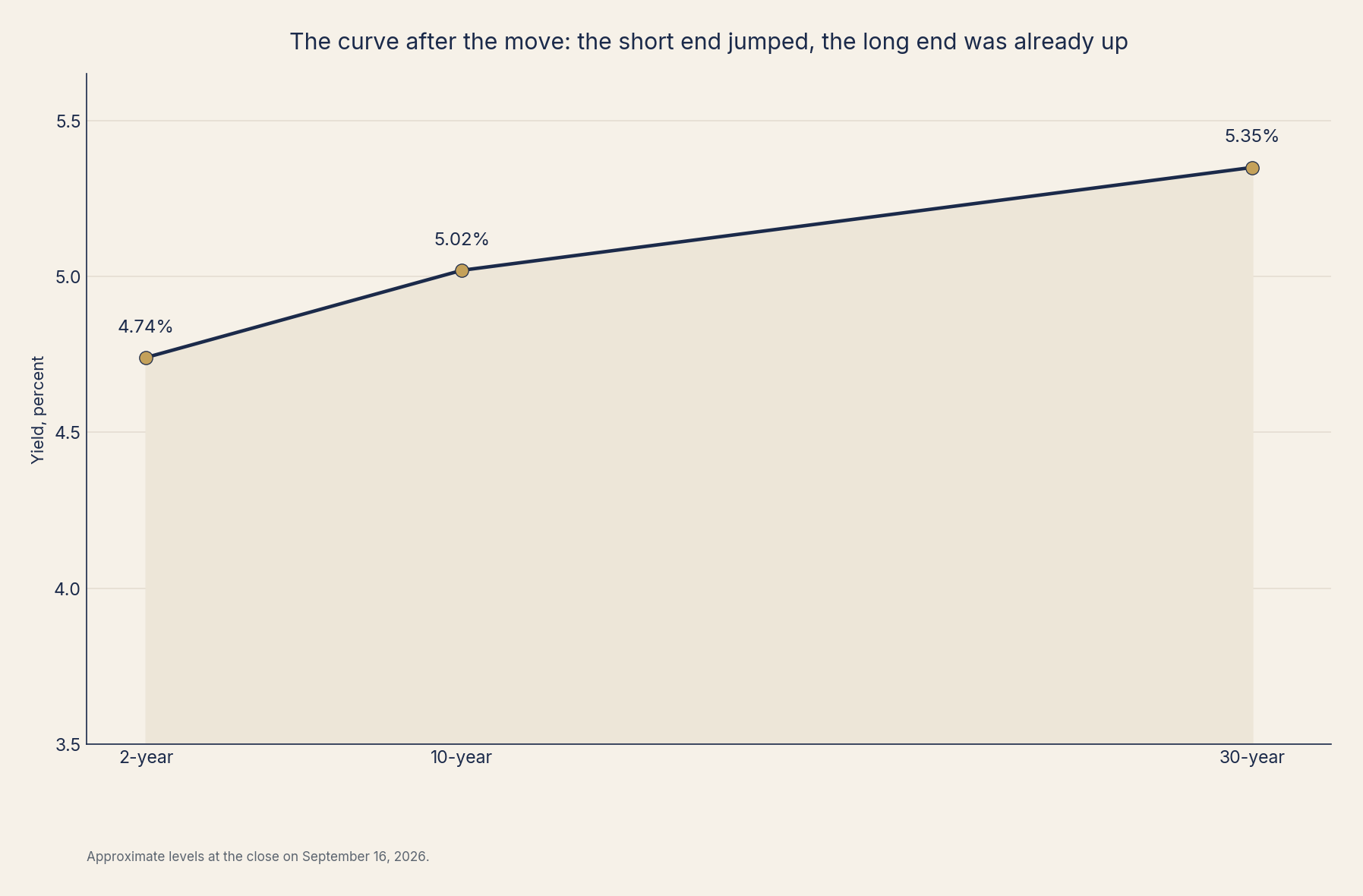
The yield on the ten-year Treasury had already returned toward 5 percent before the vote. Thirty-year yields were moving around 5.3-5.4 percent. Three forces act on the yield: inflation expectations, the term premium, and the supply of government debt. The long end of the curve had already risen before the press conference.
What the FOMC statement and Kevin Warsh said
The statement erased the June narrative of a supply shock. The core message was:
“Inflation remains elevated. Today’s action will support a more timely return to the 2 percent goal. The Committee will deliver price stability.”
Warsh said:
“The fact is that inflation is too high and has been so for too long.”
Then he hedged:
“We need to be confident that underlying inflation is moving toward the goal clearly and at a sufficient speed. Today the Committee judged that this condition has not been met.”
Between July and September, he said, three things had changed. The economy had strengthened. Inflation had not slowed. Geopolitical tension had intensified. That is his judgment. It matches the data.
Asked whether he had discussed his actions with the president, Warsh was categorical:
“I have nothing to tell you about conversations with the president. And I am not a Wall Street newsletter. Part of the Fed’s independence is staying in our lane. Independence is a two-way street.”
The sentence comes after the data. Independence here means that the Committee refuses to take orders from the White House. The hike itself is explained by the data, not by that refusal.
Why the Fed raised after CPI, PPI, and employment
Economic activity is growing at a solid pace. Consumer spending is relatively stable. Productivity is strong. Employment is keeping pace with the labor force. Inflation is high.
In the first half of 2026, high prices were explained mainly by a supply crisis tied to the conflict in the Middle East. The explanation had its logic. Over the summer, however, the headline index did not fall. Shelter costs rose. Producer prices moved up again.
Powerlessness before the price of oil is not, by itself, grounds for a hike. Strong employment helped the Fed focus now only on inflation. The core index has still not reached the Committee’s target. The long end of the curve is already making credit more expensive. The standard of “sufficient speed” has not been met. If oil cheapens and services cool, the narrative can change.
FOMC projections: the policy rate, inflation, and unemployment through 2029
Table 2. FOMC projection medians, September 16, 2026
| Indicator | 2026 | 2027 | 2028 | 2029 | Longer run |
|---|---|---|---|---|---|
| Real GDP growth, % | 2.3 | 2.4 | 2.2 | 2.1 | 2.0 |
| Unemployment, % | 4.1 | 4.1 | 4.1 | 4.1 | 4.2 |
| PCE inflation, % | 3.7 | 2.3 | 2.1 | 2.0 | 2.0 |
| Core PCE, % | 3.4 | 2.5 | 2.2 | 2.0 | - |
| Federal funds rate, % | 4.1 | 4.1 | 3.9 | 3.6 | 3.2 |
| June SEP funds rate, % | 3.8 | 3.6 | 3.4 | - | 3.1 |
Source: FOMC Summary of Economic Projections, September 16, 2026.
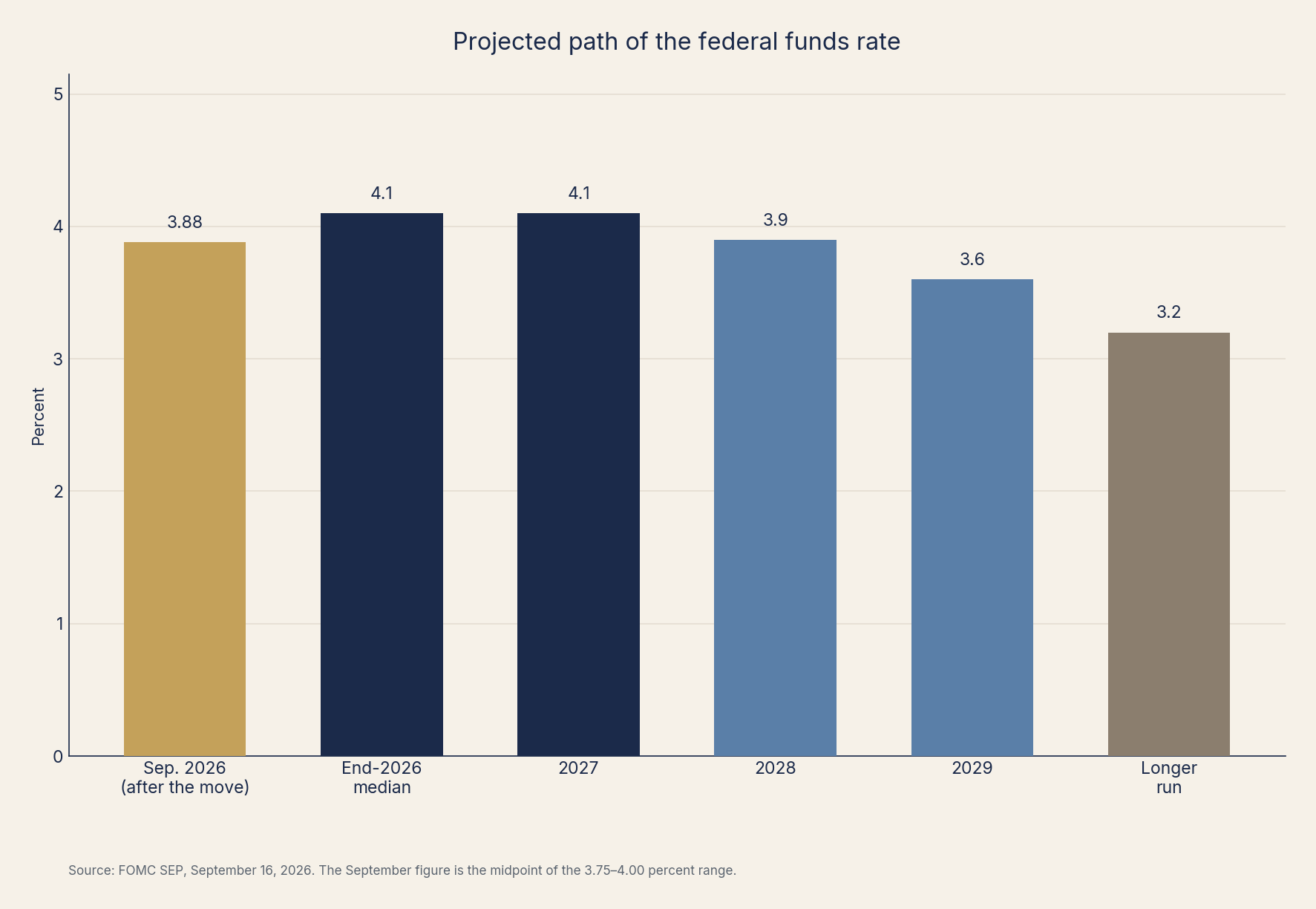
The 2 percent goal is expected to be reached around 2029. The median for the federal funds rate is 4.1 percent at the end of this year and the same in 2027. Sixteen of eighteen participants see at least one more increase by the end of 2026. Warsh did not take part in the survey. “These are not my forecasts,” he said. The projection belongs to the Committee. The word, however, belongs to the chair.
How stocks, bonds, the dollar, and crypto responded
The market had already priced the hike. The surprise came from the tone after the decision and from the dots.
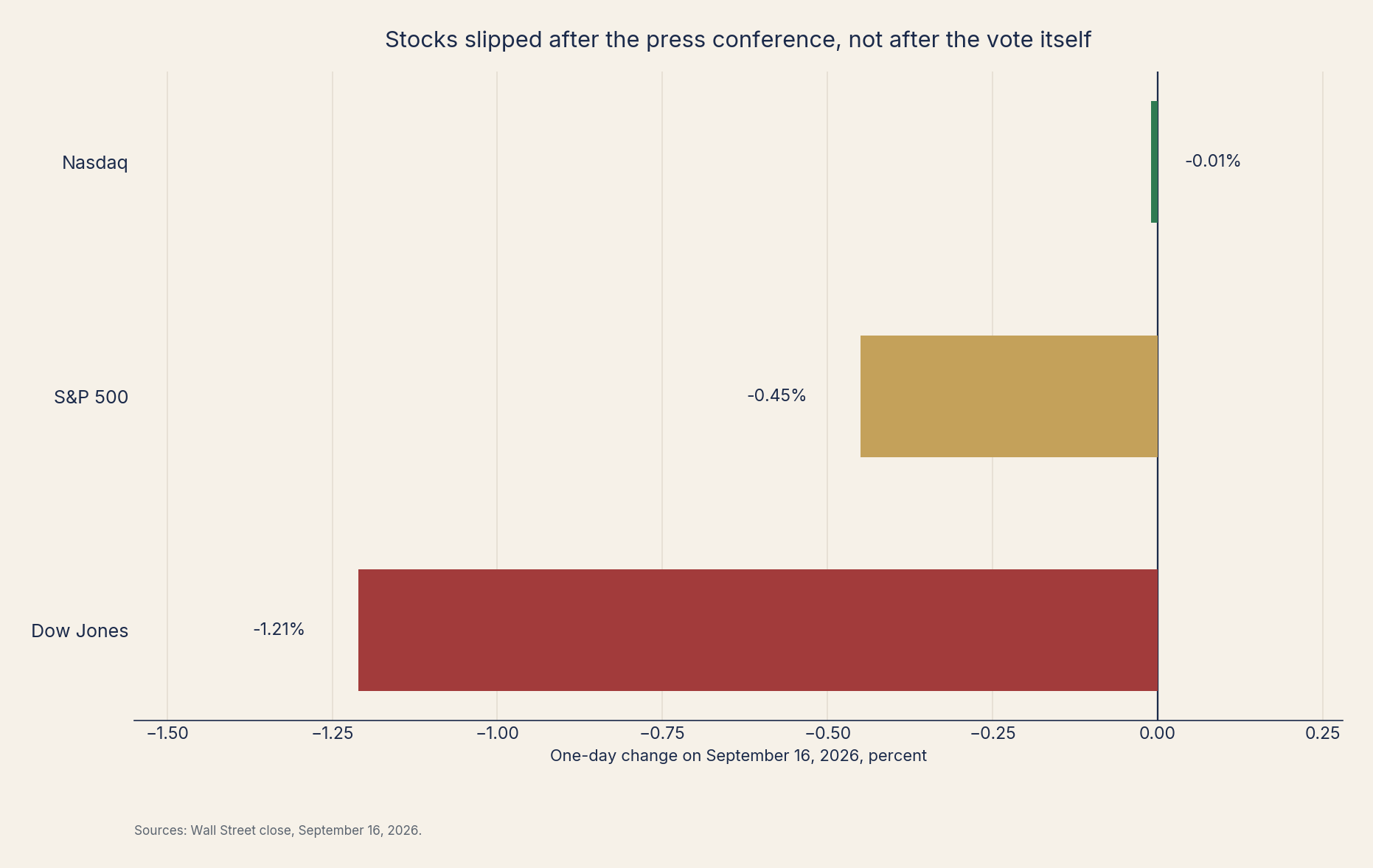
The S&P 500 closed down about 0.45 percent. The Dow lost about 1.2 percent. The Nasdaq was almost unchanged. Energy and financials took the blow. Oil cheapened the same day on news of a partial recovery in supply. That removed part of the premium in the commodity. The Committee no longer treats the energy shock as sufficient reason to leave policy unchanged.
Table 3. One-day change in the indexes, September 16, 2026
| Index | Change, % |
|---|---|
| Nasdaq | -0.01 |
| S&P 500 | -0.45 |
| Dow Jones | -1.21 |
Source: Wall Street close, September 16, 2026.
The two-year yield jumped toward 4.72-4.74 percent. Ten-year yields moved back above 5 percent. The long end changed less than the short end. The curve flattened.
The dollar strengthened. A dearer dollar makes credit more expensive in Europe, in Japan, and in emerging markets.
That the Nasdaq barely moved does not prove that technology companies are invulnerable. The hike may already have been in the price. A handful of large firms with real cash flow may have held the index up. One session does not show the difference between earnings and a promise.
Bitcoin settled near $76,000. Ether held around $2,370-$2,430. The Fed is not the only cause. The crypto market is still under the weight of the Clarity Act’s failure in the Senate.
Mortgages, the prime rate, and credit cards after the Fed’s decision
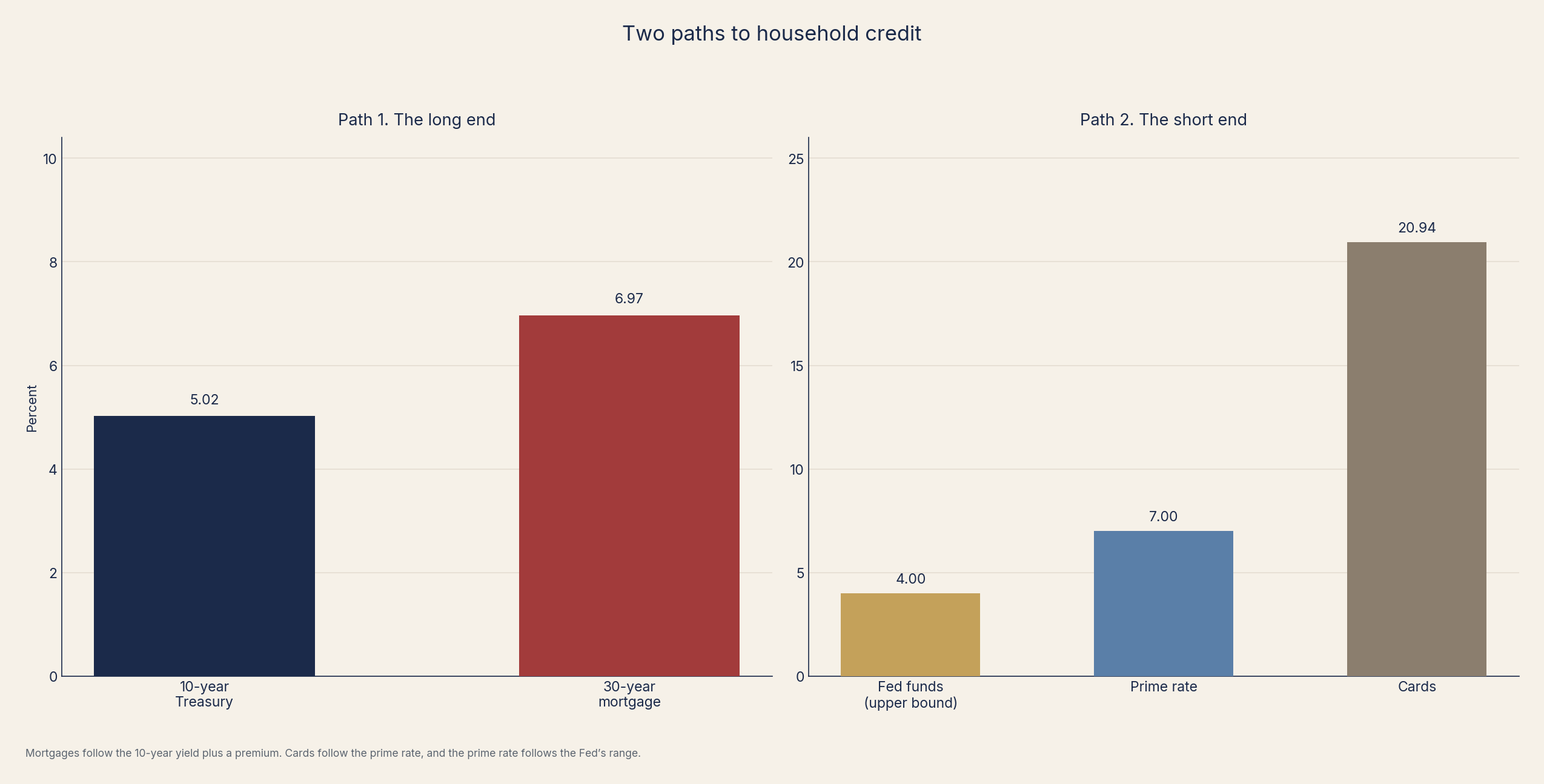
Two paths lead to the household payment.
A U.S. mortgage follows the ten-year Treasury yield and the prepayment premium. Ten-year yields were already near 5 percent before the meeting. The average 30-year fixed mortgage had already returned toward 6.7-7 percent before Wednesday. On the day of the decision, quotes rose again. The 3.75-4 percent range does not set the mortgage payment. The ten-year yield does, and the market had lifted it before the meeting.
Credit cards travel another route. Variable rates follow the U.S. prime rate. The prime rate moves with the Fed’s range and usually sits about three points above the upper bound. The average rate on existing card accounts is about 21 percent. The new increase enters statements with a lag of one or two cycles.
The U.S. housing market was already running at a slower pace. Dearer long-term credit cools demand and keeps sellers in homes with old, low rates. If inflation does not fall, and that keeps the Fed on a higher policy path, mortgages will become more expensive even if oil drops sharply.
Table 4. Two paths to household credit in the United States
| Path | Product | Level | How it is set |
|---|---|---|---|
| Short end | Federal funds rate | 3.75-4.00% | FOMC decision |
| Short end | U.S. prime rate | about 7% | About 3 points above the upper bound |
| Short end | Credit cards | ≈ 21% | Variable rates follow the prime rate |
| Long end | 10-year Treasury | 5.02% | Market, term premium, debt supply |
| Long end | 30-year mortgage | ≈ 6.97% | Follows the 10-year yield plus a premium |
Sources: FOMC; market yields at the September 16, 2026 close; mortgage quotes.
Sectors with a long purchase cycle take the hit first. Utilities and real-estate funds lose from a higher discount rate. Banks operate under higher credit risk if households fall behind on payments.
What to expect from the Fed through the end of 2026
The median projection points to one more 0.25 percentage point increase by the end of 2026. The fed-funds futures market puts a higher probability on December than on October, without ruling October out. If oil stays above $100 and core services do not cool, the odds of a second hike are not small. The reason is not Warsh’s desire for a sequence of increases. His standard of “sufficient speed” will again go unmet.
In the equity market the distinction will be between companies with attractive valuations, low debt, and stable cash flow and those without.
Short-term bonds will watch the next FOMC meeting. Long-term bonds will watch two things: whether inflation expectations recede, and whether the term premium, together with the supply of government debt, also recedes. If only the first gives way, and the budget deficit holds the second, 5 percent on the ten-year will not be a ceiling.
What would disprove this case
If core services cool and oil falls durably below $100, the second hike drops out. If unemployment moves toward 4.5 percent, Committee members will again fall into sharp disagreement. If the term premium shrinks on a fiscal news item, mortgage rates can ease without a cut from the Fed. If credit suddenly becomes much dearer, if the dollar jumps, or if foreign markets seize, the Committee will not look at the chair’s preference. It will look at the cost of credit, the dollar, and foreign markets.
Those conditions are not set by the president’s will. They are not set by the chair’s will either.
Conclusion
Cnut did not remain on the throne until the sea carried him off. He stepped back and rebuked his retinue for misleading their king. History does not remember him as master of the sea. It would grant that he was a man who at last accepted reality.
The chair and the president cannot command rates to fall. The twelve votes of the members do not subordinate inflation to the Committee. The August data, however, were already clear. Employment is strong. The headline index had not fallen. The long end of the curve was already high. The goal they set for themselves - inflation at 2 percent at a sufficient speed - was not met.
By the end of 2026 the market will not remember who chaired Wednesday’s meeting. It will watch whether inflation gives way. If it does, the second hike drops out. If it does not, the Fed will raise again, because the data will again force it to act.
Frequently asked questions on the September 2026 Fed decision
Why is the Fed raising rates when the shock comes from energy commodities?
The policy rate does not set the price of the commodity. It sets how expensive credit is until inflation returns to the 2 percent goal. Waiting is no longer neutral. Headline CPI did not fall. Shelter costs turned up. Ten-year Treasuries were already near 5 percent. The case for a hike rests on employment, the core index, the long end of the curve, and the speed standard. If oil cheapens and services cool, policy is different. Through September 16 that had not happened.
Does Wednesday’s quarter-point move raise the U.S. mortgage rate?
The mortgage follows the ten-year Treasury yield and the prepayment premium. The long end of the curve was already high before the vote. In that sense the move should already have been priced. Credit cards are another matter. They follow the U.S. prime rate, and the prime rate follows the Fed’s range. There the 0.25 percentage point increase enters with a lag of one or two months.
Is Warsh’s decision aimed at Trump?
The president wants cheap credit. The chair wants the Federal Reserve to look firm against inflation. Their wishes diverge. The vote is 12-0. The minutes will not say why the three dissenters from July changed their votes.
Will the Fed raise again before the end of 2026?
The median of the FOMC projections points to one more 0.25 percentage point increase. Sixteen of eighteen participants see at least one more hike. The market puts a higher probability on December than on October, without ruling October out. Warsh does not take part in those surveys. If core services cool and oil falls durably below $100, the second hike drops out.
Important notice
This article is for information and education only. It is not financial advice, an investment recommendation or professional advice of any kind. The views expressed are the author’s personal opinions and are not recommendations to buy, sell or hold securities, assets or investments. Investing involves substantial risk, including the possible loss of all capital. Past performance is not a guarantee of future results. Each reader should conduct independent research, consult a qualified financial adviser and weigh financial circumstances, risk tolerance and investment objectives before taking any decision. The author and borsite.net accept no liability for any loss arising from the use of the information in this article.