


In 1865, just a few months after the end of the American Civil War, Jules Verne published his novel From the Earth to the Moon. In it, the Baltimore Gun Club, bored with peace, decides to build an enormous cannon called the Columbiad in Florida and fire a metal projectile carrying three passengers toward the Moon. With remarkable scientific precision for its time, Verne details the calculations, the construction, and the launch itself. The book ends with the firing of the cannon and leaves one question hanging: will the projectile reach its target, and will the three men survive?
More than one hundred and sixty years later, on June 12, 2026, another projectile was fired - this time not into space, but onto the capital markets. Instead of a metal cylinder aimed at the Moon, it was the share price of SpaceX under the ticker SPCX.

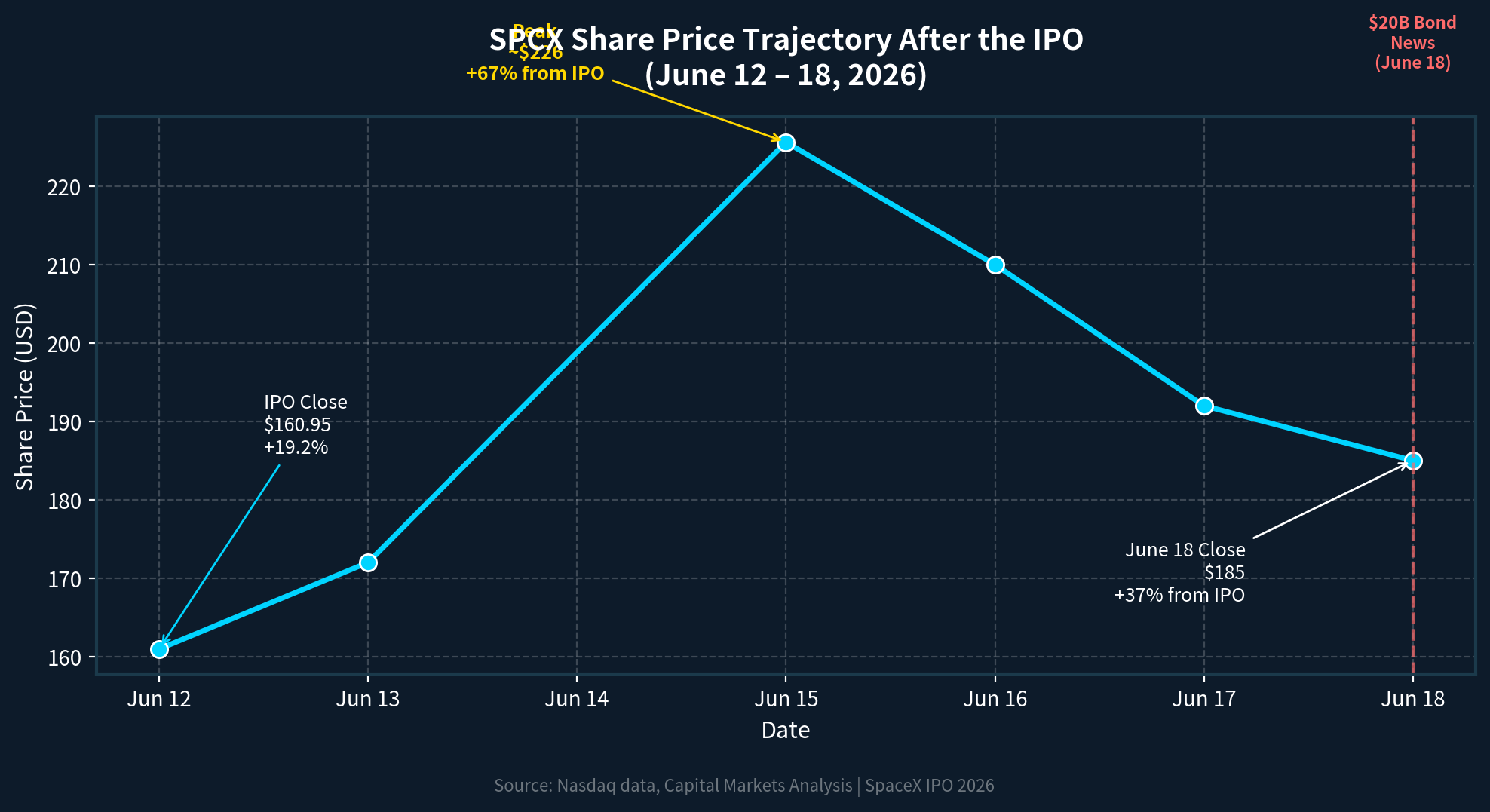
On Friday, June 12, 2026, something happened on Nasdaq that even the most seasoned Wall Street veterans had never witnessed. SpaceX - the company born in a warehouse in El Segundo in 2002 with the words “it will probably fail, but we have to try” - executed the largest IPO in the history of capital markets. Priced at $135 per share, it raised approximately $75 billion. The valuation at launch stood at roughly $1.75-1.8 trillion. The shares (SPCX) opened at $150 and closed the first day at $160.95 - a gain of 19.2% in a single session. Market capitalization exceeded $2.1 trillion, and Elon Musk became the world’s first trillionaire.
The First Nine Days: Euphoria, Peak, and Atmospheric Turbulence
On the second trading day - Monday, June 15 - the rocket continued to climb. The stock reached highs near $226, adding tens of billions to its value. At its peak, the two-day gain exceeded 60% from the IPO price. The euphoria was palpable, fueled by overwhelming demand and classic fear of missing out (FOMO).
But just like any projectile leaving the atmosphere, this one began to feel the friction. In the days that followed, classic post-IPO volatility set in: early investors took profits, the free float remained extremely thin (only about 4.9% of shares were freely tradable at the start), and selling pressure emerged. By June 18, the stock had closed at $185 - still up approximately 37% from the $135 IPO price, with a market capitalization of around $2.44 trillion. The peak near $226 was followed by an 18-20% correction from the high.
This pattern is hardly unusual for IPOs of this scale and valuation. Thin liquidity simply amplifies moves in both directions.
Institutional and Retail Demand: Oversubscription That Rewrote the Rules
Demand was astronomical - more than $250 billion chasing a $75 billion offering. Sovereign wealth funds, major institutional investors, and hedge funds competed aggressively. Because of the overwhelming institutional interest, the retail allocation was cut to just 20%. Many smaller investors were left out of the IPO itself, but FOMO remains intense.
Stories from the first days: roughly 4,400 SpaceX employees became millionaires overnight. Some of the earliest employees - even welders holding small option packages - saw their holdings turn into eight-figure sums. Gwynne Shotwell, President and Chief Operating Officer and the company’s 11th employee, watched the value of her stake climb into the billions.
Key Voices
Musk and Shotwell rang the opening bell together - he from Starbase in Texas, she from New York. Musk reiterated the mission: “To make life multiplanetary - not just for a handful of astronauts, but literally for you.” He emphasized that the company has been cash-flow positive since around 2015 and now needs capital for the next phase: more than 100,000 satellites in orbit, AI data centers in space, Starship, and beyond. Shotwell called him “the best CEO in history” and “an incredible partner.”
Analysts have been more cautious. Some major firms see this as pure momentum and “a story that sells itself.” Others have issued lower price targets, pointing to the valuation.
Valuation Multiples: Still in the Stratosphere
At around $185 per share, market capitalization stands at approximately $2.44 trillion. For comparison, 2025 revenue was $18.67 billion (up 33% from 2024). This implies a price-to-sales multiple above 130x based on the latest reported figures.
The company is still loss-making: a net loss of $4.9 billion in 2025 and an accumulated deficit exceeding $41 billion. Starlink remains the profit engine, generating roughly $11.4 billion in revenue (61% of the total) and positive margins. However, Starship development and the artificial intelligence segment (following the xAI integration) continue to generate heavy losses. Revenue growth in the first quarter of 2026 has already slowed to 15% year-over-year.
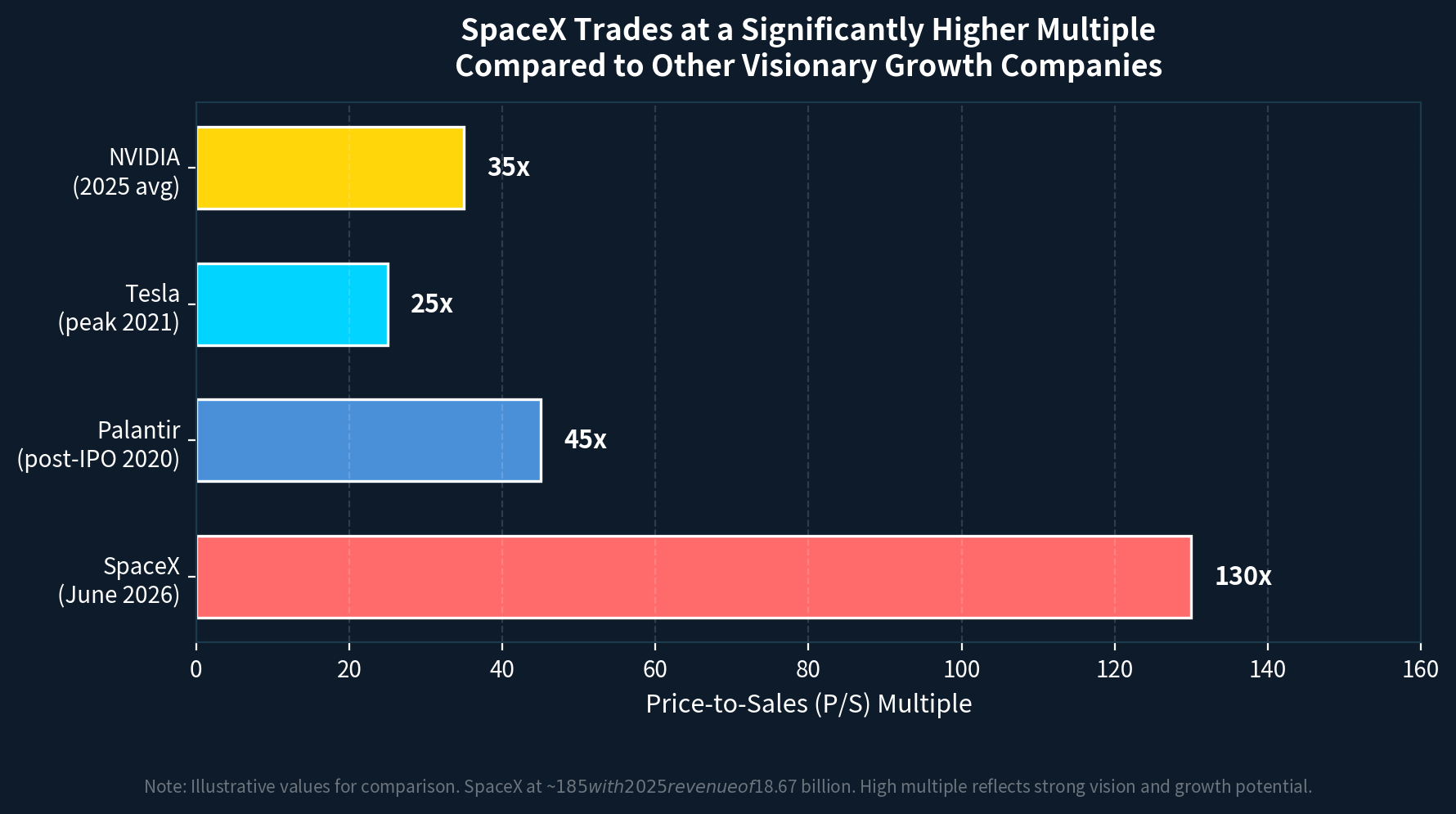
Table 1: SPCX Share Price Performance After the IPO (June 12-18, 2026)
| Date | IPO / Open | Close | High | Gain from IPO | Market Cap |
|---|---|---|---|---|---|
| June 12, 2026 (Day 1) | $135 | $160.95 | $176.52 | +19.2% | ~$2.1 trillion |
| June 15, 2026 (Peak) | ~$160.95 | - | ~$226 | +67% | ~$2.9+ trillion |
| June 18, 2026 | - | $185.00 | - | +37% | ~$2.44 trillion |
Table 2: Key Financial Metrics for 2025
| Metric | Value | Comment |
|---|---|---|
| Revenue | $18.67 billion | +33% vs 2024 |
| Net Loss | $4.9 billion | Continued heavy investment |
| Starlink Revenue | $11.4 billion | 61% of total revenue |
| Price-to-Sales Multiple | >130x | Based on latest reported figures (~$185) |
| Accumulated Deficit | >$41 billion | Since founding |
This Week’s Major Development: The $20 Billion Bond Offering
On June 18, 2026, it emerged that SpaceX bankers are preparing a potential investment-grade bond offering of at least $20 billion.
The proceeds would serve two main purposes:
- Refinancing the $20 billion bridge loan taken earlier this year following the acquisition of xAI in February 2026.
- Providing additional capital for ambitious projects, including AI data centers in space, accelerated Starship development, and the expansion of Starlink (including V3 satellites).
This is a significant development for several reasons:
- Access to debt markets on favorable terms - Even after the record equity IPO, the company can raise debt at investment-grade levels. This represents a vote of confidence from credit markets.
- Limited dilution - Unlike a new equity issuance, bonds do not dilute existing shareholders as directly (unless converted).
- Additional “fuel” for growth - It gives Musk and the team more time and resources to execute the vision without being forced to sell shares at lower levels or rely solely on operating cash flow.
At the same time, the move increases the company’s overall leverage. With interest rates still elevated and execution risks around Starship remaining material, markets will watch closely how the balance between growth and debt is managed.
The news arrived precisely as the stock was undergoing a correction - and served as a timely reminder that SpaceX is not merely a “story,” but a company with genuine access to all forms of capital.
Euphoria Until the First Quarterly Report and Lock-up - Then Gravity Returns
SpaceX’s lock-up structure is staged rather than the traditional flat 180-day wall. The first major release (up to 20-30% of eligible shares) will occur after the Q2 2026 earnings report (expected around early August). Additional tranches follow at 70, 90, 105, 120, and 135 days, with further releases after Q3. Musk and key shareholders are subject to a longer 366-day lock-up.
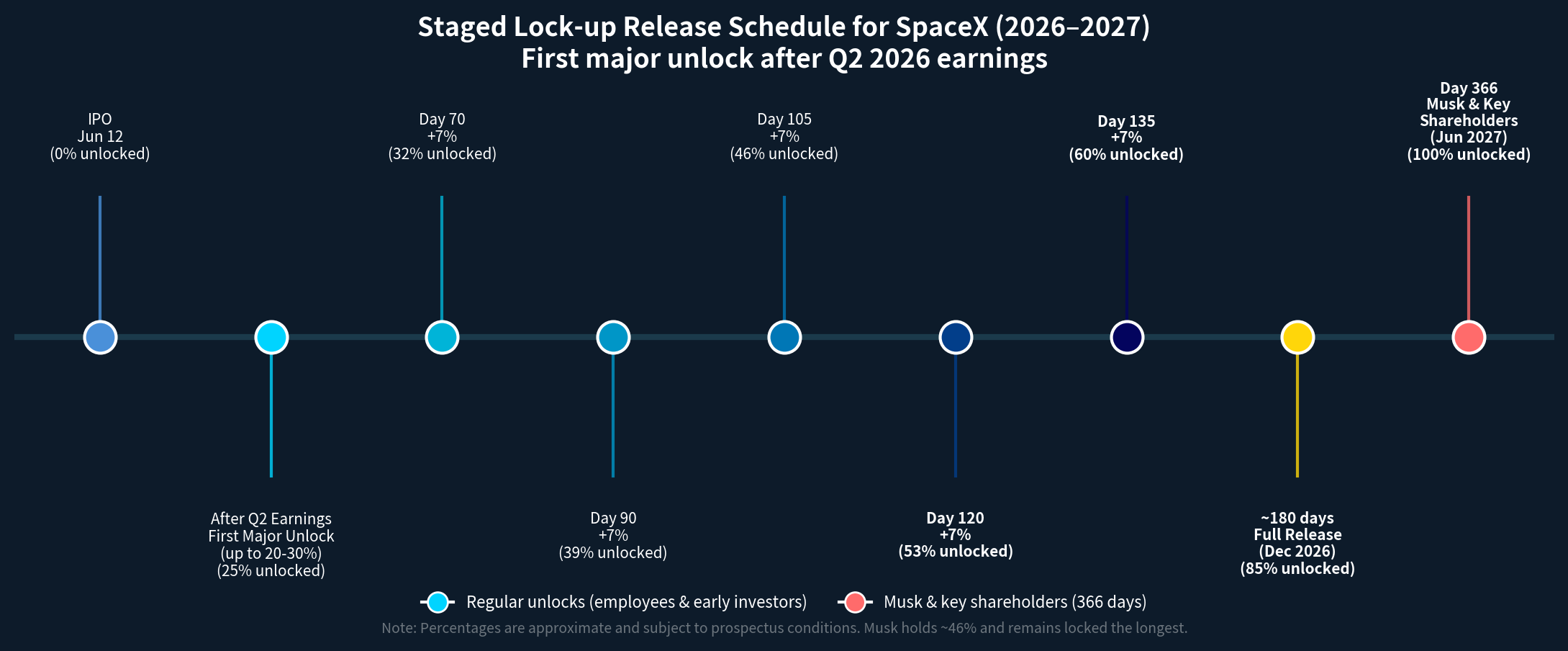
Table 3: Simplified Lock-up Release Schedule (2026-2027)
| Period | Share of Eligible Shares Unlocked | Key Event |
|---|---|---|
| After Q2 Report (~August) | Up to 20-30% | First major release |
| 70-135 days | ~7% per tranche | Staged releases |
| After Q3 Report | Additional ~28% | Second major release |
| ~180 days (December) | Remaining shares | Full release (except Musk et al.) |
| Musk and key shareholders | - | 366-day lock-up |
Historical patterns for high-valuation IPOs are clear: euphoria and limited supply keep prices elevated in the early weeks and months. However, once the lock-up period begins releasing shares and the market receives the first real quarterly results as a public company (growth rates, margins, cash burn, and progress on Starship and Starlink), corrections often follow. Many IPOs trading at 50-100x+ sales multiples have returned close to - or below - their IPO prices within 6-12 months as fundamentals catch up.
A classic parallel is Palantir. A visionary data-and-AI narrative, a strong debut, and massive institutional and retail interest. After the lock-up expired and a series of quarterly reports showed that growth was not infinite and margins needed time to expand, the stock underwent significant corrections.
Why Musk Is Different - and Why It Still Matters (Even With the New Bond Issue)
Musk’s companies have always traded far ahead of current fundamentals. Tesla spent years loss-making or barely profitable while its valuation was priced on the future of electric vehicles, autonomy, and energy. The same dynamic is playing out here.
Yet here lies the crucial difference: no other CEO in public markets today combines such an absolutely uncompromising vision (making life multiplanetary, placing AI data centers in space, “literally for you”), a proven track record of delivering the impossible (reusable rockets, Starlink as a global communications network), and the personal ability to sell that vision in a way that turns investors into long-term believers rather than short-term speculators.
With the new $20 billion bond offering, Musk and the team have secured yet another tool to execute the vision - without aggressively diluting equity. This extends the “time in the air” before the gravity of fundamentals and unlock events begins to exert full force.
Most CEOs manage expectations downward or focus on the next quarter. Musk sells a future that sounds like science fiction - and has repeatedly turned it into engineering and commercial reality. He is the “visionary and salesman” that much of the market lacks. That is why the premium can persist longer than usual - especially when debt markets are also opening their doors.
What to Expect Next
Until the first quarterly report (Q2 2026) and the beginning of more significant share unlocks, enthusiasm is likely to remain dominant, further supported by the successful bond issuance. After that, the market will conduct its cold, relentless analysis: How fast is Starlink actually growing? How close is Starship to operational economics? How sustainable are the margins? How much cash burn remains, and how is the new debt being managed?
If the numbers support the narrative, the stock can continue flying high, even with greater liquidity after the unlocks. If not, the gravity of fundamentals will assert itself - as it has hundreds of times before, including with Palantir and dozens of other visionary IPOs.
SpaceX is not just another company. It is a bet on humanity’s future as seen through the eyes of one man who has so far succeeded in turning it into reality. The new bond offering has given the rocket additional boosters. But even the most powerful rocket in history must pass through atmospheric friction and contend with gravity to remain in stable orbit.
The market has just ignited the engines and added another stage to the launch vehicle. The next two to four months - until the Q2 results and the first major unlocks - will determine whether the thrust is sufficient for a long flight, or whether a controlled descent toward more realistic altitudes will follow.
This is a story worth watching closely. Not because it is easy. But because it is real - and now backed by even more capital.
Frequently Asked Questions (FAQ)
1. What is the current SPCX share price and what happened in the first nine days after the IPO?
Answer: The stock closed its first trading day (June 12, 2026) at $160.95 (+19.2%). It continued climbing and reached a peak near $226 on June 15 (+67% from the IPO price). Classic post-IPO volatility followed as early investors took profits and the free float remained very thin. By June 18, the stock had closed at $185 - still up approximately 37% from the $135 IPO price, with a market capitalization of around $2.44 trillion.
2. Why is SpaceX preparing a $20 billion bond offering right after its IPO?
Answer: On June 18, it became clear that the company is preparing an investment-grade bond offering of at least $20 billion. The main objectives are:
- Refinancing the $20 billion bridge loan taken after the xAI acquisition in February 2026.
- Raising additional capital for AI data centers in space, accelerated Starship development, and Starlink expansion (including V3 satellites).
This is a positive signal. It demonstrates access to debt markets on favorable terms and reduces the need for further equity dilution. At the same time, it increases the company’s overall leverage.
3. When does the lock-up period begin to expire and when can we expect significant selling pressure?
Answer: SpaceX’s lock-up is staged, not a flat 180-day restriction. The first major release (up to 20-30% of eligible shares) will occur after the Q2 2026 earnings report, expected around early August. Additional tranches follow at 70, 90, 105, 120, and 135 days. The bulk of shares (excluding those held by Musk and key shareholders) are expected to be released around December 2026. Musk and major shareholders remain locked for 366 days.
4. Why is SpaceX trading at a price-to-sales multiple above 130x, and is this valuation sustainable?
Answer: At approximately $185 per share and 2025 revenue of $18.67 billion, the P/S multiple exceeds 130x. This is significantly higher than most growth companies at similar stages (Palantir traded around 45x shortly after its IPO; Tesla peaked around 25x). The valuation is driven primarily by vision and long-term potential (global Starlink network, Starship, space-based AI) rather than current profitability. The company is still loss-making. History shows that such premiums often compress once the market begins comparing the price to actual results after lock-up expirations and quarterly reports.
5. What does SpaceX have in common with Palantir, and what can history teach us?
Answer: Both are visionary growth stories with powerful narratives (data + AI for Palantir; multiplanetary life and space infrastructure for SpaceX). Both enjoyed strong debuts with massive institutional and retail interest and high multiples. After Palantir’s lock-up expired and quarterly results showed that growth was not infinite and margins needed time, the stock experienced significant corrections. The SpaceX case is similar: the current premium may last longer thanks to Musk’s charisma and the new bond issuance, but the real test will come with the Q2 results and the wave of unlocks between August and December 2026.
Important notice
This article is for information and education only. It is not financial advice, an investment recommendation or professional advice of any kind. The views expressed are the author’s personal opinions and are not recommendations to buy, sell or hold securities, assets or investments. Investing involves substantial risk, including the possible loss of all capital. Past performance is not a guarantee of future results. Each reader should conduct independent research, consult a qualified financial adviser and weigh financial circumstances, risk tolerance and investment objectives before taking any decision. The author and borsite.net accept no liability for any loss arising from the use of the information in this article.