Yin and yang are not simply opposites. In Chinese tradition they describe two principles that give rise to each other and cannot exist on their own without losing their meaning. Yang is the active, the expanding, the force that changes its surroundings; yin is the receptive, the containing, the force that builds change into a durable form and makes it usable. When one prevails without the other, the system falls apart; when the two are held in tension, it moves. In today’s technology sector this tension is especially visible between the companies that make artificial intelligence the centre of their business and those that treat it as a layer on top of an existing system of devices and services.
Palantir and Apple are the two poles of this divide. The first is an almost pure expression of yang: a software platform that grows with the acceleration of enterprise AI, with almost no capital expenditure. The second is closer to yin: a huge installed base of devices, high services profitability and a cautious approach to AI. The two reports from early November show how these different choices show up in the numbers.
Palantir Q3 2026 earnings analysis
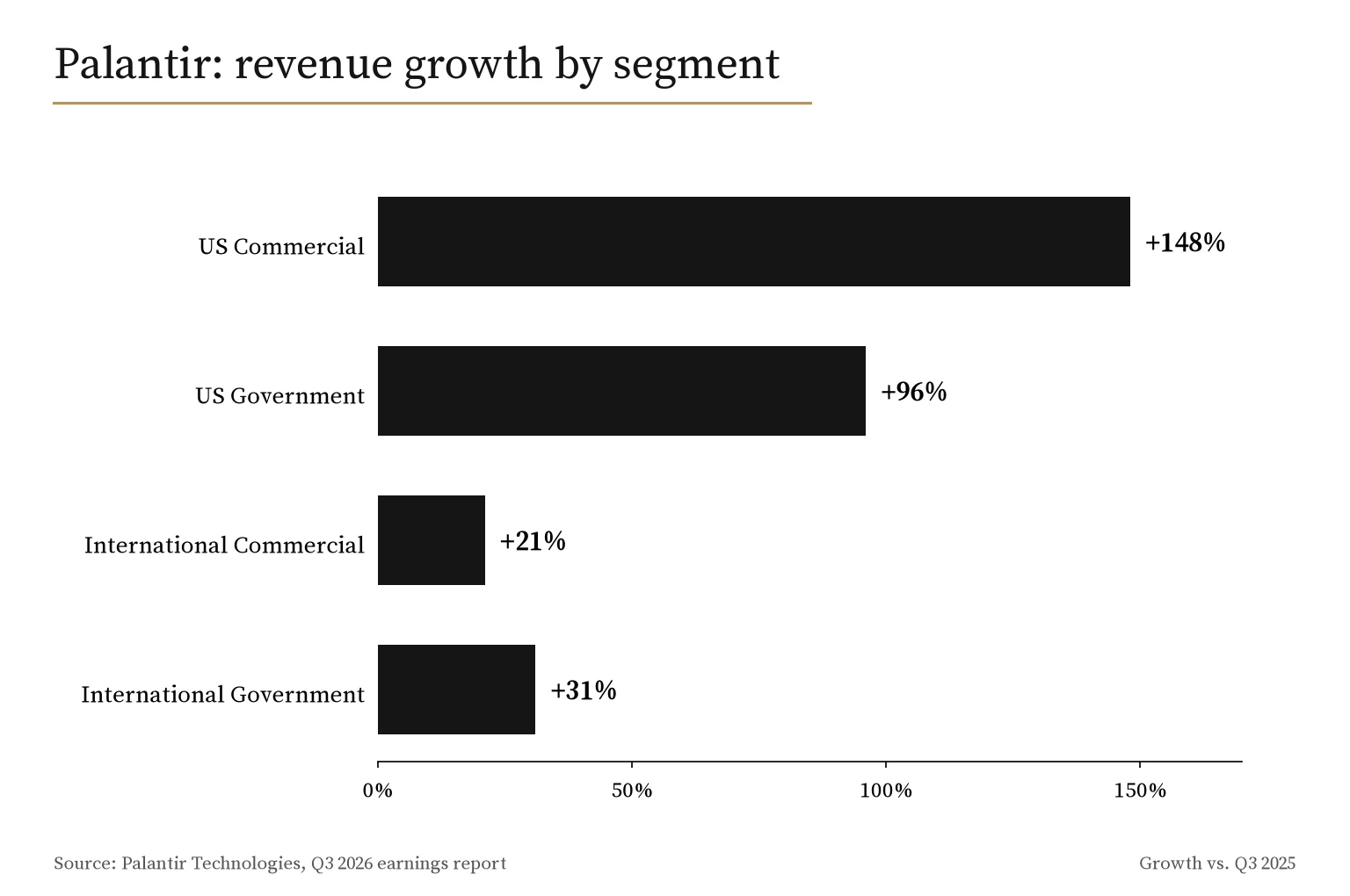
In the third quarter of 2026 Palantir reported revenue of $2.313 billion, up 96% year over year and 20% from the previous quarter. It is the first quarter in which the company crossed the $2 billion mark. Analysts expected around $2.18 billion, so the beat was about $130 million. Adjusted earnings per share came in at $0.44 against expectations of $0.41.
| Segment | Revenue ($ million) | Growth y/y | Growth q/q |
|---|---|---|---|
| US commercial | 984 | +148% | +29% |
| US government | 953 | +96% | +18% |
| Total US | 1,937 | +119% | +23% |
| International commercial | 184 | +21% | +1% |
| International government | 192 | +31% | +6% |
| Total commercial | 1,168 | +113% | +24% |
| Total government | 1,146 | +81% | +16% |
| Total | 2,313 | +96% | +20% |
US revenue reached $1.937 billion (84% of the total) and grew 119%. Within it, US commercial contributed $984 million - up 148% year over year and 29% quarter over quarter - and for the first time surpassed US government. Total commercial revenue reached $1.168 billion (+113%) and government $1.146 billion (+81%). International commercial grew only 21% to $184 million. Net dollar retention reached 165%, and US commercial remaining deal value rose 79% to $6.517 billion.
Adjusted gross margin is 85%, adjusted operating income $1.427 billion at a 62% operating margin, and GAAP operating income $1.085 billion at 47%. The Rule of 40 score (revenue growth plus adjusted operating margin) reached 158%.
What is the Rule of 40
A metric for software companies that adds two percentages: revenue growth and adjusted operating margin. If the sum exceeds 40, the company is considered efficient - it either grows fast, is highly profitable, or both. For Palantir the sum is 158 (96 + 62), which is exceptionally high.
Capital expenditure remains negligible (about $30 million for the nine months). Cash from operations reached $1.205 billion (52% of revenue) and adjusted free cash flow $1.216 billion (53% of revenue).
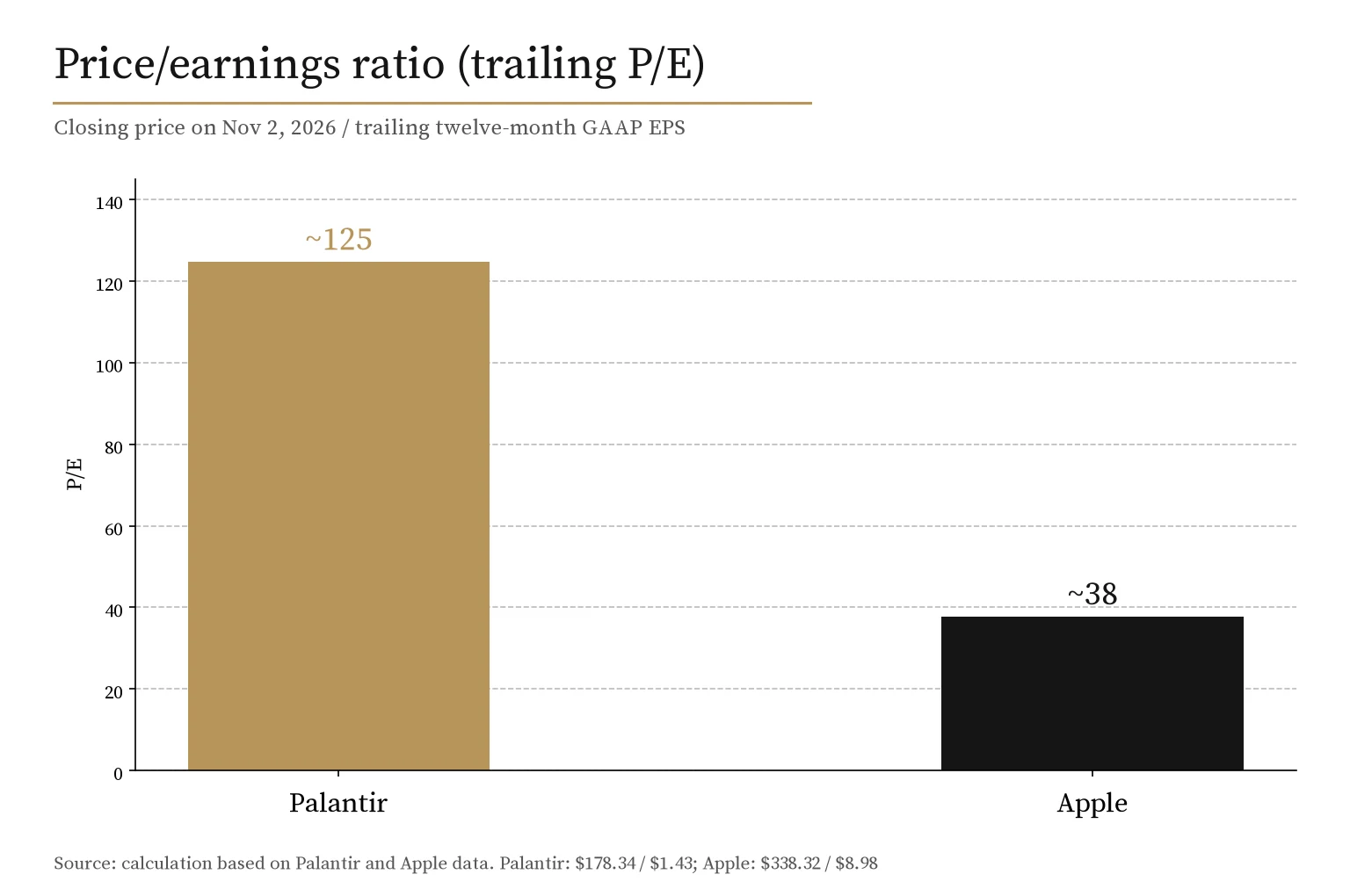
The warning signs: at a closing price of $178.34 on November 2 and trailing twelve-month GAAP EPS of $1.43, the price/earnings ratio is about 125, and some data providers using a different base put it at around 160. The average analyst price target is about $212-214, depending on the source. Deal dynamics (total contract value of new deals up 6% year over year) suggest that growth comes mainly from expansion with existing customers.
Investment horizons for Palantir
To the end of 2026: a high-risk position with a limited weight of 2% to 3%. Over one year: a moderate weight of 3% to 5%, only if growth holds above 80-100%. Triggers to review the position: two consecutive quarters of US commercial growth below 80%. Over three years, the thesis is that Palantir will turn current upsells to existing customers into sustained growth above 40% a year and keep high free cash flow with almost zero capital expenditure. For investors with a high risk appetite, the position can be up to 5-7% of the portfolio. If growth normalises earlier, three-year returns will depend more on compression of the price/earnings multiple than on operating success.
Apple fiscal Q4 2026 earnings analysis
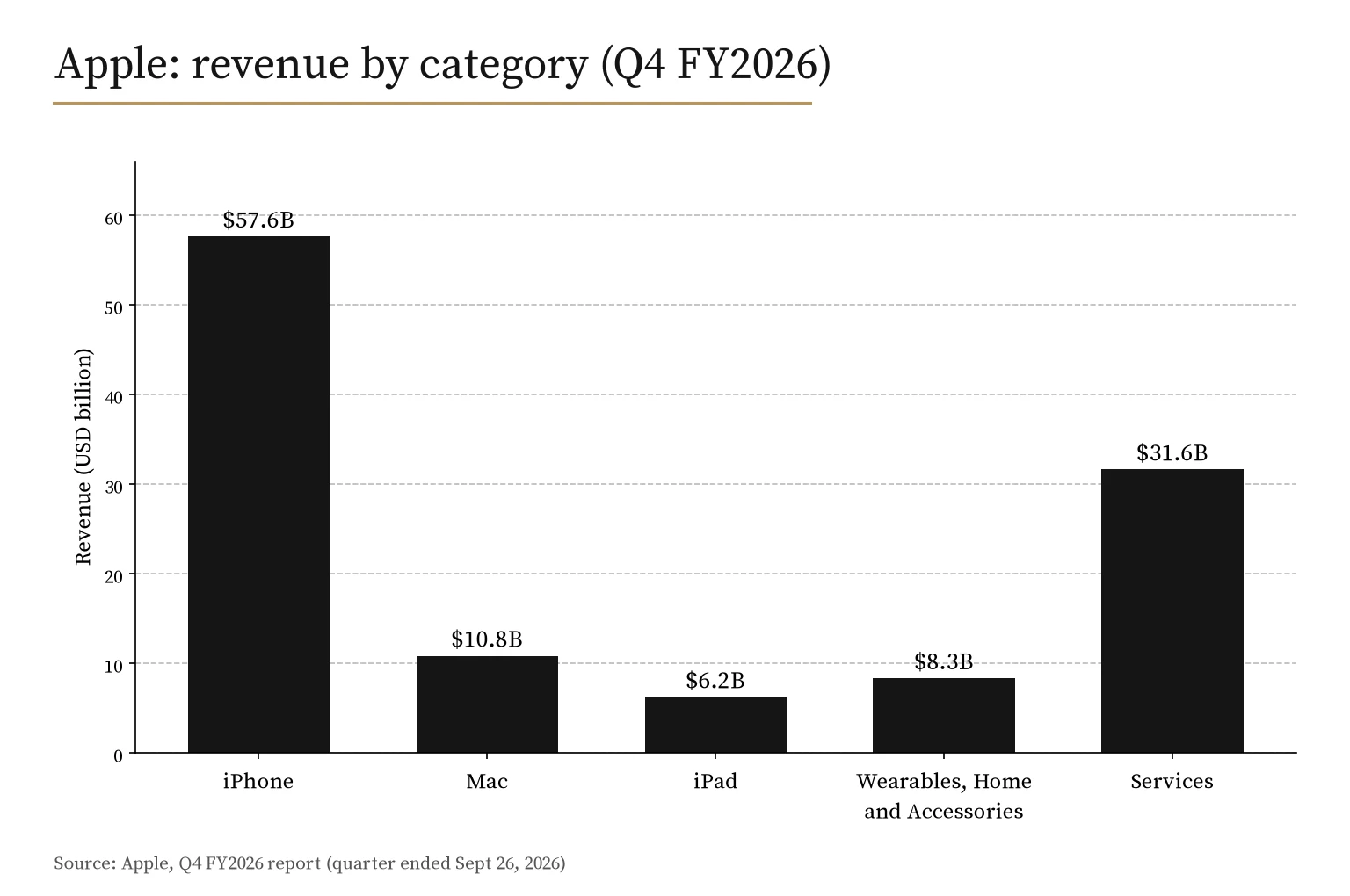
For the fourth fiscal quarter of 2026 (ended September 26) Apple reported revenue of $114.5 billion, up about 12% year over year and above the expected $113.4 billion. Earnings per share reached $2.10 against expectations of about $1.99.
| Category | Revenue ($ billion) | Growth y/y | vs. consensus |
|---|---|---|---|
| iPhone | 57.6 | +17.5% | Above |
| Mac | 10.8 | +24% | Well above |
| iPad | 6.2 | -10% | Below |
| Wearables, Home and Accessories | 8.3 | -8% | Below |
| Services | 31.6 | +10% | In line (record) |
| Total | 114.5 | +12% | Above |
iPhone and Mac are the growth engines and beat forecasts. Gross margin is 47.9%, of which about 1 percentage point came from tariff refunds. Operating income is $35.6 billion (operating margin of about 31%). Capital expenditure for the year is $9.0 billion. Free cash flow for the year exceeds $136 billion. Guidance for the December quarter calls for a gross margin of 45-46% because of higher memory costs.
The closing price on November 2 was about $338, a price/earnings ratio of about 37-38. The average analyst price target is about $333.
Investment horizons for Apple
To the end of 2026 the position has a moderate weight of 4% to 6% of the portfolio: the stock is exposed to pressure from the December margin guidance, memory is already priced in as a risk, but if management confirms that the squeeze will continue beyond December, the short-term reaction may be negative. Upside to year-end is limited. Over one year Apple remains a company with strong free cash flow and high predictability and justifies a weight of 6% to 8%; returns will depend more on the ability to defend margins and on the pace of services than on extreme revenue growth. Review trigger: a sustained decline in gross margin below 45% for two consecutive quarters or services growth below 7%. Over three years the position is among the most resilient in big tech and justifies a weight of 8% to 10% for most portfolios: strong free cash flow, the installed base and the ability to return capital to shareholders support the thesis even with moderate growth of 6% to 9%. The risk lies more in the price staying high relative to the opportunities than in operational failure. Review trigger: revenue growth below 5% for four consecutive quarters or a sustained decline in free cash flow below $100 billion a year.
| Metric | Palantir (Q3 2026) | Apple (Q4 FY2026) |
|---|---|---|
| Revenue growth y/y | +96% | +12% |
| Operating / gross margin | 62% (adj. operating) | 47.9% (gross); ~31% (operating) |
| Capital expenditure | ~$30 million (9 months) | $9.0 billion (FY2026) |
| Free cash flow | ~53% of revenue (adj.) | High (>$136 billion in FY2026) |
| P/E (trailing) | ~125 | ~37-38 |
| Average analyst target | ~$212-214 | ~$333 |
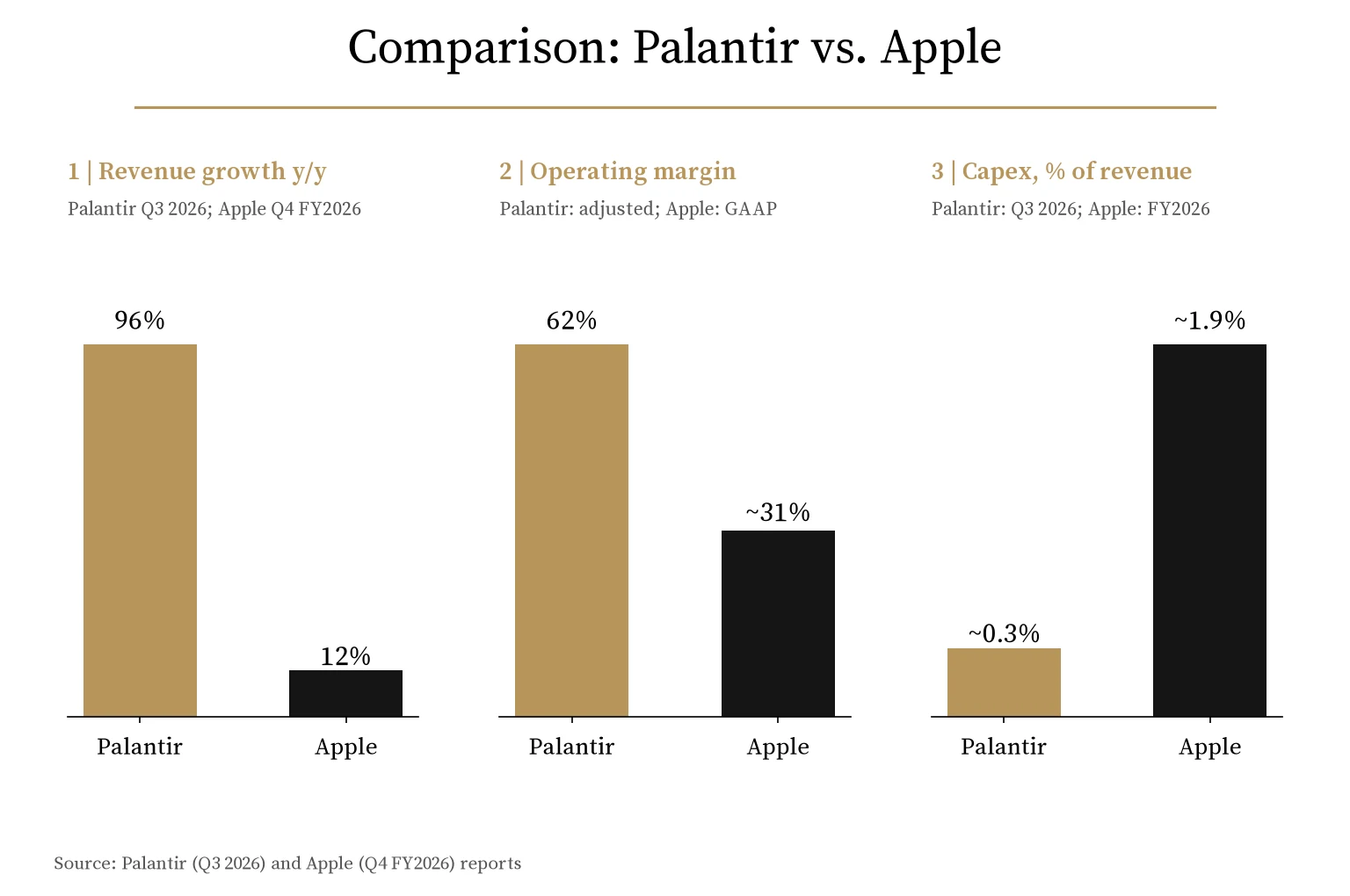
Palantir and Apple are not simply two different companies in the same sector. They are two complementary ways of responding to the same wave. Palantir carries the yang of artificial intelligence: extreme revenue growth, strong operating leverage, almost zero capital expenditure. Apple carries the yin of the same theme: record device sales, strong free cash flow, moderate growth and a cautious approach to infrastructure investment.
Frequently asked questions
Why are Palantir and Apple seen as yin and yang?
Because their choice regarding artificial intelligence is structural. Palantir makes AI the centre of its business; Apple keeps it as a layer on top of its existing system. This opposition, however, is not permanent.
Why is segment profitability not visible at Palantir?
Because the company does not publish operating profit separately for the commercial and government segments, or for the US and international businesses. Conclusions about operating leverage therefore stay at the level of the company as a whole.
What does Palantir’s near-zero capital expenditure mean?
It means that growth and returns to shareholders are funded entirely by operations. The company does not need large infrastructure investment to grow revenue. At the same time, high stock-based compensation continues to dilute shareholders.
Why is Apple not investing as aggressively in AI infrastructure?
Because its model is different. Apple has a huge installed base and high services profitability and prefers to integrate external models or run models on its devices rather than build its own data centres on the scale of the large cloud providers.
Does it make sense to hold both stocks in one portfolio?
Yes, if the investor understands that they do not substitute for each other but complement each other, and sticks to the review triggers. Together they cover both the yang and the yin of the theme, but only if the investor is willing to accept both the high volatility of the first and the limited upside of the second at current prices.
Important notice
This article is for information and education only. It is not financial advice, an investment recommendation or professional advice of any kind. The views expressed are the author’s personal opinions and are not recommendations to buy, sell or hold securities, assets or investments. Investing involves substantial risk, including the possible loss of all capital. Past performance is not a guarantee of future results. Each reader should conduct independent research, consult a qualified financial adviser and weigh financial circumstances, risk tolerance and investment objectives before taking any decision. The author and borsite.net accept no liability for any loss arising from the use of the information in this article.