
Financial data are from Anthropic’s prospectus (S-1/A-3) of November 17, 2026, and from the pricing announcement of November 18. Market data are as of the US market close on November 19.
A free weekly newsletter on markets, assets and geopolitics, every Saturday. Subscribe here.
On November 5, 1858, a share subscription opened in Paris: 400,000 shares at 500 francs each in a company that had neither a canal built nor any revenue. Ferdinand de Lesseps promised annual revenue of 30 million francs from transit fees and a construction period of six years. The French bought about half of the shares. Britain, Russia, Austria and the United States did not buy a single one. To keep the issue from failing, Egypt’s ruler Said Pasha bought the rest, ending up with about 177,000 shares.
Construction of the Suez Canal began in 1859, with the aim of linking the Mediterranean with the Red Sea and cutting thousands of kilometres off the route from Europe to Asia. The project required years of work, enormous capital and fixed commitments before the first ship could pass. Instead of six years, construction took ten, and the cost came in at more than double the original estimate. The canal opened on November 17, 1869, almost exactly 157 years before Anthropic’s stock market debut, and in the end it transformed world trade. But between the start and the first revenue lay delays and doubts about whether traffic would justify the money invested: in 1870 about 400,000 tons of cargo passed through the canal, against the 5 million expected. (I wrote in October about de Lesseps’s other, failed canal in Panama in Hot Inflation and Expensive AI Infrastructure Debt.)
Anthropic is doing something similar, only with computing power. The company priced its initial public offering at $83 a share, and the offering of 980 million Class A shares comes to $81.3 billion, more than the $75 billion in SpaceX’s base offering in June. Of that, $79.4 billion goes to Anthropic and about $2 billion to the seven founders, who are selling part of their shares. The shares began trading on Nasdaq under the ticker ANT on November 19, and the fully diluted valuation at the offer price is about $1.5 trillion. On the first day the shares opened at $111.50 and closed at $97.17, 17.1 percent above the offer price.
The price is above the initial range of $70 to $78, and the size of the offering was raised from the 825 million shares first announced. The underwriters also have a 30-day option to buy up to 147 million more shares (the so-called greenshoe, an option for additional shares). If exercised in full, it brings in about $12.2 billion more and takes the total to about $93.5 billion, above SpaceX’s $85.7 billion after its own option. On top of the proceeds comes $26 billion from a private placement of non-voting Class N shares with strategic partners: AMD, Broadcom, Google, Micron, Microsoft, Nvidia and TSMC. Nvidia alone puts in about $10 billion. The total capital flowing into the company from the deal is about $105 billion gross, and together with the founders’ sales the figure is $107.3 billion.
The market values Anthropic as a software platform with exceptional growth, but its balance sheet carries long-term minimum obligations for computing power that are typical of an infrastructure company. They can become a burden if the pace of usage slows. The first day of trading showed how willing investors were to accept this combination of high operating leverage and fixed commitments: they paid a premium at the open (+34.3%), but about half of it was gone by the close (+17.1%). By high operating leverage I mean a large share of fixed costs, so that every change in revenue is magnified many times over in profit or loss.
Anthropic’s revenue: growth of over 1,200 percent and an annualized revenue rate of $81 billion
The data in the prospectus show growth that is almost unheard of among public companies.
| Period | Revenue | Growth |
|---|---|---|
| 2023 | $41 million | - |
| 2024 | $386 million | +841% |
| 2025 | $4.585 billion | +1,088% |
| First 9 months of 2026 | $33.242 billion | +1,206% vs first 9 months of 2025 |
| Q3 2026 | $16.96 billion | +1,127% vs Q3 2025, +47% vs Q2 2026 |
| Annualized revenue rate (Oct 31, 2026) | ~$81 billion | +$10 billion vs Sep 30, 2026 |
In the first nine months of 2026 revenue reached $33.242 billion, against $2.545 billion in the same period a year earlier. The third quarter alone brought in $16.96 billion, 1,127 percent more than a year before.
The pace is slowing, though. Quarter on quarter, revenue grew 132 percent in the first quarter, 144 percent in the second and 47 percent in the third. From such a base a slowdown is natural, but it is the most important question for the valuation, because the valuation assumes that growth will stay exceptional for years to come.
As of October 31, 2026, annualized revenue (the so-called run-rate), calculated under the company’s own definition (usage over the last 28 days multiplied by 13, plus monthly subscriptions multiplied by 12), was about $81 billion. That is $10 billion more in a single month, compared with $71 billion on September 30, and in May the figure was $47 billion, so after the third quarter growth is accelerating again. About 79 percent of revenue for the nine months came from usage-based pricing and the remaining 21 percent from subscriptions. Customers spending more than $100,000 over the last 12 months number more than 11,900, against about 950 a year earlier; over 1,900 spend more than $1 million and about 250 more than $10 million. Net revenue retention from existing customers is about 900 percent.
A high share of usage-based revenue is an advantage when usage accelerates and a weakness when it slows. If activity at the largest customers falls, or if competition pushes the price per token down, revenue can fall faster than at companies dominated by fixed subscriptions. Retention of 900 percent means that customers from a year ago are paying on average nine times as much. This is impressive, but the metric measures existing customers only, and the base a year ago was low ($1.38 billion of revenue in the third quarter of 2025), so a figure like this cannot be sustained over the long term. That makes growth more dependent on Anthropic’s ability to keep and expand usage at organizations it has already won than on a constant flow of new ones.
Revenue concentration remains significant. Although the company has more than 11,900 customers with annual spending above $100,000 and no single customer accounts for more than 10 percent of revenue, the five largest customers account for about 25 percent of revenue for the nine months (about 21 percent in the third quarter, against 36 percent in the first). Many of them have no long-term contracts and can cut usage at any time, which increases sensitivity to decisions by a few key customers to reduce usage or switch to alternative providers. Anthropic’s pricing power against OpenAI, Google and Microsoft is not yet fully proven: the company manages to retain customers at current prices, but there are no public data showing an ability to raise prices without losing volume. If competition lowers the price per token, profitability and the growth rate could fall at the same time.
Costs and profitability
The main cost is computing power and infrastructure. Over the nine months it grew more slowly than revenue, by 329 percent against 1,206 percent, which improved profitability. In the third quarter, however, compute costs rose 77 percent from the second quarter while revenue rose 47 percent, and their share of revenue went back up from 48 to 58 percent. The operating loss for the nine months was about $1.26 billion, and $567 million for the third quarter, after an operating profit of $974 million in the second.
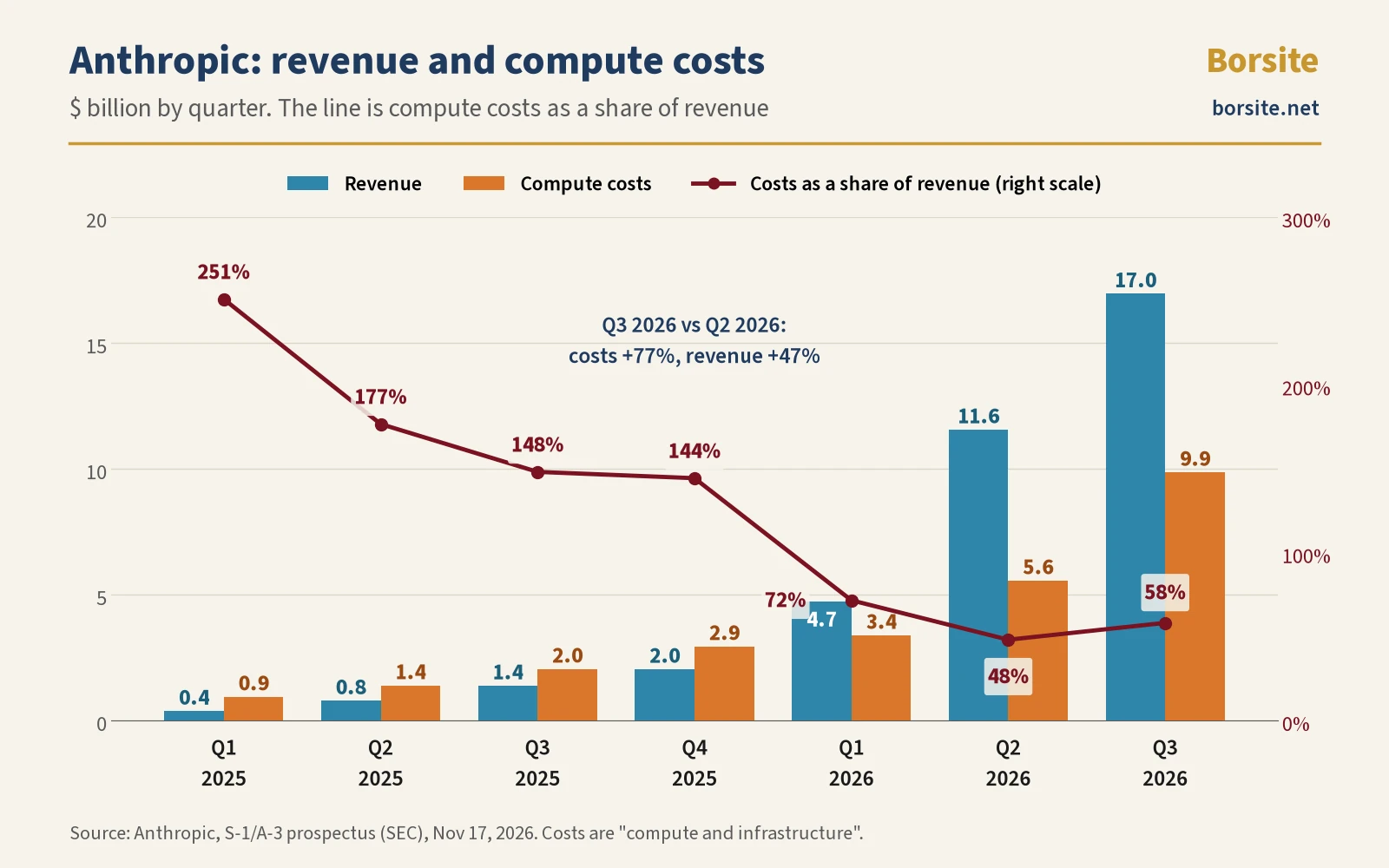
The adjusted operating margin is positive, about 12 percent for the period and about 15 percent in the third quarter, against 19 percent in the second. According to the prospectus, the decline came mainly from $5 billion of computing power under short-term contracts, which costs significantly more than capacity under multi-year contracts, and from $2 billion of non-cash charges related to the donation matching program. Adjusted profitability excludes non-cash items and certain one-off costs; comparability with other companies in the sector depends on how material these adjustments are. The company does not report gross margin separately, only total compute and infrastructure costs, which makes comparison with software companies harder. If a significant part of the improvement comes from temporarily slower growth in infrastructure costs relative to revenue, the sustainability of profitability will be put to the test in the next wave of capacity expansion.
The GAAP net loss is much larger, about $104 billion for the nine months, but most of it ($94.3 billion) comes from non-cash revaluations of convertible instruments and derivatives. After the IPO these revaluations will probably shrink, as some of the instruments convert or expire. Cash flow from operations is positive at about $6.6 billion.
Compute commitments: $901 billion and the balance sheet risk
As of September 30, 2026, cash and short-term investments stood at $131.8 billion, with a further $14.8 billion available under an undrawn credit facility. Traditional capital expenditure is relatively low for now, because much of the infrastructure is secured through long-term contracts with suppliers, but the share of the company’s own data centers is growing. The main burden lies in long-term commitments for computing power and infrastructure, which according to the prospectus amount to about $901 billion.
| Item | Amount |
|---|---|
| Total commitments | ~$900.9 billion |
| Due in the next 12 months | ~$70.7 billion |
| By the end of 2030 (incl. the next 12 months) | ~$451.6 billion |
| 2031-2045 | ~$449.3 billion |
| Cash and short-term investments (Sep 30, 2026) | $131.8 billion |
| Undrawn credit facility | $14.8 billion |
| Cash after the IPO and private placement (estimate, gross) | ~$237 billion |
Many of the contracts with Google, Amazon, Microsoft, Nvidia and AMD contain minimum obligations regardless of actual usage (payment regardless of utilization, the so-called take-or-pay). There are also significant equipment leases. With the proceeds of the IPO and the private placement, the cash position exceeds $230 billion, which covers the commitments for the next 12 months more than three times over. In addition, payments under these contracts are already part of operating costs, and operating cash flow remains positive. The problem is therefore not 2027 but the period up to 2030: about $451.6 billion has to be paid by the end of 2030, and the remaining roughly $449 billion between 2031 and 2045.
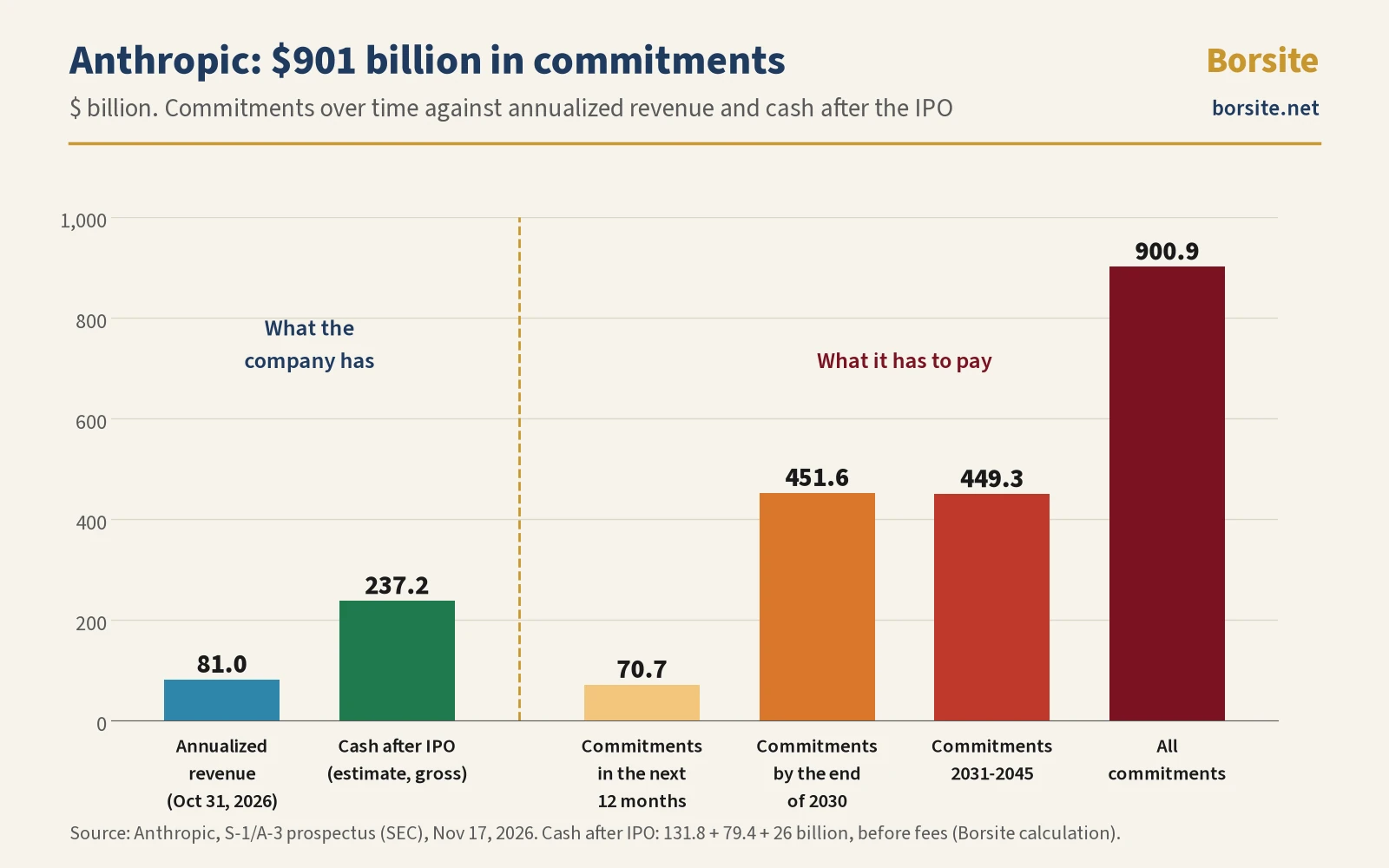
With growth of 70-100 percent, revenue covers an ever larger part of these payments. With growth of 40-50 percent, the IPO money could melt away within two to three years (an illustrative estimate), which would require either renegotiating some of the contracts or raising new capital. Dependence on access to chips and electricity adds execution risk: delays in deliveries or regulatory restrictions on exports could make part of the committed capacity more expensive or harder to use, without releasing the company from the minimum payments.
Dario Amodei himself has called computing power the company’s “deepest business dilemma”. In his words, Anthropic buys relatively little capacity in advance and, when demand is strong, relies on its cash to buy more on the spot market. The third quarter shows the price of this approach: short-term capacity costs significantly more than long-term capacity.
Financing and use of proceeds
Before the IPO the company raised capital in a series of private rounds, the last of which was $65 billion at a valuation of $965 billion in May 2026. The IPO valuation of about $1.5 trillion is about 55 percent higher. As of September 30, the total capital raised was $141.1 billion. The proceeds from the offering and the private placement are earmarked for general corporate purposes: working capital, operating expenses and investment in computing power and infrastructure, as well as staff retention. No specific acquisitions have been announced.
Control of the company
Public investors buy Class A shares, which carry one vote per share and a proportional share in dividends and in liquidation. Their combined vote, however, is capped at 49.9 percent. A single Class F share, held by the Founder LLC of the seven co-founders, carries a fixed 50.1 percent of the votes on all general shareholder matters and is not diluted by later issues. A separate Class T share, held by the Long-Term Benefit Trust (a trust with financially disinterested trustees), elects the majority of the board: four of the seven members, once one still vacant seat is filled. Together these two mechanisms make Anthropic a “controlled company” under Nasdaq rules. Buyers of the public shares have no real ability to influence the election of directors or the outcome of votes on general matters, regardless of how many shares they hold.
Anthropic is also a public benefit corporation. The board is obliged to balance the interests of shareholders with the company’s public purpose, the responsible development of artificial intelligence. The Anthropic Public Benefit Fund holds 5 percent of the fully diluted shares, and the employee donation program already costs $2 billion in non-cash charges in a single quarter.
With controlled companies the market often applies a discount for the limited control of minority shareholders. The multiple of 18-19 times annualized revenue may already include part of this discount, or investors may ignore it because of the exceptional growth. The risk increases if tension arises among the co-founders in the Founder LLC, or between them and the Long-Term Benefit Trust, over the direction of the company or the allocation of capital.
Interest from institutions and individual investors
Subscriptions covered the offering about twice on the very first day of the investor presentations (the so-called roadshow) and later reached nearly seven times the 825 million shares initially offered, with much of the demand coming from large institutional indications. Some of these indications are “soft” and can be withdrawn after pricing if market conditions deteriorate or if investors decide their allocation is too small. The company planned for up to 20 percent of the shares to go to individual investors, as much as individual investors received in the SpaceX deal. Strong institutional interest, however, will probably reduce their actual share. Orders were taken through platforms such as Robinhood, Schwab, Fidelity, SoFi and E*TRADE in the United States, as well as through brokers in Europe, Australia, Canada and Japan. Vanda Research estimates net purchases by individual investors on the first day of trading at about $250 million, twice its forecast for SpaceX. The amount is significant in absolute terms, but small relative to the size of the offering and probably not enough on its own to hold the price well above $83 if institutional sellers appear. I could not find published data on actual net purchases by individual investors on the first day as of this update.
Expectations for the debut were for an opening above the offer price. Pre-IPO derivatives (contracts for difference and so-called perpetual futures, contracts with no expiry) traded at about $97 on November 17 and about $102 on the morning of November 19, a premium of about 17-22 percent over $83. Grey market quotes pointed to a premium of 22 to 26 percent: about 24 percent at IG, while the German broker Lang & Schwarz went as high as $105. A broker model that applies the ratio seen at the SpaceX debut pointed to a first trade at about $92. The actual opening was $111.50, 34.3 percent above the offer price and above every quote listed here, while the close at $97.17 landed near the derivatives level of November 17.
Comparison with the SpaceX debut
SpaceX went public on June 12, 2026, at $135 a share and sold 555.6 million shares, raising $75 billion in the base offering. After the underwriters exercised their option, the total reached about $85.7 billion. The valuation at the offer price was about $1.77 trillion. The shares opened at $150 and closed the first day at $160.95, a gain of 19 percent, taking the market capitalization to about $2.1 trillion. Trading volume exceeded 500 million shares.
| Item | SpaceX | Anthropic |
|---|---|---|
| Debut date | June 12, 2026 | November 19, 2026 |
| IPO price | $135 | $83 |
| Proceeds (base offering) | $75 billion | $81.3 billion ($79.4 billion to the company) |
| With the additional share option | ~$85.7 billion | up to ~$93.5 billion (147 million shares, 30 days) |
| Valuation at IPO | ~$1.77 trillion | ~$1.5 trillion fully diluted (~$1.1 trillion non-diluted) |
| Open | $150 (+11%) | $111.50 (+34.3%) |
| First-day close | $160.95 (+19.2%) | $97.17 (+17.1%) |
| First-day volume | ~508 million shares | ~846 million shares |
| Market cap at close | ~$2.11 trillion | ~$1.28 trillion non-diluted (~$1.75 trillion fully diluted) |
| Book coverage | over 4 times | nearly 7 times |
| Share for individual investors | ~20% | up to 20% |
The first-day difference is measured against SpaceX’s gain: +11 percent at the open and +19.2 percent at the close. Anthropic opened +34.3 percent and closed +17.1 percent versus the offer price, a stronger open but a weaker close than SpaceX. Unlike SpaceX, however, Anthropic has long-term compute commitments of about $901 billion and a higher concentration of control through its special share classes. SpaceX came to market with physical assets and a clearer path to positive cash flow from Starlink; Anthropic is closer to a model with high operating leverage and fixed minimum obligations. About a month after its debut, in mid-July, SpaceX shares fell below the offer price, a reminder that a strong first day does not guarantee a lasting valuation. The first day of ANT showed that the market is willing to pay a premium for a company with faster revenue growth, despite a heavier infrastructure bill and more limited rights for minority shareholders, although about half of that premium was gone by the close.
Valuation and multiples
At a $1.5 trillion valuation, Anthropic trades at about 18.5 times its annualized revenue of $81 billion (13.6 times on a non-diluted basis of about $1.1 trillion).
| Item | Value |
|---|---|
| IPO price | $83 |
| Proceeds (base offering) | $81.3 billion |
| Fully diluted valuation | ~$1.5 trillion |
| Non-diluted valuation | ~$1.1 trillion |
| Annualized revenue | ~$81 billion |
| Fully diluted valuation / annualized revenue | ~18.5 times |
| Non-diluted valuation / annualized revenue | ~13.6 times |
| Fully diluted valuation / revenue for the last 12 months ($35.3 billion) | ~42 times |
| Market value at the first-day close | ~$1.28 trillion non-diluted (~$1.75 trillion fully diluted) |
| Multiple at close (to annualized revenue) | ~15.9 times non-diluted, ~21.6 times fully diluted |
Against revenue for the last nine months, annualized (about $44 billion), the multiple is considerably higher, at about 34 times, and against revenue for the last 12 months ($35.3 billion) about 42 times. Banks expect revenue of about $270-280 billion in 2028, and Goldman Sachs does not expect positive annual free cash flow before 2030. The valuation depends less on the current multiple and more on whether these forecasts come true, but only if growth stays high and the minimum commitments do not turn into a liability on the balance sheet. For comparison, OpenAI, which is not yet listed, was valued at $852 billion in March 2026, and in May Anthropic overtook it with its $965 billion valuation.
What the analysts say
Morningstar puts the fair value of the stock at $92 and considers it undervalued in the $70 to $78 range. New Street Research rates it Buy with a $105 target. KGI Securities starts with Outperform and a $100 target. Against the $83 offer price, that is upside of 10.8, 26.5 and 20.5 percent.
| Analyst | Target / fair value | Rating | Vs $83 | Vs the first-day close |
|---|---|---|---|---|
| Morningstar | $92 (fair value) | Undervalued in the $70-78 range | +10.8% | -5.3% |
| New Street Research | $105 | Buy | +26.5% | +8.1% |
| KGI Securities | $100 | Outperform | +20.5% | +2.9% |
The risks the prospectus highlights
- The conflict with the US Department of War. After Anthropic refused to allow its models to be used for mass domestic surveillance and fully autonomous weapons, the US President said he had directed federal agencies to stop using its technology, and the Secretary of War ordered the company to be designated a “supply-chain risk”. On March 4, 2026, the department sent formal letters, and earlier it threatened to invoke the Defense Production Act. Anthropic is challenging these actions, but the risk is described in the prospectus.
- Circular financing. Google, Amazon, Microsoft, Nvidia and AMD are at the same time investors, suppliers of computing power and sales channels. Google’s stake is capped at 14.99 percent, Amazon holds convertible notes, AMD has committed to buy up to $5 billion of shares in exchange for deliveries of its GPUs, and Nvidia puts about $10 billion into the private placement. I wrote about the same theme at Nvidia in yesterday’s analysis of its results.
- Copyright. In 2025 the settlement in the Bartz case cost the company $1.5 billion. The prospectus warns that new adverse rulings could force it to modify, retrain or restrict its models.
- Model safety. The prospectus describes an incident during a cybersecurity test: because of a misconfigured test environment, four models gained unauthorized access to real external systems. The risk to reputation and regulation is direct.
- Export controls. The banks turned away orders from institutions in mainland China and Hong Kong, partly because of US defence trade rules (ITAR). Restrictions on chip exports also affect the supply of computing power itself.
- Competition. During the roadshow investors asked whether Anthropic can keep its lead while Google and others catch up. The price per task is also falling: according to the prospectus, Opus 5.5 cuts customers’ cost per task by about 40 percent compared with Opus 5. This widens usage, but puts pressure on the price per token.
What it means for the market
The first day of trading gave a partial answer to whether the public market is ready to pay the current multiples for a company whose growth is exceptional, but whose long-term compute commitments run to hundreds of billions: the market paid a premium, but about half of it was gone by the close. The open at $111.50 and the close at $97.17 set the initial market value at about $1.28 trillion non-diluted (about $1.75 trillion fully diluted) and became the benchmark for comparison with the other players in artificial intelligence.
Once the lock-up periods (bans on selling shares) expire, a large volume of shares will be able to come to market. About 15.5 billion shares are subject to such a ban, more than fifteen times the number offered. Up to 3.7 billion can be released before day 180, and about 300 million employee shares can be sold from the very first day. The co-founders and the largest shareholders are locked up for up to 365 days. The shares from the private placement are not subject to the underwriters’ lock-up, but they are restricted securities. The higher the price, the greater the incentive for employees and early investors to sell at the first opportunity.
Conclusion
The Suez Canal did eventually pay off and changed world trade, but not for everyone who took on the initial risk. In 1875 debt-ridden Egypt sold its stake to Britain for 4 million pounds. British Prime Minister Benjamin Disraeli bought it with a loan from Lionel de Rothschild, and Britain became the company’s largest shareholder just as traffic was starting to grow: from about 400,000 tons in 1870 to more than 2.4 million tons in 1874.
Today Anthropic is building its own canal, this time for computing power. The difference is that the Suez Canal was a physical monopoly with a 99-year concession, while computing power ages in 3 to 5 years and is sold in a competitive market. A canal is dug once, but chips have to be replaced many times over the life of commitments that run to 2045. The current valuation of 18-19 times annualized revenue is justified if revenue approaches the $270-280 billion the banks expect in 2028 and if the company turns its high usage growth into sustainable cash flows that cover the minimum commitments without frequent contract renegotiations or new capital raising. With growth below 50 percent, or a loss of pricing power against competitors, the valuation becomes vulnerable, regardless of the result of the first day of trading (+17.1% versus the offer price).
The canal could turn out to be one of the most important in the history of technology, or it could remain an expensive project whose traffic does not justify the commitments made. And as with Suez, the profit may go not to those who take on the initial risk, but to those who buy at the right moment.
Frequently asked questions
How much did Anthropic raise in its IPO, and at what valuation?
The offering of 980 million Class A shares at $83 comes to $81.3 billion. Of that, $79.4 billion goes to the company and about $2 billion to the co-founders. On top of that comes $26 billion from a private placement with strategic partners, so the company receives about $105 billion gross. The fully diluted valuation at the offer price is about $1.5 trillion. At the first-day close the market value was about $1.28 trillion non-diluted and about $1.75 trillion fully diluted.
What is the main risk to the valuation?
The main risk is the long-term compute commitments of about $901 billion, many of which contain minimum obligations regardless of actual usage. With the IPO proceeds the company covers the payments for the next 12 months more than three times over, but by the end of 2030 it has to pay about $451.6 billion. If revenue growth slows below 50 percent, these commitments could put pressure on cash and force contract renegotiations or new capital raising.
Do public shareholders have real control?
No. Class A shares carry one vote each, but their combined share is capped at 49.9 percent. One Class F share, held by the Founder LLC, carries a fixed 50.1 percent of the votes. A separate Class T share, held by the Long-Term Benefit Trust, elects the majority of the board, four of the seven members, once the vacant seat is filled. The company is a “controlled company” under Nasdaq rules.
How does Anthropic’s debut compare with SpaceX’s?
SpaceX raised $75 billion (about $85.7 billion with the underwriters’ option) at a valuation of about $1.77 trillion, opened 11 percent higher and closed its first day up 19 percent. Anthropic raised more in the base offering ($81.3 billion), but comes to market with a lower valuation and heavier fixed infrastructure commitments. Anthropic’s book was covered nearly seven times, against more than four times for SpaceX. On the first day ANT opened at $111.50 (+34.3%) and closed at $97.17 (+17.1%) on volume of about 846 million shares.
Under what conditions is the current valuation justified?
A valuation of 18-19 times annualized revenue is justified if revenue approaches the $270-280 billion the banks expect in 2028 and if the company turns growth into sustainable cash flows that cover the minimum commitments without frequent contract renegotiations. With growth below 50 percent or a loss of pricing power, the valuation becomes vulnerable.
How can I buy Anthropic shares?
The shares trade on Nasdaq under the ticker ANT. Before buying, check the fees, the exchange rate for converting into dollars and the taxation of dividends and capital gains. This is not a recommendation to buy.
Updated on November 19, 2026, at 11:40 pm Sofia time, with first-day trading data.
Related analysis
- Nvidia: $115.8bn in Revenue, $390bn in Commitments and Colette Kress at the Helm
- Two trillion, no control
- Hot Inflation and Expensive AI Infrastructure Debt
- The Absurd Scale of AI Spending and the Cost of Financing It
- The AI Stock Selloff in November 2026: Lost Value, Leverage and What Comes Next
Newsletter
A free weekly newsletter on markets, assets and geopolitics, every Saturday. Subscribe here.
Disclaimer
This material is analytical and educational. It is not a personal investment recommendation and not a call to buy or sell securities. Markets are volatile; valuations carry uncertainty; the data are as of the dates indicated. Do your own research and, if needed, consult a licensed adviser.
Sources
1. Anthropic, S-1/A-3 prospectus, SEC EDGAR, Nov 17, 2026 https://www.sec.gov/Archives/edgar/data/2130357/000162828026074338/anthropicpbc-sx1ax3.htm
2. Anthropic - pricing of the initial public offering, Nov 18, 2026 https://www.anthropic.com/news/anthropic-prices-initial-public-offering
3. Anthropic - Series H, $65 billion at a $965 billion valuation, May 28, 2026 https://www.anthropic.com/news/series-h
4. AP - Anthropic prices its IPO at $83, Nov 18, 2026 https://apnews.com/article/anthropic-ipo-pricing-70b660ddf900d90bbf484ecdf1fb441c
5. NPR - $79.4 billion to the company, Nov 18, 2026 https://www.npr.org/2026/11/18/nx-s1-6046212/anthropic-record-ipo-price
6. Bloomberg Law - $107.3 billion including the private placement, Nov 18, 2026 https://news.bloomberglaw.com/mergers-and-acquisitions/anthropic-is-said-to-price-ipo-at-83-per-share
7. CNBC - third-quarter financials in the S-1, Nov 2, 2026 https://www.cnbc.com/2026/11/02/anthropic-ant-s-1-quarter-financials.html
8. CNBC - individual investors and the Vanda Research forecast, Nov 18, 2026 https://www.cnbc.com/2026/11/18/anthropic-ipo-retail-investors.html
9. The Next Web - the order book, bank forecasts and Amodei’s comments, Nov 16, 2026 https://thenextweb.com/news/anthropic-ipo-orders-seven-times-spacex-pricing-week
10. Lianhe Zaobao (Bloomberg, Reuters) - grey market and pre-debut derivatives, Nov 19, 2026 https://www.zaobao.com.sg/en/finance/world/anthropic-heads-listing-grey-market-premium-above-20
11. FinanceFeeds - pre-IPO derivatives and shares free to trade from day one, Nov 19, 2026 https://financefeeds.com/anthropic-ant-stock-first-trade-today-after-83-ipo-bull-104-bear-78/
12. RoboForex - model for a first trade around $92 https://roboforex.com/blog/anthropic-ipo/anthropic-stock-price-prediction/
13. Morningstar - fair value estimate for Anthropic https://www.morningstar.com/stocks/anthropic-we-see-stock-undervalued-ipo-pricing-range
14. CNBC - New Street Research starts at Buy with a $105 target, Nov 17, 2026 https://www.cnbc.com/2026/11/17/anthropic-ipo-new-street-buy-rating.html
15. StreetInsider - KGI Securities starts at Outperform https://www.streetinsider.com/New+Coverage/KGI+Securities+Starts+Anthropic+%28ANT%29+at+Outperform/27346932.html
16. SpaceX, final prospectus 424(b)(4), SEC EDGAR https://www.sec.gov/Archives/edgar/data/1181412/000162828026042639/spaceexplorationtechnologi.htm
17. CNBC - SpaceX first day, Jun 12, 2026 https://www.cnbc.com/2026/06/12/spacex-ipo-spcx-live-updates.html
18. TechCrunch - SpaceX after the IPO, $85.7 billion with the option, Jun 16, 2026 https://techcrunch.com/2026/06/16/spacex-is-public-everything-you-need-to-know-post-ipo/
19. CNBC - SpaceX falls below its IPO price, Jul 15, 2026 https://www.cnbc.com/2026/07/15/spacex-spcx-stock-ipo-price.html
20. Bloomberg - SpaceX book more than four times covered, Jun 10, 2026 https://www.bloomberg.com/news/articles/2026-06-10/spacex-ipo-is-said-to-be-more-than-four-times-oversubscribed
21. WSJ - individual investors received 20% of SpaceX shares, Jun 12, 2026 https://www.wsj.com/livecoverage/spacex-ipo-stock-market-06-12-2026/card/individual-investors-received-20-of-ipo-shares-sources-say-nUeVuopv0uEZlnhNGtAl
22. Reuters - Anthropic valued at $965 billion and OpenAI at $852 billion, May 28, 2026 https://www.reuters.com/business/anthropic-raises-65-billion-now-valued-965-billion-2026-05-28/
23. Suez Company (1858-1997) - the 1858 share issue, traffic and the 1875 sale (after Fitzgerald and Karabell) https://en.wikipedia.org/wiki/Suez_Company_(1858%E2%80%931997)