
After the Battle of Actium in 31 BC, Octavian crushed the fleet of Mark Antony and Cleopatra and became the sole ruler of the Roman world. Two years later he entered Rome not as a conqueror at the head of an army, but as a man who formally restored the republican institutions while in reality concentrating power in his own hands. The true shape of the new order, however, was not visible on the day of his triumph, but in the years that followed, when it became clear which of the old institutions kept their strength and which gave way to the new power.
In the first hours after the election, the market reacted to the triumph itself. The question is what happens once it becomes clear which promises can be kept and which will turn into political wrangling.
The midterm elections of November 3, 2026 overturned control of Congress and key governorships. Democrats won both the Senate and the House of Representatives and took states long seen as Republican strongholds. In Texas, James Talarico became the first Democrat elected to the Senate since 1988. Gina Hinojosa became the state’s first Democratic governor in more than three decades. We saw similar results in Georgia and Ohio. The driving force was the combination of high prices, tariffs and the war in Iran, which has kept fuel prices high since February and sustains inflationary pressure.
The market reaction in the first hours was a classic unwinding of positions opened on expectations of fast deregulation and accelerated construction. S&P 500 futures and especially Nasdaq-100 futures fell sharply (by as much as 1.3% and 2.3% respectively), the 10-year Treasury yield fell about 6 basis points to 4.90%, the dollar weakened, gold rose, and bitcoin slipped below $76,000. The sharpest blow, however, came from Texas. The new governor, Gina Hinojosa, campaigned on a promise of a moratorium on new data centers until the legislature adopts stricter rules on power supply, water allocation and local costs. In August and September, Greg Abbott himself had already paused new grid connections for data centers and the related environmental permits pending an ERCOT audit, but Hinojosa promises a broader and more lasting moratorium. According to estimates by Jefferies and Wells Fargo, Texas accounts for about 26-27% of planned US capacity for such centers, and according to Jefferies about 13.3 gigawatts of announced capacity is at risk of delay. The same signals are coming from the new Democratic governors in Georgia and Ohio. By the morning of November 4, however, futures had reversed and were trading about 1% higher, and bitcoin had recovered almost all of its loss.
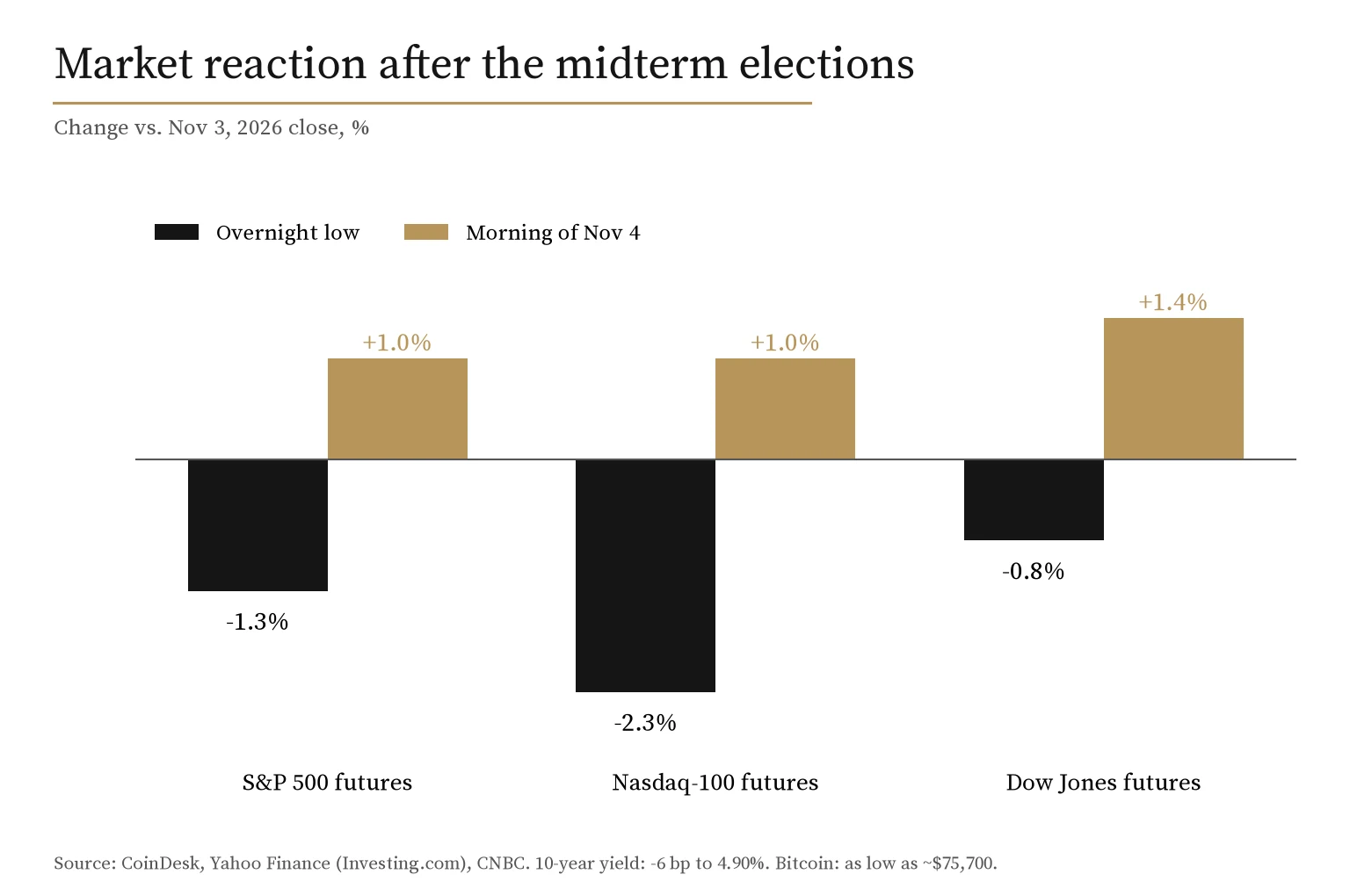
Part of the decline in stocks and crypto assets in the first hours after the election may also reflect the unwinding of existing positions, thinner liquidity in the early hours of trading, or broader political uncertainty not tied only to Texas. It was because of data centers that the technology segment took a sharper hit than the rest of the market, with shares of data center operators lagging power producers and the broad technology index by about 1.5-2 percentage points in the very first hours. The market reacted to events in Texas because it saw a concrete risk to the pace of capital spending that is already reflected in the valuations of Nvidia, the cloud providers and the companies building the centers themselves.
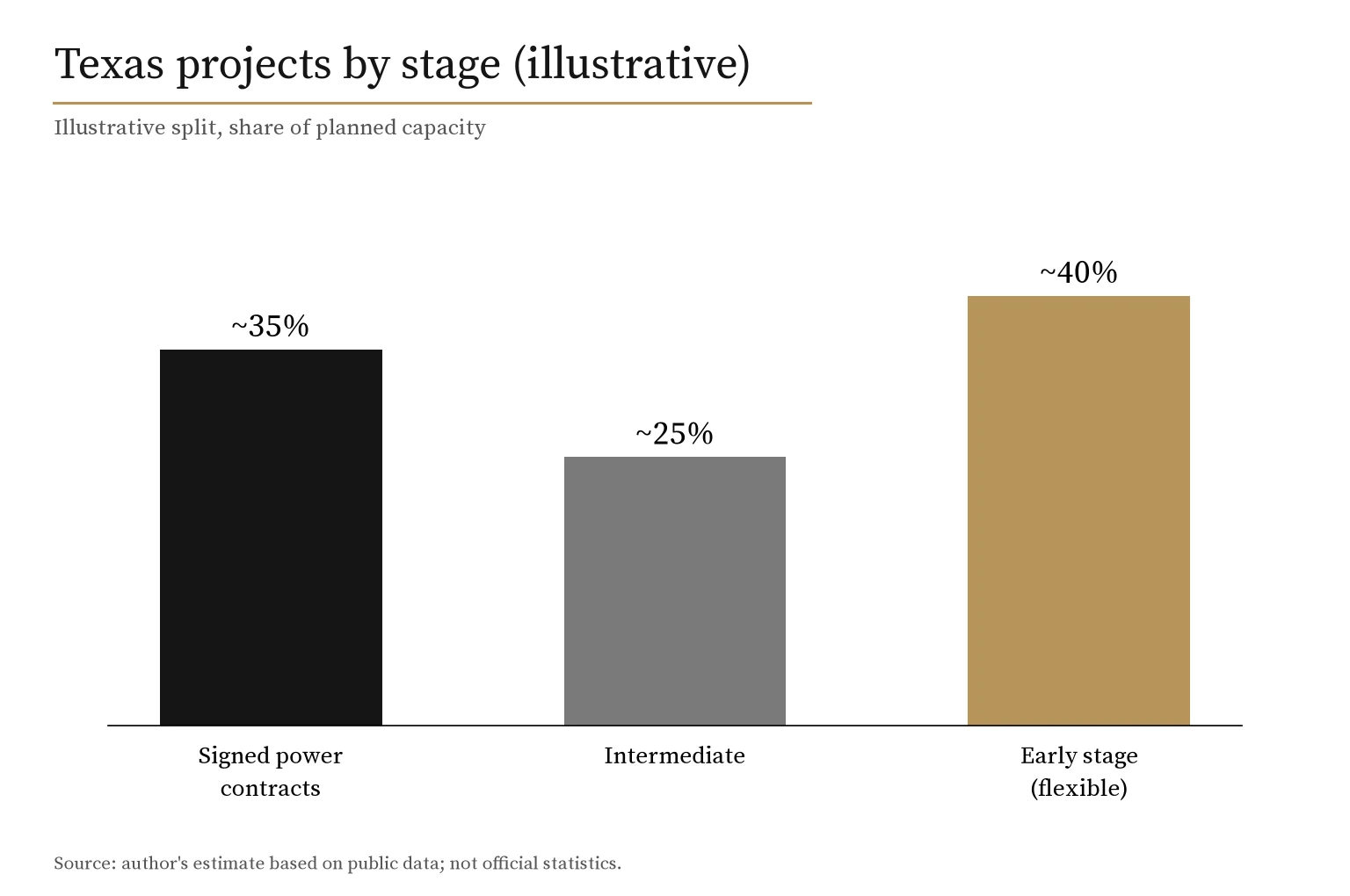
Not all of them are equally vulnerable, however. The share of projects with signed power contracts varies between 30% and 40%, depending on the source. For them, a delay means higher costs and a longer timeline, but not automatic cancellation. The intermediate stage is less clear, and the early stage even more so. Some early-stage projects could be relocated to states with friendlier regulation within 18-24 months. Between one third and one half of these projects could move to states with more grid headroom without running into the same obstacles; this estimate is based on publicly announced plans for alternative sites and on conversations with developers and consultants working on such sites. The rest would end up in states with already congested grids or with local political debates on the issue. The difference between costs already incurred and projects that can still be changed or relocated determines whether the hit to valuations will be a one-off or stretched over time. For now, the market prices all announced projects as equally at risk, which overstates the immediate risk and underestimates the possibility of reallocation.
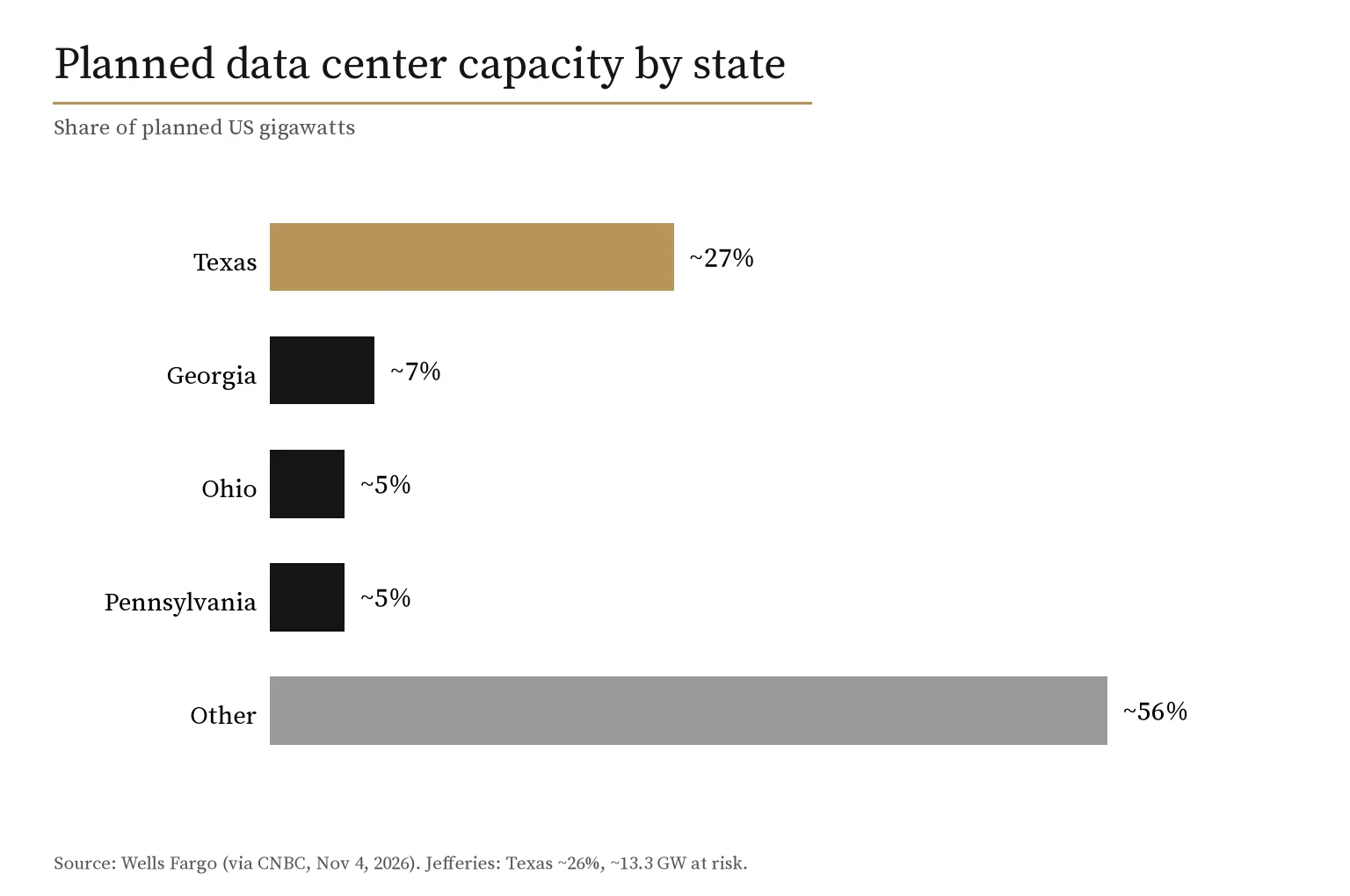
| State | Share of planned capacity |
|---|---|
| Texas | ~27% |
| Georgia | ~7% |
| Ohio | ~5% |
| Pennsylvania | ~5% |
| Other | ~56% |
| Category | Share | Characteristics |
|---|---|---|
| Signed power contracts | ~35% | Costs already incurred; delay, but rarely cancellation |
| Intermediate | ~25% | In progress; sensitive to timelines |
| Early stage (flexible) | ~40% | Can be relocated within 18-24 months |
The legal and procedural options of the new governors are limited. The moratorium promised by Gina Hinojosa most likely cannot be imposed by her order alone. It would require either a law passed by the Texas legislature or administrative rules that companies with permits already issued or with signed power contracts can challenge in court. In the first six to twelve months, the real effect will probably be slower new permits and stricter review of projects without signed contracts, not a mass halt of construction that is already well advanced. Court challenges could stretch the process into 2027. The same limits apply to the governors in Georgia and Ohio.
Federal tools can add further uncertainty even if state moratoriums prove more limited. A budget clause restricting funding for certain grid projects, or an investigation requiring utilities to disclose their contracts with data centers, could indirectly affect the pace of construction. Such tools have been used in the past against other energy and infrastructure projects, including in disputes over pipelines and renewable capacity, which shows that this kind of pressure is possible, though not decisive.
The incentives of local authorities, utilities and landowners, however, can slow or soften this process. In Texas, some municipalities and counties have already benefited from tax breaks and jobs tied to data centers. Utilities have an interest in new long-term power contracts. These interests cannot change the governor’s political promise, but they can create internal resistance to a potential moratorium and limit the speed at which it becomes administrative practice.
Relocating some of the early projects has consequences and is not an easy undertaking. If it happens in states with already congested grids - for example Arizona or Virginia - it creates stronger pressure on grid connection prices and on the political reaction than a move to states with more spare capacity. High power prices hurt data center operators more than power producers, who can benefit from higher prices if grid connections are not significantly delayed. If permitting difficulties also affect the build-out of the grid, the companies building transmission infrastructure will come under pressure too. The effect within the infrastructure segment is not uniform. This is already visible in the relative underperformance of data center operator stocks by about 1.5-2 percentage points versus power producer stocks.
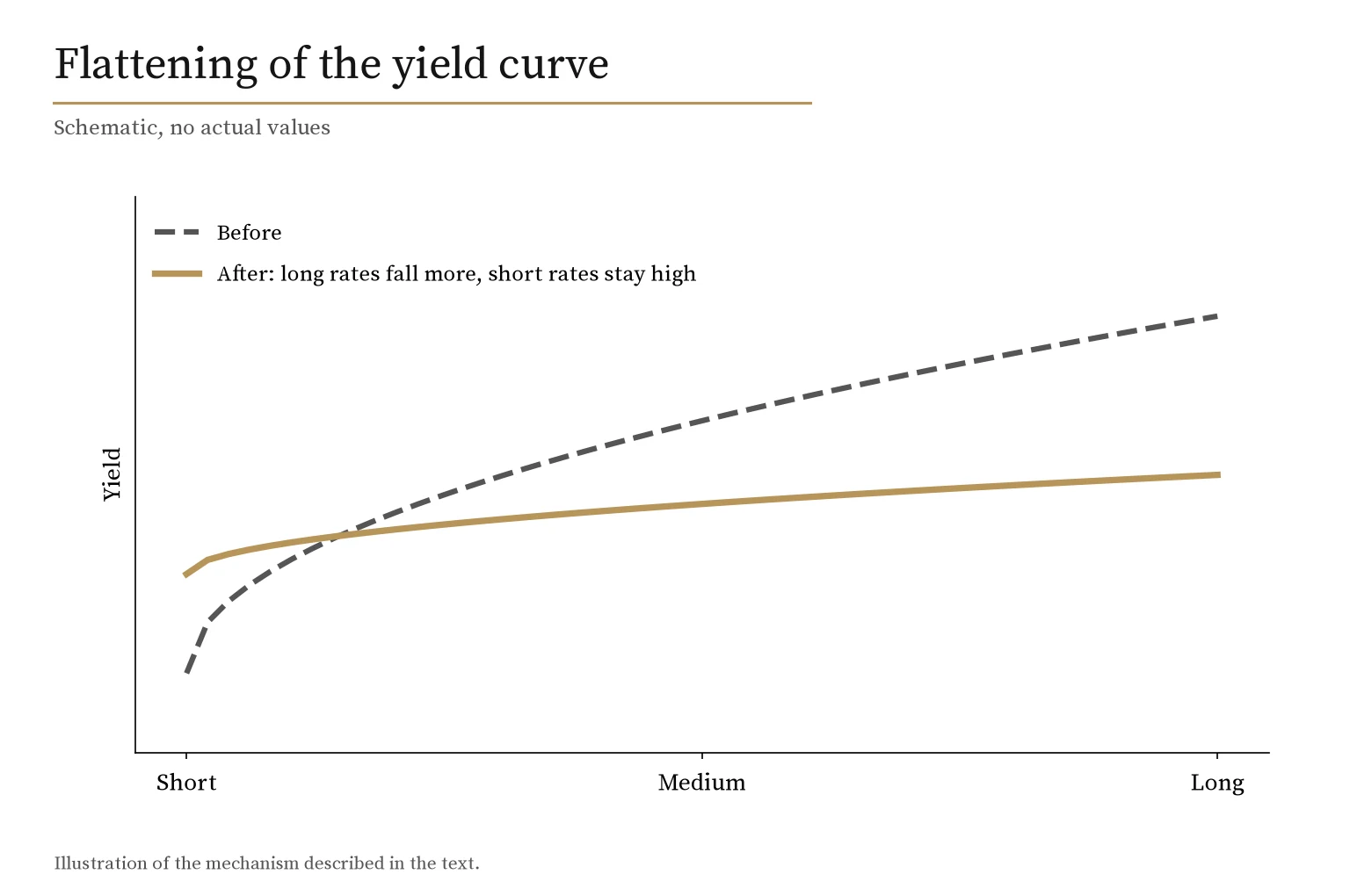
The fiscal effect is also more complex than a simple expectation of slower spending growth. A decline in long-term yields, combined with a weaker dollar and a persistent inflation premium (sustained by the war in Iran), changes real interest rates. If the decline is stronger at the long end of the curve while short-term rates stay higher because of energy pressure, the curve flattens or even inverts further. The deficit remains around 6% of GDP (6.2% for fiscal 2026), and interest payments already exceed defense spending. Bessent promises a deficit of about 3% of GDP by the end of the current administration’s term, but the market does not expect serious fiscal consolidation, only slower spending growth. Real rates and the shape of the yield curve, however, independently affect how attractive stocks are relative to bonds.
For crypto, the decline does not come only from delayed legislation or the risk of investigations into deals linked to the Trump administration. The pressure on prices comes mainly through real money flows. Bitcoin ETFs were already under pressure before the election: on October 30 and November 2 alone, net outflows totaled about $1.04 billion. Part of institutional demand is sensitive to political risk over a horizon of two to three quarters, while another part is more conservative. Flows can also slow for reasons unrelated to the election, such as investors wanting to reduce risk or a change in the correlation with the Nasdaq. Comparing bitcoin ETF flows with flows into other risk assets would help separate political risk from broader de-risking. In earlier periods of regulatory uncertainty, ETF flows slowed for several quarters before recovering, provided the long-term framework did not change materially. The observable markers here are changes in weekly or monthly ETF flows, comments from the large players in the sector, and regulatory signals from specific agencies. If flows slow while the price recovers, that would suggest the sensitive institutional segment is smaller than assumed, or that the slowdown has several causes. If both slow while flows into other risk assets do not slow to the same extent, political risk is more significant. Historical averages after midterm elections show that bitcoin has often recovered over the following 12 months, but those recoveries happened in an environment where regulatory uncertainty was not so closely tied to a specific political conflict.
The historical context also deserves attention, but it should not drive our decisions. Since 1950, the S&P 500 has been higher 12 months after all 19 midterm elections, with an average return of about 15%. A divided Washington has often coincided with better, not worse, market results. Between the poles of “the slowdown materializes quickly and the correction is deeper” and “the slowdown does not materialize and a recovery is more likely” lies the middle scenario, in which delays and rising project costs do not stop capital spending, but spread it over time and raise the cost of capital for the projects themselves. In that case, the valuations of infrastructure players adjust while end demand for computing power stays high. This scenario becomes more likely if new permits slow but already contracted projects continue, and if some early projects relocate without meeting immediate resistance in the host states.
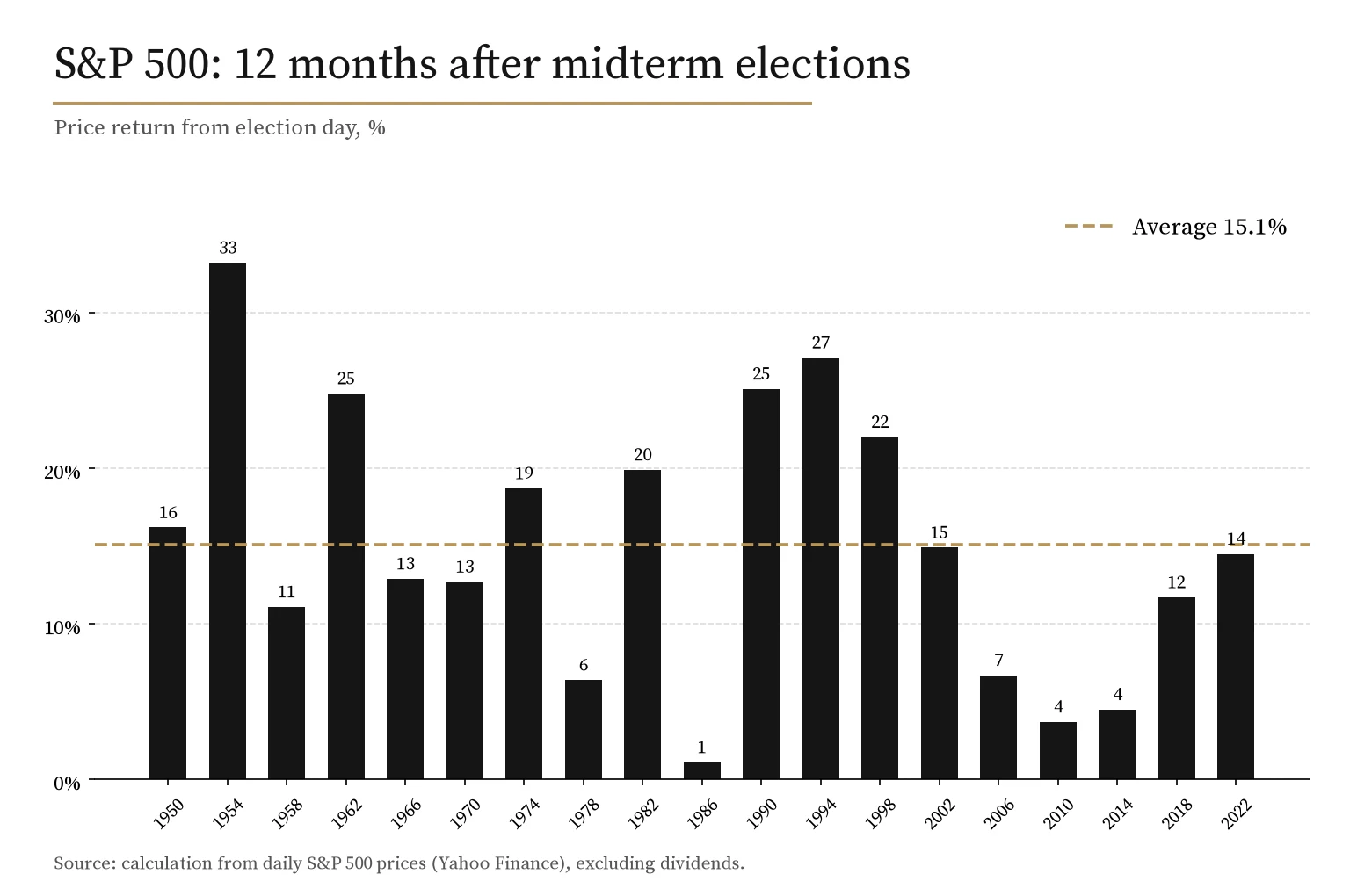
| Period | Average return | Positive cases |
|---|---|---|
| All since 1950 (19 elections) | ~15% | 19 of 19 |
| Weakest (1986) | ~1% | - |
| Strongest (1954) | ~33% | - |
Part of the market already treats slower new permits in Texas as likely, which shows in the relative underperformance of data center operators by about 1.5-2 percentage points. What remains open is whether the slowdown will spread to projects with signed contracts and whether relocation to other states will be fast enough to preserve the overall pace of capital spending. The middle scenario would be refuted if, over the next six months, concrete administrative decisions in Texas halt advanced projects with signed power contracts, if court rulings confirm a serious moratorium without significant exceptions, if the data show gigawatts actually cancelled or moved to other states in volumes exceeding the early stage, or if the pace of orders to equipment suppliers declines persistently.
The war in Iran works in two different ways. One is the direct effect on inflation and on consumers’ real incomes; the other is the effect on the margins of companies that are large consumers of electricity. If power prices stay high at the same time as permits slow, the hit to the returns of data center projects is twofold and does not affect all technology companies equally.
The market’s first reaction is already a fact and is reflected in prices, but the question is whether a second wave will follow once the concrete decisions of the new governors in Texas, Georgia and Ohio become clear and once it is visible what procedural, legal, local and federal constraints they face. If the decisions confirm delays and higher costs that spread capital spending over time, the correction in the infrastructure segment may last longer. If the decisions prove more flexible, or if projects relocate in significant volume without immediate resistance in the host states, the historical pattern of recovery remains more likely. The market has priced in part of the risk, and whether it gets confirmation depends on the observable steps.
In “War and Peace”, Tolstoy shows how great events seem decided at the moment of the clash, and only later does it turn out that the outcome was determined by thousands of smaller decisions made long before the day of the battle. The market’s first reaction is already a fact. Whether it turns into a lasting repricing or remains an episode depends on decisions that have yet to be made on the political stage.
Frequently asked questions
Should a portfolio be rebalanced right after the election?
No. The first reaction is already reflected in prices. Rebalancing makes sense only if concrete decisions confirm a longer stretching of capital spending over time, or if energy prices stay high long enough to hit the margins of data center operators.
Which Texas data center projects are most exposed?
The most exposed are early-stage projects without signed power contracts. Projects with power already secured can absorb delays and higher costs, but are cancelled less often. Between one third and one half of the “flexible” projects, according to estimates based on publicly announced plans and conversations with developers and consultants, could move to states with more grid headroom.
How does the war in Iran affect technology companies differently?
High fuel prices raise inflation and reduce real incomes, while also increasing the cost of electricity for data center operators. Combined with slower permitting, the hit to returns is twofold. Power producers can benefit if new grid capacity is not delayed, which is already reflected in their relative performance of about 1.5-2 percentage points.
Why don’t historical returns guarantee the same for bitcoin and ether?
The current cycle depends more heavily on ETF inflows. Part of institutional demand is sensitive to political risk over the next two to three quarters, but flows can also slow for other reasons. A comparison with flows into other risk assets would help show whether political risk is higher. If flows slow while the price recovers, risk appetite is lower or the slowdown has another cause. If both slow while other risk assets do not, political risk is significant for the sector.
What shape of the yield curve would be most unfavorable for stocks?
A situation in which long-term rates fall more sharply while short-term rates stay high because of expensive power and fuel. The inflation premium does not disappear and the yield curve flattens.
Important notice
This article is for information and education only. It is not financial advice, an investment recommendation or professional advice of any kind. The views expressed are the author’s personal opinions and are not recommendations to buy, sell or hold securities, assets or investments. Investing involves substantial risk, including the possible loss of all capital. Past performance is not a guarantee of future results. Each reader should conduct independent research, consult a qualified financial adviser and weigh financial circumstances, risk tolerance and investment objectives before taking any decision. The author and borsite.net accept no liability for any loss arising from the use of the information in this article.