


Monday, 21 September 2026. Nasdaq at a record. The following wind did not help every ship on Wall Street.
The ancient mariner trusted the wind, at times more than the chart. A following wind carried the ship without tearing the canvas; a headwind drove it back to shore; a calm left it in open water until the stores ran out. That is why the deck had customs that looked like superstition from the beach and like law on board. No one whistled. A whistle called the wind, and the wind that answered did not come as a fair breeze. It came as a gale. The man who wanted a light air in a calm knew the measure. The man who whistled out of impatience paid with torn sail, and sometimes with a wreck.
On Monday a following wind blew for only part of the artificial-intelligence sector. Cheaper oil and lower yields encouraged investors, and Muse filled Meta’s sails and those of the processor makers. Arm, Intel, Meta and AMD led the session. Nvidia and Microsoft were already running before the last wind - model training and cloud services - and this breeze did not add speed. Anyone who expected the same weather for the whole sector broke the old rule and whistled on deck.
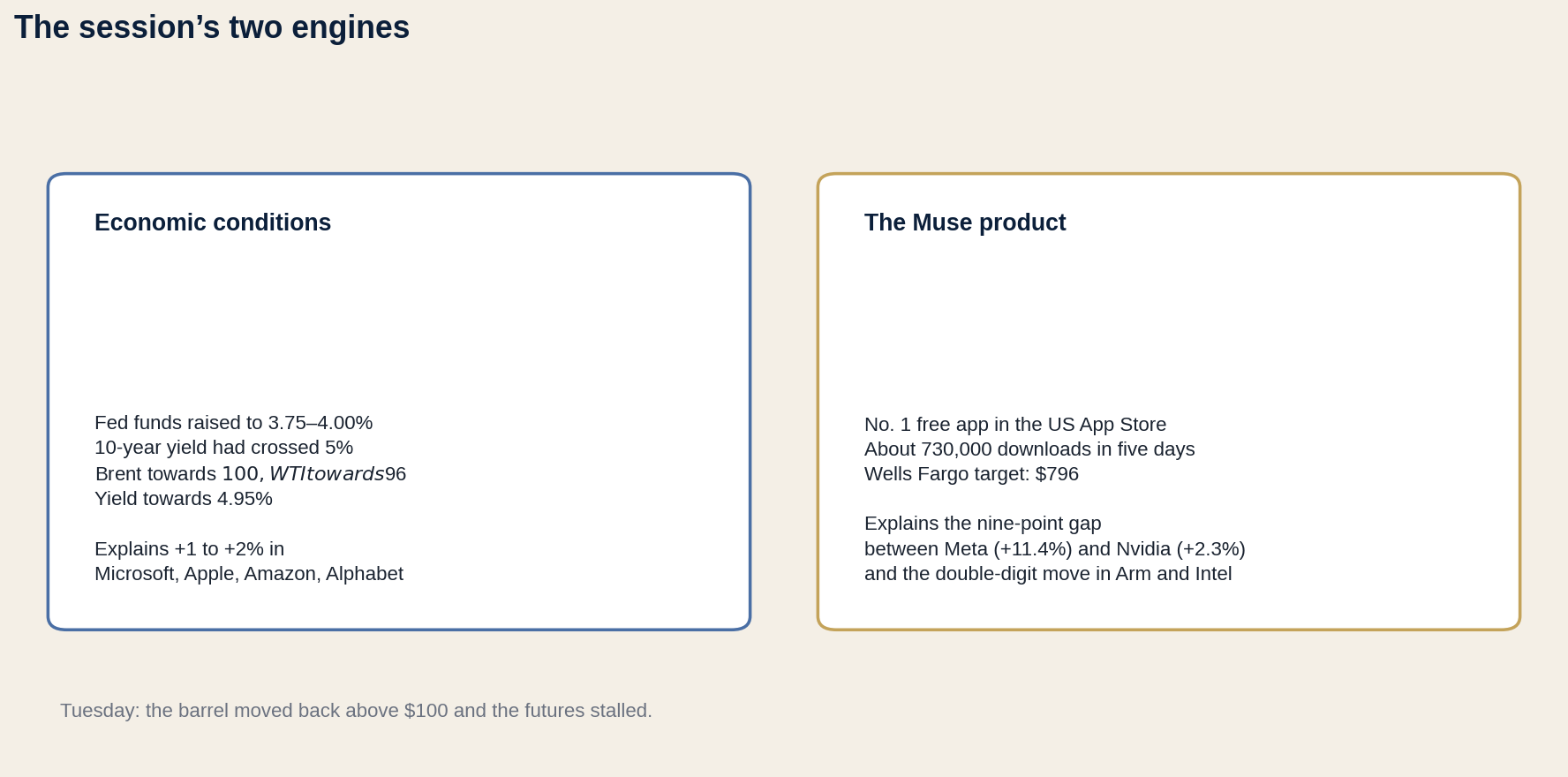
Nasdaq closed at a record. The S&P 500 added 1.5% and came within 0.4% of its August high; the Philadelphia Semiconductor Index, SOX, rose 4.3% to 12,433. Nvidia added 2.3%. The nine-percentage-point gap between Meta and Nvidia is not a function of the oil price but of Muse. On Tuesday Brent moved back above $100 and the futures stalled. Had Monday been the start of a new AI cycle, the index would not have wilted when oil rose.
Last Wednesday the Federal Reserve raised the funds rate to 3.75-4.00%, after the 10-year Treasury yield had crossed 5%. On Monday Brent slipped towards $100, WTI towards $96 and the 10-year towards 4.95%. That lift nudged Microsoft, Amazon, Alphabet and Apple higher without any company-specific news. It does not explain the double-digit gains among the processor makers.
What Meta did
The shares closed at $741.25, up 11.4% - the company’s strongest session since April 2025. Wells Fargo raised its price target from $640 to $796. Analyst Ken Gavrelski wrote that Meta now has a product, not merely a data-centre bill. Options volume rose: the market bought not only the stock but options on the next move.
Muse launched on 8 September. Sensor Tower counted about 730,000 downloads in five days. On Monday the app sat first among free titles in the US App Store, ahead of ChatGPT, Gemini and Claude. The agent sends mail, books travel, fills forms and buys once it has access to the accounts. Paid plans run from $20 to $100 a month.
Meta and Microsoft both trade at about 28 times earnings. The 11.4% rise in one and the 1.6% rise in the other are not a function of that multiple. The market has at last seen a consumer service at Meta, while Microsoft’s Azure cloud is already in the price.
Connect is on Wednesday and Thursday. After the jump, the average analyst target sits close to the market price; Wells Fargo still sees about 7% to $796. If the company does not show user growth and higher revenue, Monday’s move will remain a one-day re-rating.
Why Intel added 12.7%
Intel closed at $122.36. Turnover in the stock ran about 60% above average; options volume nearly tripled, and call contracts dominated. Tigress Financial set a $145 target. The company remains about 13% below its June high of $140.94, after a gain of more than 200% since January. This is a catch-up in an already expensive sector, not a cheap stock.
Three factors now govern the tape. First, Muse lifts demand for the server processor, and Wedbush named Intel and AMD as the firms that can meet it. The market is again trading the rumour that SK Hynix is considering a lease or a joint venture at Intel’s Ohio plant; attention is on 18A and on a stronger Xeon. Reports that Intel is filling only about half of its orders are read as demand above capacity and as room for a higher price. If shipments do not rise, the unfilled orders will not become revenue. Intel is worth about $640 billion, Nvidia $5.4 trillion; AMD is already at $1 trillion. The market is re-rating Intel’s server processor and its contract chip production, not the leader in model training.
AMD crossed $1 trillion
AMD closed at $615.52, up 10%, and for the first time passed a $1 trillion market value. It is the fourth US chipmaker through that threshold after Nvidia, Broadcom and Micron. The stock is up 185% since January. Meta accounts for about 5.5% of revenue.
The price now sits at the average analyst target of about $616. Expected earnings are capitalised about 41 times: below the 10-year average of 44 and above Nvidia’s recent multiple of about 16. In this session the market priced AMD as a supplier both for AI agents and for accelerators. Further gains require new analyst targets, not the same level.
What the market bought
The market priced the server processor, part of the memory stack and the consumer agent, not the training of large models. Nvidia lagged Arm, Intel, AMD and Qualcomm. Corning added about 6% as a supplier of optics and glass for data centres. Micron and TSMC already stand above $1 trillion and did not drive Monday’s tape. What traded was the agent and the architecture that runs it.
Some of the money came out of short positions and the names that led through the summer and went into the processor makers. The flow into Intel and Meta call options shows investor interest in the development of those two businesses, not merely a shift from one holding to another. SOX marked a fifth consecutive up session. This is rotation inside the AI trend. A flow into the whole sector will show if users stay after Connect and if oil does not push the 10-year yield back to 5%.
The big winners and the big laggards
The winners sell an agent or a processor. The laggards sell cloud services and model training. None of the Magnificent Seven closed lower. The difference is who has a new market story to tell and who was relying on cheaper crude.
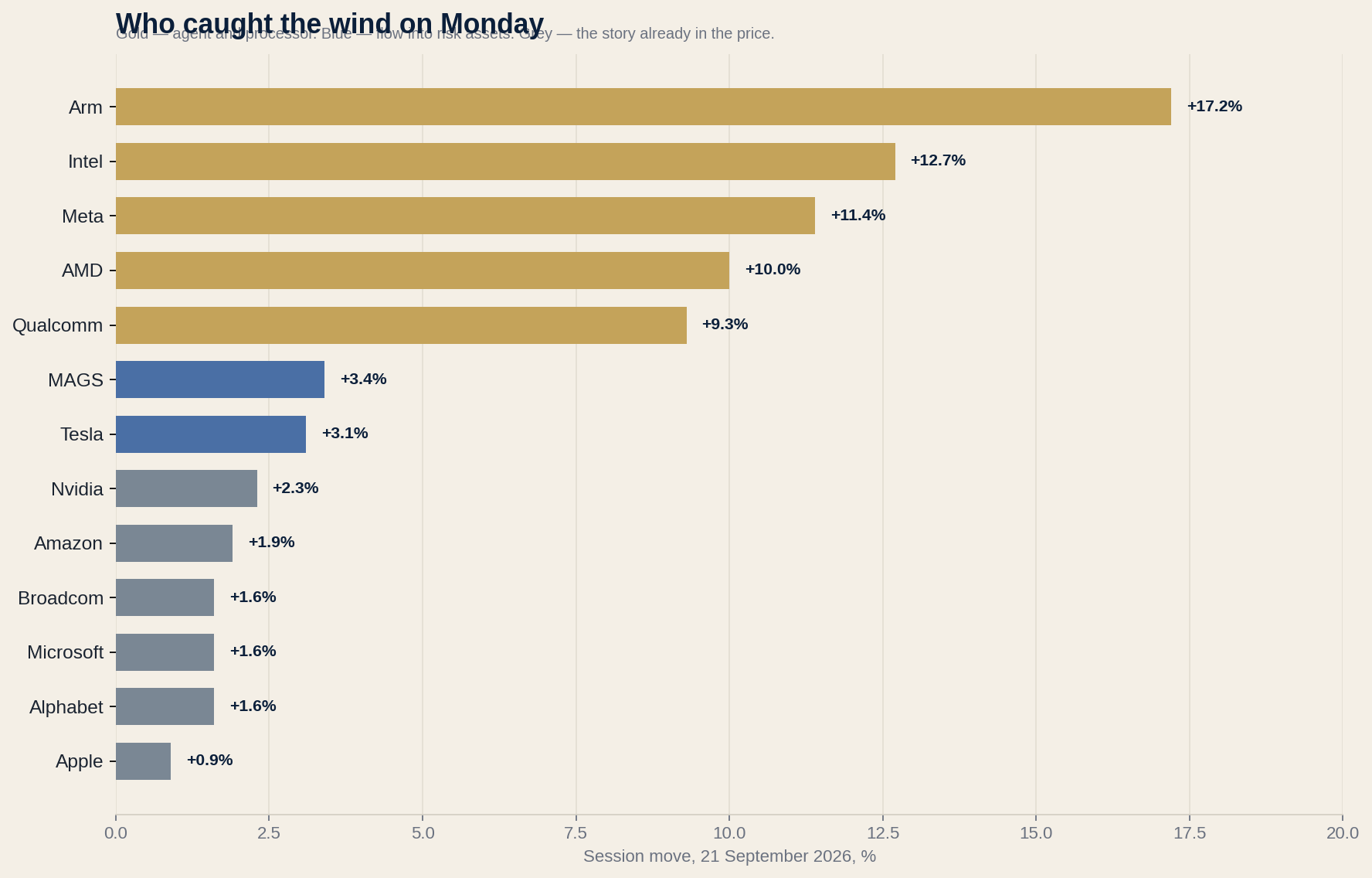
Table 1. Close on 21 September 2026
| Company | Close 21.09 | Day’s move | What was traded |
|---|---|---|---|
| Arm | $322.90 | +17.2% | processor time for agents |
| Intel | $122.36 | +12.7% | processor for agents; Ohio-plant rumour |
| Meta | $741.25 | +11.4% | Muse and the Wells Fargo target |
| AMD | $615.52 | +10.0% | $1 trillion; Meta is the second-largest customer |
| Qualcomm | $194.23 | +9.3% | rotation into the processor |
| MAGS | $72.89 | +3.4% | Magnificent Seven ETF; almost all of the gain is Meta |
| Tesla | $375.63 | +3.1% | general flow into risk assets, not Muse |
| Nvidia | $227.38 | +2.3% | model training already paid for |
| Amazon | $258.45 | +1.9% | cloud without a new consumer line |
| Broadcom | $362.66 | +1.6% | the custom accelerator was not the session’s theme |
| Microsoft | $501.61 | +1.6% | Azure already in the price |
| Alphabet | $354.97 | +1.6% | Gemini trailed Muse |
| Apple | $338.98 | +0.9% | unconfirmed rumour of an in-house server |
If at Connect Meta does not show user growth, the trend in the stock can reverse: Meta and the processor makers correct, and Nvidia and Microsoft lead the trend again.
Risks and opportunities
At Meta the risk is the conference itself. The market has already capitalised the downloads and part of the options bid. What is needed is growth in active users and growth in paid services. At Intel the risk is that the Ohio talks remain a rumour and that the 18A node slips. At AMD the risk is the multiple. The company trades at about 41 times expected earnings and has no buffer if AI agents do not lift demand for the server processor the way they lifted demand for the graphics accelerator. At Arm the risk is the one-day gain of 17%: the company sells a licence to an architecture, not the finished server.
The common risk is the policy rate and oil. If in October the Federal Reserve raises rates again and the barrel holds above $100, technology valuations will come back under the pressure seen after the Warsh meeting. On Monday energy stocks and AI stocks moved in opposite directions: oil fell, technology rose. On Tuesday the directions reversed.
The opportunity is limited and depends on three things. If agents truly load server processors, Intel, AMD and Arm earn from demand that Nvidia does not cover alone with graphics accelerators. If Muse brings money from subscriptions and from advertising, Meta earns outside News Feed ads. If on Thursday Trump and Xi confirm shipments of chips and of critical minerals, the sector keeps political support for one more session.

What to watch through year-end
Through the rest of this week the calendar is tight. On Wednesday the preliminary purchasing managers’ indices for the United States, the United Kingdom and the euro area are released - the first figures after the Fed meeting. Connect opens the same day. On Thursday comes the meeting between Trump and Xi.
A following wind does not help every ship in the ocean. Its gusts fill the sails that sit at the right angle to it. Until Meta Connect, until the activity indices are published and until Thursday’s meeting, the conditions do not change: the Fed funds rate, the oil price and whether users return to Meta. Anyone who treats the whole fleet as one trade mistakes a calm for the right course. Anyone who whistles up a new cycle calls more wind than the masts will bear. The custom is simple. The wind is not summoned. One waits. And one watches which sails are set and trimmed.
Questions after the article
Why did Arm, Intel and Meta rise on Monday while Nvidia barely moved?
The market priced Meta for the arrival of the Muse agent and the processor that has to run it. Nvidia’s price already capitalises model training. The nine-point gap between Meta and Nvidia does not come from the oil price. It comes from the new services and products of those companies.
Is this a new cycle in artificial intelligence, or rotation inside the same trend?
This is rotation inside the same trend. Cheaper crude and lower yields eased the multiples across the technology sector, which is why Microsoft, Apple and Amazon are modestly higher without company news. On Tuesday oil moved back above $100 and the futures stopped rising.
What does Meta have to show at Connect?
Growth in active users. The market has already paid for the downloads of the new application and for part of the interest in the options. What is needed are people who open the app again and growth in users who pay $20 to $100 a month for Muse. Without that, Monday’s gain remains a one-day re-rating.
Are Intel and AMD still cheap after the jump?
In absolute terms, no. Intel remains below its June high but is up more than 200% since January. AMD closed at the average analyst target and trades at about 41 times expected earnings.
What will the market watch through year-end?
Three things: whether users return to Meta after the figures from Connect, Federal Reserve policy after October, and the oil price against the diplomacy around the Strait of Hormuz.
Important notice
This article is for information and education only. It is not financial advice, an investment recommendation or professional advice of any kind. The views expressed are the author’s personal opinions and are not recommendations to buy, sell or hold securities, assets or investments. Investing involves substantial risk, including the possible loss of all capital. Past performance is not a guarantee of future results. Each reader should conduct independent research, consult a qualified financial adviser and weigh financial circumstances, risk tolerance and investment objectives before taking any decision. The author and borsite.net accept no liability for any loss arising from the use of the information in this article.