


Micron has sold the memory and recognized the revenue. Amazon uses the chips and is looking for someone else to own them. The two are not the same deal. The question that joins them is who owns the chip, and who pays for the use of it.
For the quarter ended September 3, Micron recognized $54.23 billion of revenue, against $41.46 billion in the previous quarter and $11.32 billion a year earlier. Customer deposits for memory still being made were $12.7 billion at quarter-end, and the revenue was recognized on delivery, so the sale is already paid. Amazon uses Grace Blackwell chips in its data centers and means to transfer them to a separate company whose owner is, for the moment, unnamed. Until that transfer is signed, the cost of the computing power still sits on Amazon’s books. On Friday the Bureau of Labor Statistics reported 29,000 new jobs, against about 90,000 expected. Futures put a lower probability on an October increase, while members of the Federal Reserve still project at least one further increase by the end of the year.
In 335 BC Aristotle returned to Athens and, until his death in 322, led the school at the Lyceum, where he composed the Politics. The work comes down to us as notes on the polis. In Book I, chapters 8 to 10, he separates use from acquisition. A house is owned so that people may live in it. Acquisition serves a life when a household obtains land and goods only so far as it needs them. He sets apart the loan whose profit lies in the money itself, because the lender does not give the household a thing it needs. He seeks a profit on his money.
Amazon uses Grace Blackwell chips in its data centers. It has not said which company would own them, if it decides to transfer them to a separate company at all.
Revenue is reported by unit
Micron does not split the report into products and services. It reports four business units and two kinds of memory. Revenue for the quarter ended September 3 was $54.23 billion. For fiscal 2026 it was $133.2 billion, 256 percent more than the $37.4 billion of 2025.
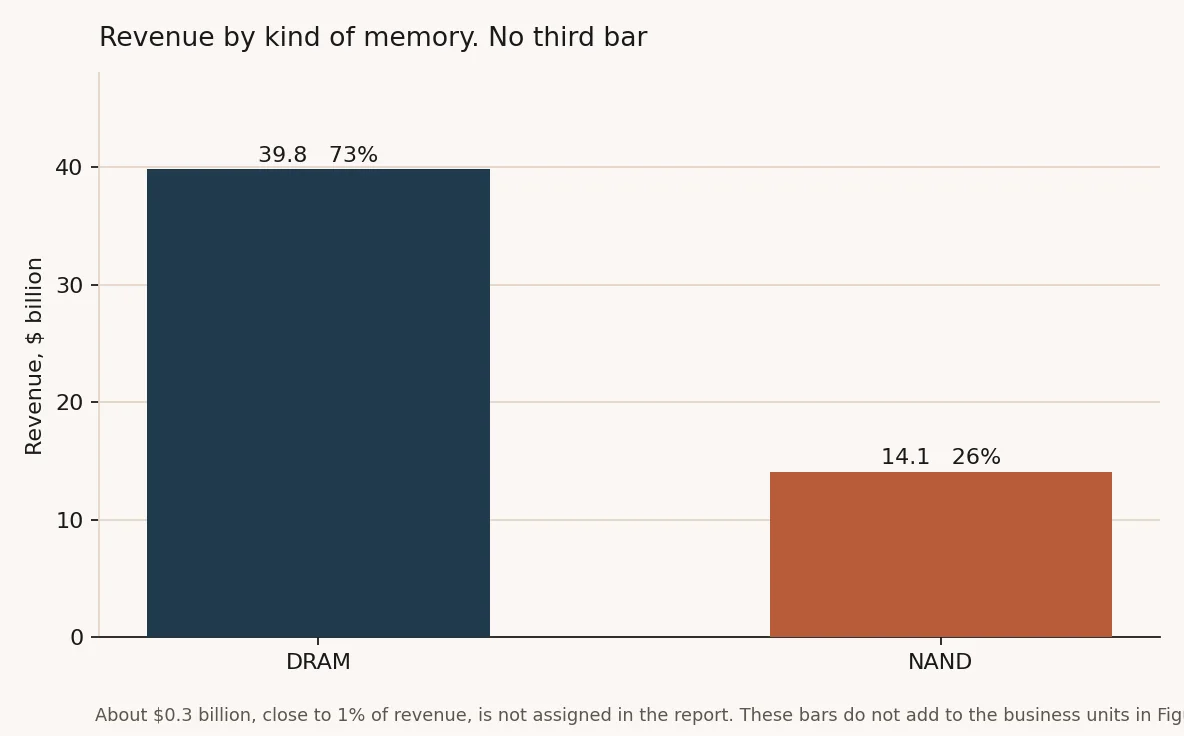
Of the quarter’s $54.23 billion, DRAM contributed $39.8 billion, or 73 percent, and NAND $14.1 billion, or 26 percent. The remaining $0.3 billion or so, close to 1 percent, is part of the same reported revenue, but the company does not say where it came from. DRAM prices rose by about 15 to 19 percent from the previous quarter, and NAND prices by about 30 percent. Bit shipments rose by a mid-single-digit percentage in DRAM and by about 10 percent in NAND, so the increase came from price, not from the volume sold.
Table 1. Revenue and profit by business unit
| Unit | Revenue, $ bn | Share | Gross margin | Operating margin |
|---|---|---|---|---|
| Core data center | 18.0 | 33% | 90% | 85% |
| Cloud Memory | 16.3 | 30% | 83% | 76% |
| Mobile and client | 13.1 | 24% | 90% | 88% |
| Automotive and embedded | 6.8 | 13% | 84% | 79% |
| Total | 54.2 | 100% | 87.0% | 82.3% |
The consolidated gross margin of 87.0 percent and the consolidated operating margin of 82.3 percent are non-GAAP, outside generally accepted accounting principles. Gross margins by unit are those in the prepared remarks. Operating margins by unit are the figures carried in the source article, and they do not add up to the consolidated 82.3 percent. Cloud Memory is the name of the unit, not a service. Officially the four units are the Core Data Center, Cloud Memory, Mobile and Client, and Automotive and Embedded business units.
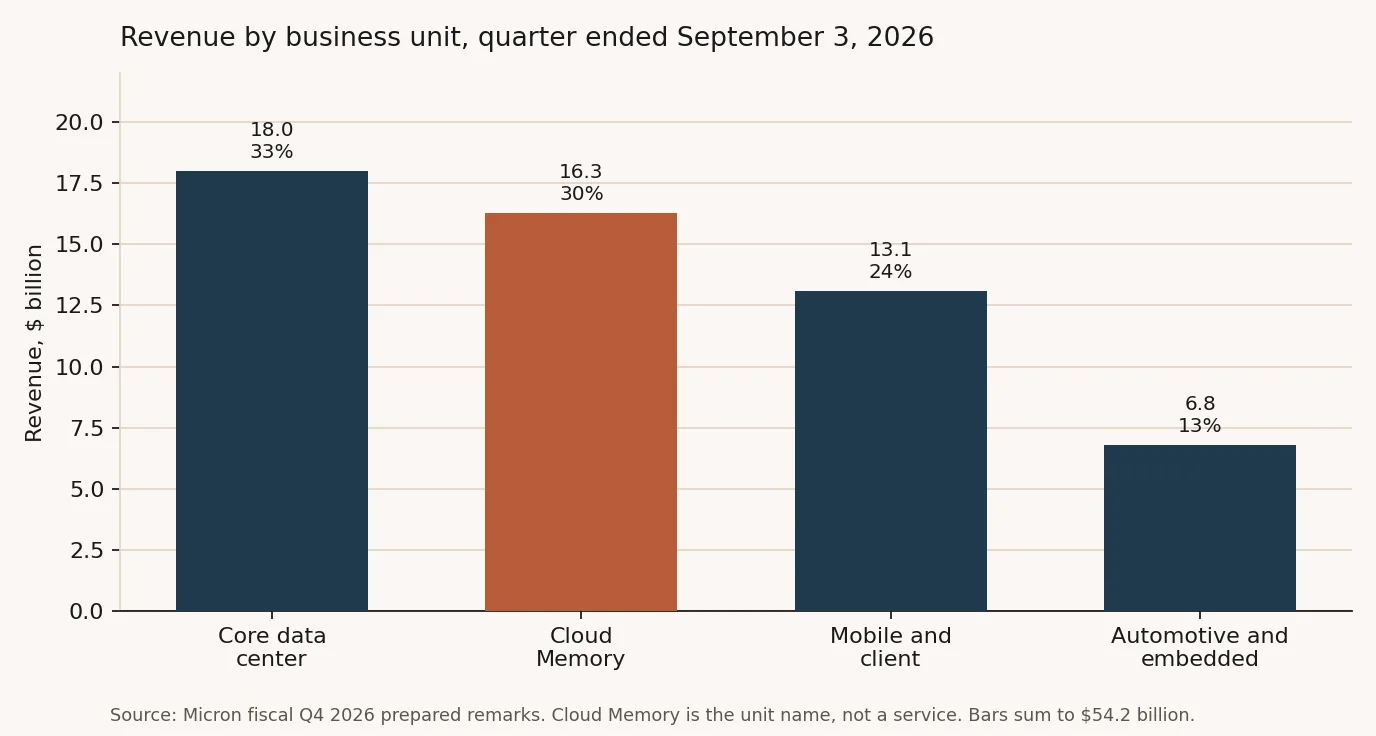
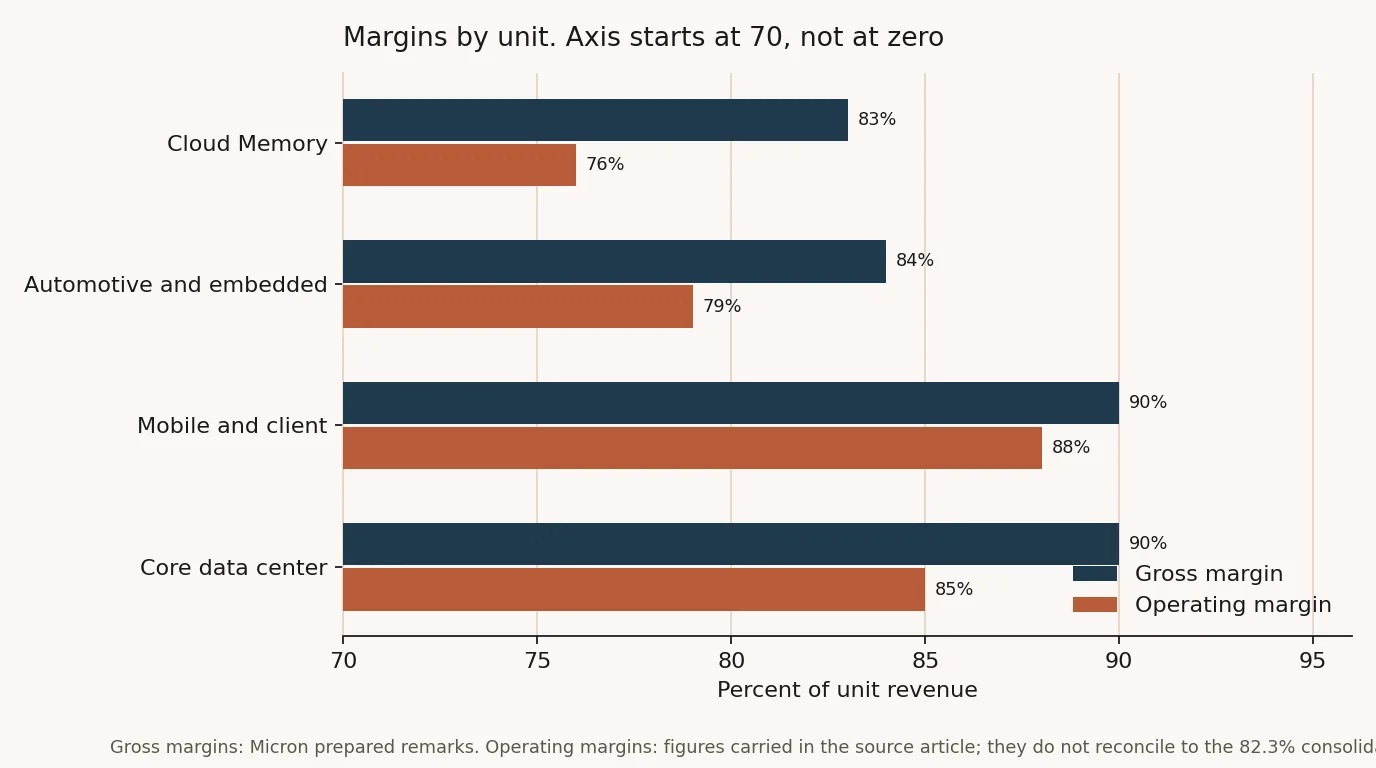
Table 2. The two kinds of memory
| Kind | Revenue, $ bn | Share | Price vs prior quarter | Shipments |
|---|---|---|---|---|
| DRAM | 39.8 | 73% | about 15-19% | mid-single-digit rise |
| NAND | 14.1 | 26% | about 30% | about 10% |
| Not assigned | about 0.3 | about 1% | not given | not given |
Table 2 does not add to Table 1. Units are a cut by customer. DRAM and NAND are a cut by product. The unassigned 1 percent has no bar in Figure 3.
The company does not publish a cost of goods for DRAM and for NAND, only a gross margin and profit by unit. On revenue of $54.23 billion, gross profit under generally accepted accounting principles was $47.05 billion, or 86.8 percent, and the non-GAAP figure was 87.0 percent, 210 basis points above the previous quarter and against 45.7 percent a year earlier. Cost of goods was the remaining $7.2 billion or so. For the full year the gross margin was 81.1 percent, 40 percentage points above fiscal 2025. That 81.1 percent is the year’s margin, not a growth rate.
Operating expenses for the quarter were $2.57 billion on a non-GAAP basis, $1.1 billion higher, mainly from performance pay across the workforce and from $300 million of public contributions. Operating profit was $44.64 billion, or 82.3 percent of revenue. Non-GAAP net income was $38.40 billion, or $33.42 a share, against $3.03 a year earlier. On the first day after the report the shares traded around $1,097, after $1,065.11 in the previous session.
The margin is different in every unit. The core data-center unit has a gross margin of 90 percent and an operating margin of 85 percent; mobile and client, 90 and 88; automotive and embedded, 84 and 79. Cloud Memory has 83 and 76, because the higher share of HBM raises the cost. The weakest margin is in the unit that sells the memory for graphics processors.
Management says the performance pay has gone into inventories and will compress the gross margin in the first quarter of fiscal 2027, without giving the amount. That is why it offers 86.25 percent as a floor for the year, not as a ceiling. Part of the 87 percent margin comes from selling goods already made at a higher price, and the report does not say how large that part is. If the price stops rising, those goods will reduce the margin in later quarters, not in the quarter already reported. The forecast of $38.15 a share for the current quarter should not be multiplied by four and treated as a year, because the first quarter carries the lower margin and management expects a higher one after it.
Customer deposits fund the fabs. They are not profit.
Debt is $5.2 billion, about $500 million lower, with an average maturity of about nine years. Cash and investments are $73.5 billion, the net cash position is $68.3 billion, capital spending is $10.8 billion, cash from operations is $44.0 billion, and free cash flow is $33.2 billion. Fabrication plants, the fabs, are what the customer deposits are financing.
Table 3. Position at the end of the quarter
| Line | Amount | What it is |
|---|---|---|
| Cash and investments | $73.5 billion | the balance |
| Debt | $5.2 billion | down by about $500 million |
| Net cash | $68.3 billion | cash after debt |
| Customer deposits | $12.7 billion | already inside cash; returned if the minimum purchase stops |
The lines do not add. Customer deposits are already inside cash and are not added to it.
Table 3b. Flow for the quarter, and the contractual commitment
| Line | Amount | What it is |
|---|---|---|
| Customer deposits received | $12.3 billion | cash from financing, not free cash flow |
| Free cash flow | $33.2 billion | after customer deposits are taken out |
| Capital spending | $10.8 billion | for the quarter |
| Contractual commitments | $32 billion | an obligation, not cash; not the $22 billion of advances in the press |
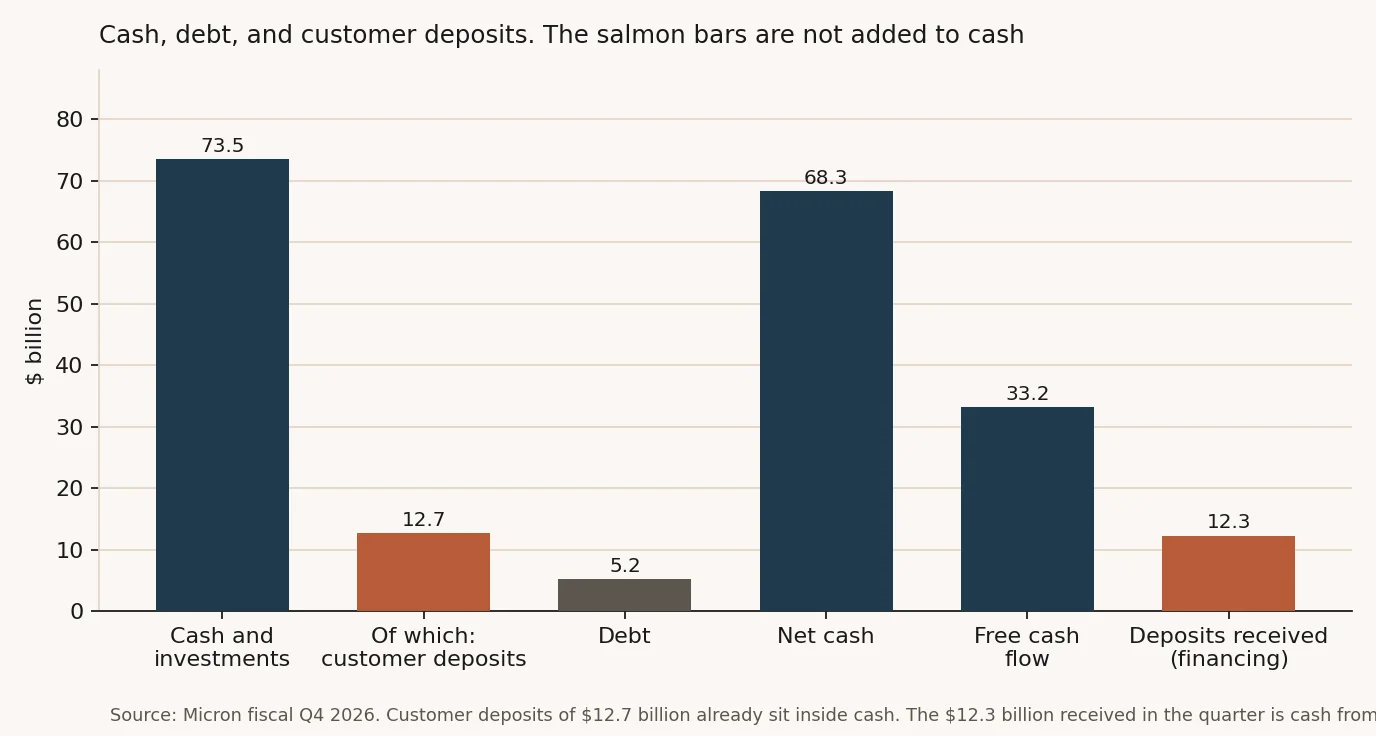
In the company’s notes, customer deposits are $12.7 billion. During the quarter $12.3 billion came in, and that inflow sits in cash from financing, not in free cash flow. The deposits are returned to customers toward the second half of the contracts if the minimum purchases have been met. Financial commitments under the strategic contracts have risen to $32 billion, almost all of it in deposits and letters of credit. That is not a further $32 billion of cash on top of the $12.7 billion. It is an obligation under the contracts: how much the company has undertaken to provide, not a second stock of cash. Publications outside the report speak of $22 billion in advances and about $100 billion of minimum obligations under 14 contracts. Those sums do not match the notes, and they do not enter the balance sheet. Advances, in this article, means only that outside figure.
The customer pays before receiving the memory, and with that money Micron builds the fabs. If the minimum purchase stops, the customer deposit goes back and the company has to fund the fab. These are potentially harder terms than servicing $5.2 billion of debt, because the debt is owed to creditors with a stated maturity, while a customer deposit can be called back even after the fab has been built and the money invested in it.
Remaining obligations to perform are about $150 billion under 26 contracts. Under them Micron must deliver memory and the customers must buy it, and those deliveries are more than 35 percent of revenue through 2030. On three quarters of these obligations the price sits inside a band, most of them with a floor and a ceiling. On one quarter the price is reset from time to time to the market. Management values the sum at the contracted volumes and the minimum prices, and calls it conservative. The price floor holds while the customer meets the minimum purchase, and it falls away if the customer stops. The company does not say at what price that floor stops earning a profit, and it does not name the customer. Without the name, the share of revenue remains a percentage, and the risk of a single buyer cannot be seen. Without HBM’s share of the $54 billion, it is not clear who bought the scarce memory this quarter.
In 2025 SK Hynix held about 60 percent of the HBM market, as Nvidia’s principal supplier of HBM3E; Samsung held between 17 and 35 percent, depending on the generation; Micron held between 11 and 21 percent. This quarter’s report does not give the current market share. It gives the price and the margin. Cloud Memory’s margin of 83 percent is below the 90 percent of the core data-center unit. The product in heaviest demand is not yet the product with the highest margin in the unit.
What management said, and what it did not
The forecast for the current quarter is revenue of $61.5 billion, plus or minus $1.5 billion; a gross margin of about 86.25 percent; operating expenses of about $2.06 billion; and earnings of $38.15 a share, plus or minus one dollar. For the year a record is expected, and revenue growth in every quarter. For calendar 2027 the contracts cover most of the HBM bits, at a higher price, and the margin against ordinary DRAM is narrowing. The company is working with Nvidia on the first custom HBM4E.
The prepared remarks give no share of HBM in revenue, no date on which a particular customer’s deposit is returned, and no price at which the floor stops earning a profit. Management does not see when supply and demand will balance, and it expects supply in fiscal 2027 and 2028 to lag demand by more than it did in 2026. The same company had a gross margin of 45.7 percent a year earlier. It also expects unit volumes in computers and phones to fall by a double-digit percentage, and memory in servers to grow more slowly, because supply is short.
Capital spending in the first half of fiscal 2027 is about $25 billion, and in the second half it rises faster, mostly in construction of fabs. New fabs add volume with a lag of several quarters. From December 9, 2026, the company intends to return all surplus cash flow to shareholders. The share next year is not valued by multiplying the $38 by four. It depends on whether customers honor the price floor, and on whether capital spending outruns the customer deposits.
The $8 billion is not a sale
On October 2 the Financial Times reported that Amazon had spoken with investors about transferring Grace Blackwell chips worth about $8 billion into a separate company that would lease them back. The chips number in the thousands, and Amazon already uses them in more than a dozen data centers in five states, among them Nevada and Virginia. The company would raise debt on the expectation that its rating would follow Amazon’s AA, and it would sell up to 10 percent of the equity to outside investors. The same report says Amazon would not own the chips. The two statements do not fit together until someone says who owns the other 90 percent of that company, and whether Amazon consolidates it. If Amazon consolidates the company, the chips have not left the group. If it does not, Amazon pays rent to an outside owner for chips it already uses. Amazon has not commented on the talks, and no contract has been signed.
Table 4. What the Financial Times reports, and what it does not
| Line | Reported | Missing |
|---|---|---|
| Asset | Grace Blackwell chips, about $8 billion | a buyer and a price |
| Place | more than a dozen centers in five states | the term of the lease |
| Debt of the company | a rating tied to Amazon’s AA | a guarantee from Amazon |
| Equity sold | up to 10 percent to outside investors | who owns the other 90 percent |
| Consolidation | the two statements do not fit | whether Amazon consolidates the company |
| Scale | about 4 percent of $200-220 billion of annual spending | a first step, or a ceiling |
There is no lease term, no written guarantee from Amazon on the company’s debt, and no word on who bears the residual value if the chip is written down. Grace Blackwell is due to be succeeded by Vera Rubin. Amazon says this generation should work for at least five years, while in similar cases banks write off a graphics processor over three to four years. Something of the kind has already been seen in the CoreWeave loan, which rested on contracted payments from customers, and in Nvidia’s guarantees of the chip’s residual value, which the market did not accept when that value was 25 percent of the price. The $8 billion is the latest attempt to take the chips off Amazon’s balance sheet by transferring them to a separate company, from which Amazon would go on using them for a rent. Amazon’s capital spending for the year is toward $200 billion to $220 billion, almost double 2025, mainly for AWS. Eight billion is about 4 percent of that spending, and the report does not say whether the sum is a first step or a ceiling.
A customer deposit and a rent to a separate company are not the same thing
Micron takes a customer deposit in order to deliver a good that has not yet been made: the money comes in, the revenue is recognized on delivery, and the deposit remains a liability to the customer. Amazon is looking for an investor who would own a chip the company already uses, and lease it back. One transaction finances a future fab. At Amazon the chips are already running in the data centers and would be transferred to a separate company so that they leave the balance sheet. Use continues in both cases. They leave the balance sheet only if Amazon does not consolidate that company.
Orders to Nvidia and to the memory makers are not being cancelled. It is not clear who would pay if the separate company became a party to the contract and AWS went on using the chips. If the payment stopped coming from that company rather than from Amazon, the seller would have revenue from a buyer that does not use the chip. At Micron that question is not yet on the table, because the customer deposit comes from the customer that buys the memory.
Firms are neither laying many people off nor hiring many
In September employment rose by 29,000, against an average of 45,000 over the previous twelve months and a forecast of about 90,000. Unemployment was 4.2 percent, against 4.1 percent in August. July was revised down by 31,000, to a loss of 10,000, and August down by 29,000, to 133,000, so the two months together are 60,000 weaker. Hourly pay was up 3.0 percent on the year. The share of people of working age in the labor force was 61.8 percent, 0.7 points below September 2025.
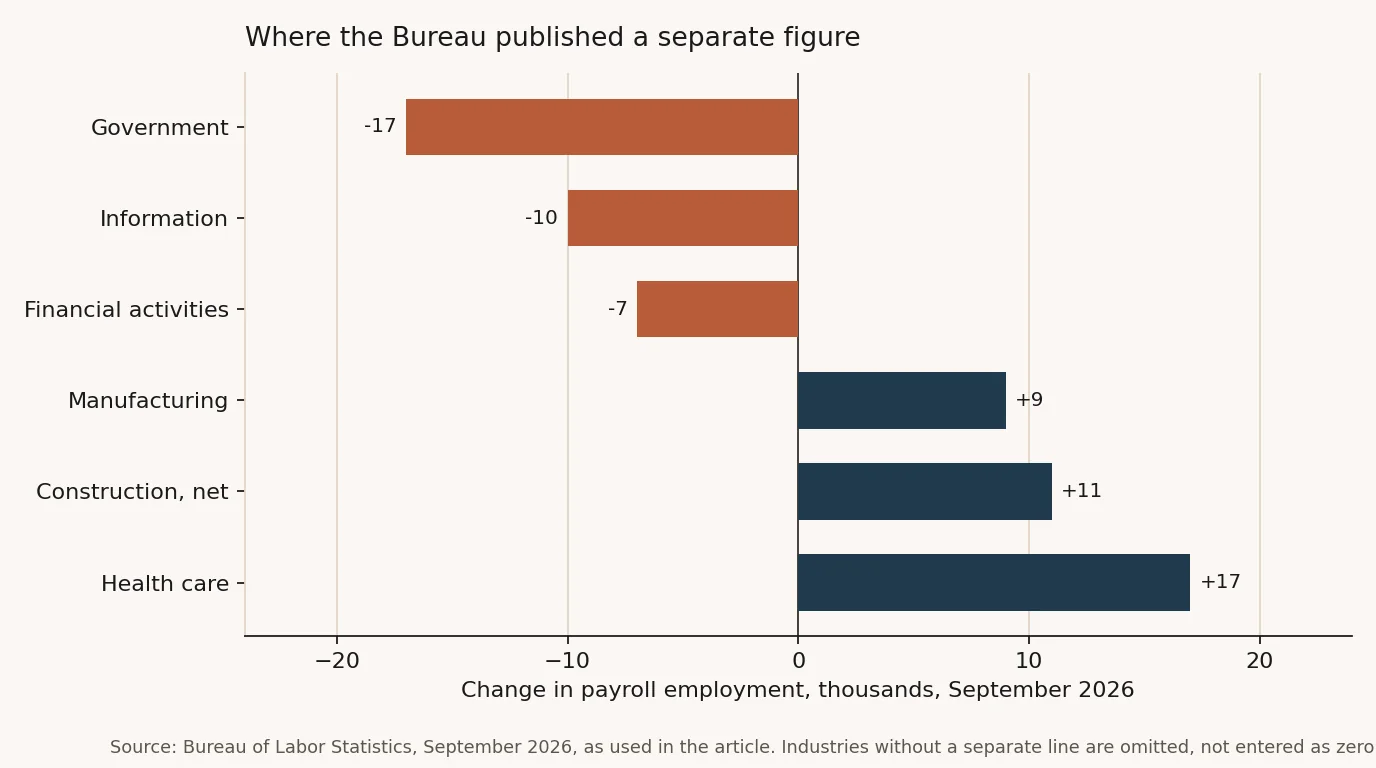
In September health care added 17,000 jobs, against a monthly average of 33,000 over the previous year. Construction added 11,000 on a net basis. That net figure is smaller than the gain inside it: nonresidential specialty trade contractors added about 12,300, while residential construction fell, which is why 12,000 can sit inside an 11,000 total. Manufacturing added 9,000 and stands 72,000 above the December 2025 low. Financial activities were down 7,000, and 129,000 below the May 2025 peak. Information was down 10,000, and government down 17,000. Against September 2025, private education and health care are about 516,000 higher, professional services 123,000 higher, and government 216,000 lower.
The figures for job openings are for August, because the September figures have not been published. Openings were 7.1 million and barely changed. Hires were 5.2 million. Separations were 5.1 million, of which 3.1 million were quits and 1.6 million were layoffs, with no change by industry. Firms are neither cutting many people nor opening many new jobs. In information, openings in August were 123,000, against 141,000 a year earlier.
The 29,000 new jobs can be read in two ways, and the two readings do not agree. Set against the forecast of 90,000, the month was weak. Set against the Federal Reserve staff’s estimate that, after the fall in immigration, fewer than 10,000 jobs a month are enough to keep unemployment from rising, 29,000 is not a collapse. Members who still project one increase in rates by the end of the year are leaning on the second reading. On Friday the market stressed the first, which is why it marked down the probability of an increase in October.
The market puts a lower probability on a rate increase in October. Members still project one by the end of the year.
On Monday the market put the probability of a further increase in October at about 70 percent. On Friday, after the employment report, that reading was 22.7 percent. John Williams, president of the New York Fed, had said there was no need for urgency. The members’ projections from September still include at least one further increase of a quarter point by the end of the year. Futures after the report leave December in the reckoning, though part of the market puts it in January or March. The ten-year yield reached 5.342 percent on Thursday, the highest since 2002, and on Friday closed at 5.277 percent on the TNX index, after news that the Group of Seven would release 100 million barrels of oil and diesel from the reserve. The rise over the quarter, more than 80 basis points, does not turn on one month of employment figures.
The price of long-term debt, and a rent that has not been agreed
Micron’s capital spending for the quarter was $10.8 billion, and for the second half of fiscal 2027 management is preparing a higher figure, because customer deposits are financing new fabs. Amazon wants to move about 4 percent of its annual capital spending off the balance sheet, because it does not want the whole $200 billion sitting on its books while debt yields more than 5 percent. In September employment rose by 29,000, and in August openings barely rose. Spending on chips does not show up in the number of people hired.
The return at Micron is in the gross margin of 87 percent and in free cash flow of $33 billion, once the customer deposits have been taken out. It shrinks if the DRAM price stops rising while a fab built with other people’s money goes on being built. The return at Amazon cannot be calculated until the rent is agreed. Into it go the period over which banks write the chip off, three to four years; the life Amazon gives the generation, at least five years; and the yield on long-term debt, above 5 percent. What is missing is the rent the investor will ask for, and the profit AWS takes from the customer for the same use. If the rent, reckoned on the shorter write-off, comes out higher than that profit, the difference stays with Amazon.
The house and the money
Aristotle defines acquisition by what a household needs for a decent life. Once that need is met, things cease to be used and begin to be piled up. At Micron the revenue has been recognized. On the balance sheet sit $12.7 billion of customer deposits for memory not yet delivered, not the $22 billion of advances in publications outside the report. The deposit goes back if the customer does not buy the minimum volume. That volume is not the price floor. The fabs built with this money remain Micron’s, and from then on the company itself has to finance them. The risk is not the $5.2 billion owed to creditors. The risk is that the fabs have already been built, and the money for them has gone back to a customer who did not take the contracted volume.
Amazon uses the chips and is looking for a separate company to own them. No owner has been named for the other 90 percent, there is no lease term, and no one has said who bears the loss if the chip is written down before the lease ends. Until those things are known, the $8 billion is a conversation about 4 percent of annual capital spending, not a sale. The chips have to earn their keep against a yield above 5 percent. The seller is in a hurry to return the surplus to shareholders once the customer deposits are in. The buyer is looking for someone else to own the chips it goes on using.
Frequently asked questions (FAQ)
Who owns the $8 billion of chips the Financial Times wrote about?
No one has been named, because no contract has been signed. The paper reports talks about a company that would own the chips, raise debt, and sell up to 10 percent. Amazon has not commented. If Amazon consolidates that company, the chips stay in the group. If it does not, the use is paid for as rent to another owner.
Which figure for customer deposits enters Micron’s balance sheet?
The $12.7 billion in the notes. The $32 billion of contractual commitments is not added to it. The $22 billion of advances in publications outside the report does not enter the balance sheet.
What floor does management give after the reported 87 percent gross margin?
A forecast floor of 86.25 percent for fiscal 2027, because performance pay sits in inventories and will compress the first quarter. A year earlier the margin was 45.7 percent. This is a floor on the forecast, not the contract price. The price floor holds only while the customer buys the minimum volume, and the company does not say at what price it stops earning a profit.
What does the employment report change in the odds of a rate increase?
It takes the odds of an October increase from about 70 percent on Monday to 22.7 percent on Friday. It does not remove the members’ projection of one further increase by the end of the year. On the staff’s reckoning, unemployment starts to rise below 10,000 jobs a month, and 29,000 is not below that. The ten-year yield closed on Friday at 5.277 percent, after 5.342 on Thursday.
What links Micron’s report to Amazon’s talks?
Not a common deal. Who owns the chip, and who pays for the use of it. Micron’s customer deposits finance fabs that are still being built. Amazon is looking for an investor to own chips already in use, and to lease them back. Orders already placed with Nvidia remain. It is not clear how the transaction would be accounted for if a separate company became the lessor and AWS the user.
Important notice
This article is for information and education only. It is not financial advice, an investment recommendation or professional advice of any kind. The views expressed are the author’s personal opinions and are not recommendations to buy, sell or hold securities, assets or investments. Investing involves substantial risk, including the possible loss of all capital. Past performance is not a guarantee of future results. Each reader should conduct independent research, consult a qualified financial adviser and weigh financial circumstances, risk tolerance and investment objectives before taking any decision. The author and borsite.net accept no liability for any loss arising from the use of the information in this article.
Leave a Reply
Трябва да влезете или да се регистрирате, за да публикувате коментар.