


Starlink makes the profit. xAI carries the valuation. The shares closed at $171.92.
In January 1969 David Bowie wrote a song about an astronaut who leaves and does not come back. “Space Oddity” was released on 11 July, five days before the launch of Apollo 11 and nine before Neil Armstrong stepped on to the Moon. The title plays on Stanley Kubrick’s 2001: A Space Odyssey. Bowie watched the film more than once, under the influence of drugs, and later said the passage through the star gate had shaken him hard enough for the song to come. In the same months he saw Earthrise, the photograph from Apollo 8, for the first time, and separated from the dancer Hermione Farthingale. Major Tom came out of that, not as a poster for the space craze but as a man whose link with Earth thins until it goes.
Bowie called the song a farce and an antidote. The working astronaut, he said, was a machine. His Major Tom was a man, and the song was an attempt to hold science and feeling together. The BBC played it under the landing coverage without noticing that the character does not come home. Major Tom remained. Bowie returned to him in “Ashes to Ashes”, and again in “Blackstar”.
On 6 February 2018 SpaceX launched the first Falcon Heavy from Cape Canaveral. Instead of a block of concrete, Elon Musk sent his own red Tesla Roadster, with a mannequin in a spacesuit at the wheel. The mannequin is called Starman, after another Bowie song. The dashboard reads “Don’t Panic”. Before liftoff Musk said the radio would play “Space Oddity” on a loop as the car headed for a solar orbit that crosses the path of Mars. The car has since passed beyond the orbit of Mars. Nothing is heard in a vacuum. What travelled was the gesture: a programme, a camera, a car.
The gesture does not reach Mars on its own. Falcon Heavy carried a mannequin. Starship, if it keeps to the timetable, is meant to lift the V3 satellites, then cargo, then people. Starlink is the network through which Earth still has a link with what was sent up. xAI is the business through which Musk expects the company’s value to move from rockets to computing power. The song in the cabin will not take the car any farther. Revenue will, and the report expected around 17 November is the first place that can show.
Where the money comes from
On 6 October 2026 the shares closed at $171.92, after $171.09 on 5 October and $158.96 on 2 October. At 13.57 billion shares the market value is about $2.33 trillion. The 7 October session had not opened, so the multiples below use the 6 October close. Since listing the range has been $104.83 to $225.64. The offer price was $135. The average one-year analyst target is $226, with published targets from $140 to $450. Analysts forecast 2026 revenue of $44.7 billion and earnings of about 7 cents a share. For the third quarter they forecast revenue of $13.4 billion and earnings of 15 cents a share. The same full-year forecast is about 7 cents. If one quarter produces 15 cents, the other three must together produce a loss of about 8 cents. That gap is depreciation of the new data centres, not slower revenue growth. The company has not confirmed 17 November as the reporting date.
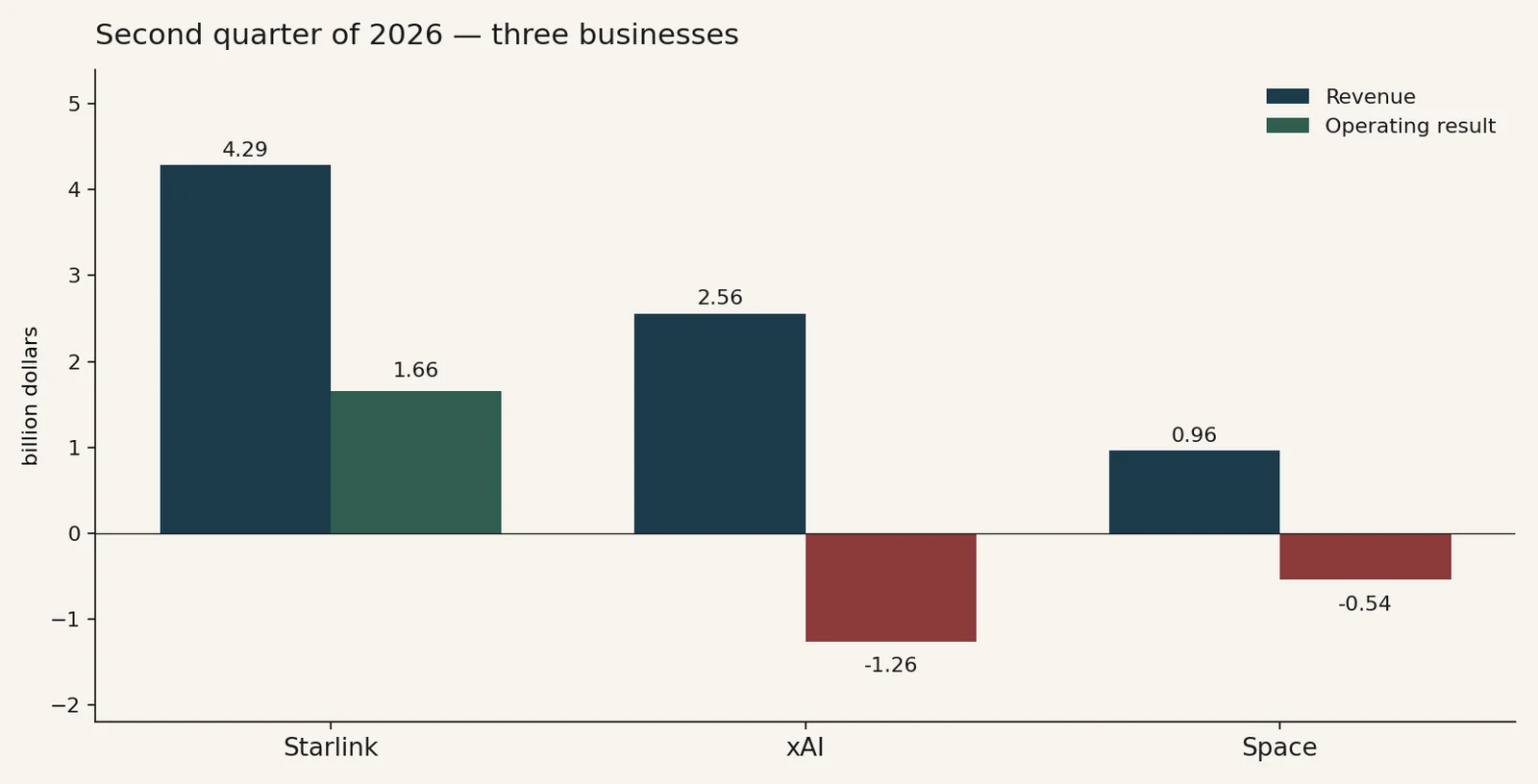
The second quarter, reported on 4 August, showed revenue of $7.81 billion, up 92 per cent. Starlink reported revenue of $4.29 billion and an operating profit of $1.66 billion. Artificial intelligence, housed since February in xAI together with Grok and X, reported revenue of $2.56 billion and an operating loss of $1.26 billion. Falcon, Dragon and Starship reported revenue of $0.96 billion and an operating loss of $0.54 billion. The consolidated operating loss narrowed to $0.14 billion. Capital expenditure reached $18.37 billion, of which $15.83 billion went into computing power.
| Business | Revenue | Operating result | Capital expenditure |
|---|---|---|---|
| Starlink | $4.29bn | +$1.66bn | $1.37bn |
| xAI | $2.56bn | -$1.26bn | $15.83bn |
| Starship | $0.96bn | -$0.54bn | $1.17bn |
| Total | $7.81bn | -$0.14bn | $18.37bn |
In 2025 revenue was $18.7 billion, the operating loss $2.6 billion and the net loss $4.9 billion. Starlink contributed revenue of $11.4 billion and an operating profit of $4.4 billion. The intelligence business contributed revenue of $3.2 billion and an operating loss of $6.4 billion. After the listing and the $25 billion bond issue, cash was about $94 billion to $100 billion. Free cash flow in the first half was negative by about $25 billion.
Starlink: subscribers, revenue, and the only profit
Starlink had 12 million subscribers at the end of June, double the year before, against 6 million in the second quarter of 2025 and 10.3 million at the end of March. Average revenue per subscriber fell from $85 a month to $66, because volume is rising and price is falling: newer markets and cheaper plans now weigh more than the older customers. Consumer revenue in the second quarter was $2.49 billion. Corporate and government contracts, including Starshield, doubled to $1.81 billion, and the quarter included multi-year awards of more than $6 billion. American, Southwest and Virgin Atlantic are among the customers.
This is the only business that already makes an operating profit. Second-quarter operating profit, annualised, is about $6.6 billion. At 25 to 40 times that profit, Starlink alone is worth $160 billion to $260 billion, about a tenth of the group’s market value. The prospectus puts broadband and mobile connectivity at $1.6 trillion. An independent estimate cuts the figure to about $129 billion, because the company’s number takes in the whole connectivity market outside China and Russia, which is not an available market in any practical sense.
The V3 satellites, each with downlink capacity of about 1 terabit a second, still have no regular launch schedule. Starship is the vehicle that can carry them in number. Falcon 9 lifts far fewer spacecraft a flight, so the new satellites do not reach orbit fast enough to take more subscribers. Until V3 is launched on a regular schedule, growth is limited by the capacity of the present constellation and by a price that is already falling.
Starship: why it is not yet profitable
Space revenue in the first half was lower than in the first half of 2025. The second quarter itself was up 29 per cent: launches were fewer, 38 against 46, but flights for outside customers were larger and brought in more revenue. Development spending, mainly on Starship, reached $1.08 billion in the quarter, against $0.69 billion a year earlier. Flight 12 in May introduced the V3 vehicle. Flight 13 in July deployed 20 production V3 satellites. In September the vehicle reached orbit, but the flight was cut short by an engine fault. Flight 14 then reached low Earth orbit and deployed Starlink satellites.
Starship does not sell tickets to Mars. It is meant to cut the cost of a tonne to orbit and to raise the number of satellites one launch can carry. Without that cadence, connectivity runs into the limit of the present constellation, and orbital computing centres remain a drawing. The business stays loss-making until development becomes an operation.
xAI, and what Musk said about September
On 11 August Musk told staff that artificial-intelligence revenue would overtake the rest of the company in September, and by a wider margin in the fourth quarter. In four or five years, he added, AI would account for 99 per cent of the group’s value. Ten gigawatts by the end of 2027, at $30 to $50 a watt, would on his reckoning produce $300 billion to $500 billion of annual revenue. On 28 September he said it was becoming more likely that Starlink would, over time, carry most of the world’s internet traffic.
The second-quarter figures do not bear that out. AI revenue was $2.56 billion. Starlink and space together were $5.25 billion. To overtake Starlink in the next quarter, with Starlink still growing, xAI would have had to double its revenue in three months. Advertising in the same business, $367 million, was lower than a year earlier. Capacity was 1.4 gigawatts. Adjusted earnings before interest, tax, depreciation and amortisation were positive for the first time, at about $1.15 billion, but the operating result was still a loss: depreciation of the data centres, and the cost of growth, took it there.
Cloud contracts worth $14.1 billion were signed in the quarter. On 4 August management said there was a further $6.7 billion of contracted revenue from the sale of computing power over the following six months, on top of the $14.1 billion. That is not cash in the accounts. It becomes revenue when the data centres start running, which was due to begin in October. One customer accounts for 19.5 per cent of group revenue. Capital expenditure on AI was 6.2 times the business’s revenue. Cash covers several quarters of spending at that rate, not an open-ended run of it. The $25 billion of bonds carry about $1.5 billion of annual interest, at an average coupon of 5.855 per cent.
What the 17 November report can settle
The report will show whether AI revenue in the third quarter has passed $4 billion to $5 billion and has approached Starlink, or passed it. A quarter in which AI remains second by revenue does not prove that September itself failed to cross. It does weaken the deadline Musk gave staff. The contracted revenue from October, still unrecognised, has to be set out, as does any customer that has used the 90-day termination clause. Capital expenditure is separate: whether it is still above $15 billion a quarter, and how many gigawatts sit behind it.
Starlink is read on subscribers, revenue per subscriber, the share from companies and government, and on when the V3 satellites go up on a regular schedule. Starship is read on flight cadence, and on whether the V3 vehicle has moved from test flights to a schedule. Group earnings per share say little while depreciation of the data centres keeps the operating result at a loss.
What would have to go right
Starlink already makes an operating profit and holds government contracts. The advantage is its own satellites in orbit and a cheap launch. Without both, another company cannot reach 12 million subscribers in two years. If the V3 satellites enter service on schedule in 2027, connectivity revenue can grow without a further share sale.
Contracted computing power is the shortest path from about $8 billion of quarterly revenue to the analysts’ forecast of $45 billion for the year, and to revenue above $100 billion in 2027, if customers stay and the capacity is switched on in time. Some forecasts already put 2027 above $108 billion. At that revenue, today’s $2.33 trillion is 22 times 2027 sales. For infrastructure on long contracts, that multiple can be defended if the margin after depreciation exceeds 20 per cent.
Cash gives the company time. It does not have to sell shares in November to pay for the next data centre. That is the difference from private laboratories that live from one financing round to the next.
What is wrong with the price
The shares are priced for a business that is still loss-making at the operating line. A multiple of about 100 times 2025 revenue, and about 52 times the 2026 forecast, leaves no room if the timetable slips.
Revenue per subscriber is falling. Twelve million subscribers at $66 are not twelve million at $85. If companies and Starshield do not cover the gap, Starlink grows in subscribers and not in profit.
One customer accounts for 19.5 per cent of revenue, and the contracts can be ended at short notice. A data centre built for a particular customer cannot be converted for another within a month.
The report contains no September figure, and no figure for December annualised revenue of $100 billion. Analysts forecast AI revenue of about $15.6 billion for the whole of 2026, far below what Musk told staff. That gap is the argument over the shares.
If the data centres are late coming into service, because of permits or opposition to the sites, a contract can remain in force while the revenue arrives later. Depreciation starts on schedule. Cash falls by about $15 billion a quarter.
The prospectus cites a market of $28.5 trillion, of which $26.5 trillion is in AI, including $22.7 trillion of corporate applications. That is not a forecast of SpaceX revenue. It is the company’s estimate of the markets from which it hopes to take a share.
The share price and the multiples
At $171.92 and 13.57 billion shares, the market value is about $2.33 trillion. There is no net profit, so there is no trailing price/earnings ratio. The forward ratio, on earnings of a few cents, is about 105 times, and it does not carry information.
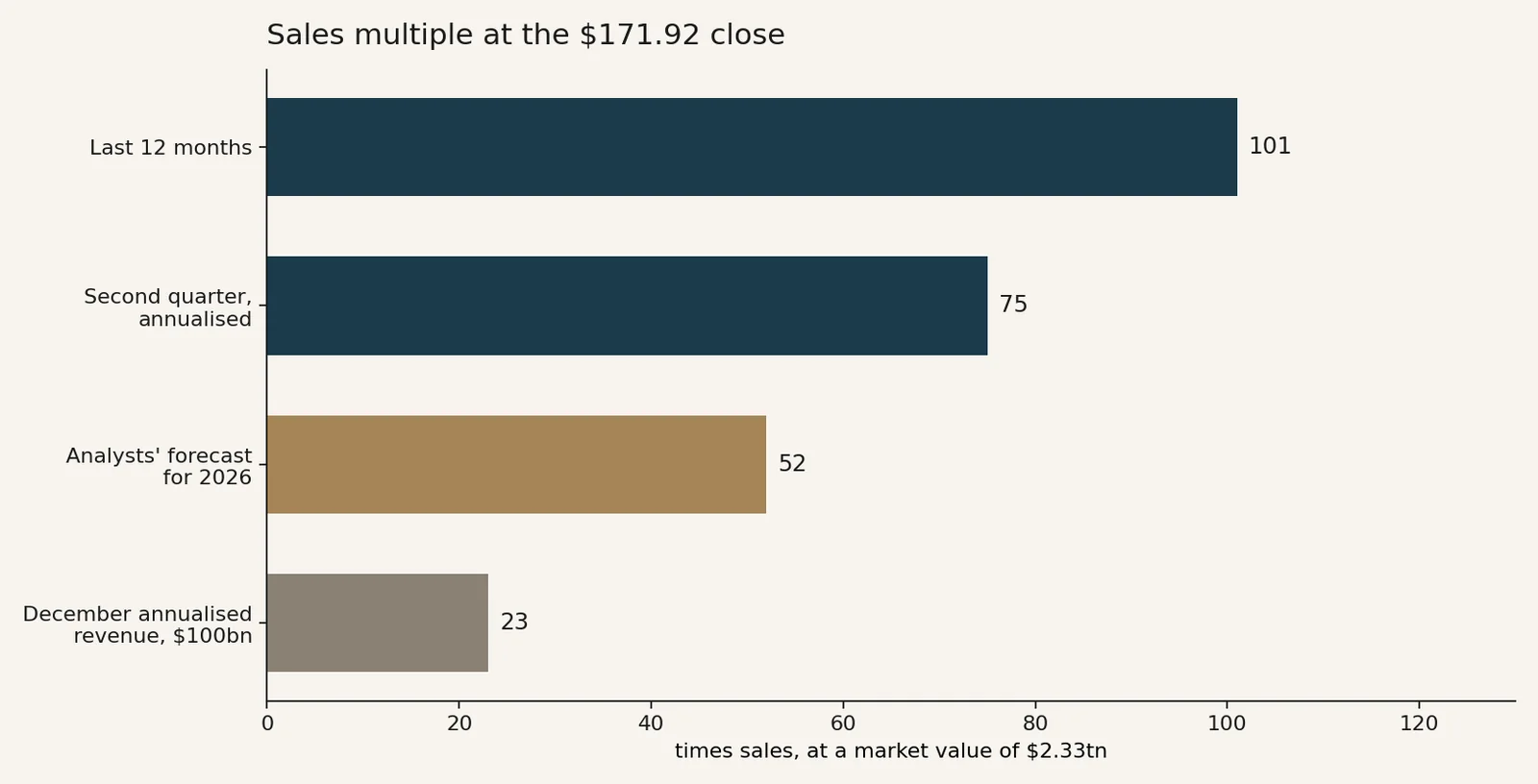
| Base | Revenue | Times sales |
|---|---|---|
| Last 12 months to 30 June | $23.0bn | about 101 |
| Second quarter, annualised | $31.3bn | about 75 |
| Analysts’ 2026 forecast | $44.7bn | about 52 |
| December annualised revenue of $100bn, if it happens | $100bn | about 23 |
Against Starlink’s annualised operating profit of $6.6 billion, the whole group is worth more than 350 times the profit of its only profitable business. Adjusted earnings before interest and tax in the second quarter were $3.5 billion, $14 billion annualised, or about 167 times. Debt in June was below cash, so enterprise value sits close to equity value, not above it.
From the offer price of $135 to $171.92 the shares are up about 27 per cent, and from the July low of about $107 they are up more than 60 per cent. The high, $226, has already been reached. It stands 31 per cent above the 6 October close.
Two views sit on that price.
Adam Jonas of Morgan Stanley, in a note on 5 October titled “Cheap and Getting Cheaper”, reiterated an overweight recommendation and a target of $300. At $159, he wrote, Starship and Starlink were already in the price at about $127 a share, and the remaining $32 or so was xAI. He urged investors to build a position before Starship flight 15. A possible catch of the ship, he said, “could be the biggest positive catalyst since the IPO.”
Jeremy Grantham of GMO, on Morningstar’s The Long View in July, with the shares around $148, called it “the craziest IPO in the history of man”. He said: “In 50 years, they’ll be telling and writing stories about SpaceX, and they’ll be quoting you paragraphs from the prospectus, and you will be laughing at it.” And: “It will be amazing, by the way, if it doesn’t collapse, because it will need such massive developments on AI that our entire lives are totally different.”
If the forecasts are met
Third-quarter revenue above $13.4 billion, xAI close to Starlink or ahead of it, and October contracts still in force would hold the analysts’ forecast of about $45 billion for 2026 and open 2027 towards $100 billion. The quarters do not add themselves into that figure. The first quarter was $4.69 billion of revenue, the second $7.81 billion. If the third is $13.4 billion and the fourth about $20 billion, the year is about $46 billion, some $1.4 billion above the $44.7 billion forecast. The annual figure and the quarterly figures are two forecasts, not one number.
At 25 times 2027 sales the market value is $2.5 trillion, close to the last price. At 40 times it is $4 trillion, about $295 a share. If today’s 52 times is held on sales of $100 billion, the price is about $380. The $226 target is about 23 times sales of $100 billion, or 50 times sales of $45 billion. The multiple does not rise with delivery. The same multiple is applied to higher revenue.
Earnings stay thin through 2026 and into early 2027, because the data centres enter depreciation faster than the margin after depreciation recovers. A buyer at this price is buying revenue and contracts, not earnings.
If the forecasts are missed
If xAI remains second by revenue, if December annualised revenue is $40 billion rather than $100 billion, and if Starlink revenue per subscriber stays at $66, the $45 billion forecast is revised to $30 billion to $35 billion. At 20 times that revenue the market value is $600 billion to $700 billion, or $45 to $52 a share. A sum of the parts, in which Starlink, Starship and cash set the price and xAI is given little value, lies between $42 and $103. The $45 to $52 range sits inside that lower case: it is 20 times the revised forecast, while $42 to $103 is the price of the businesses whose revenue is already known. The July low, $105, has already been reached.
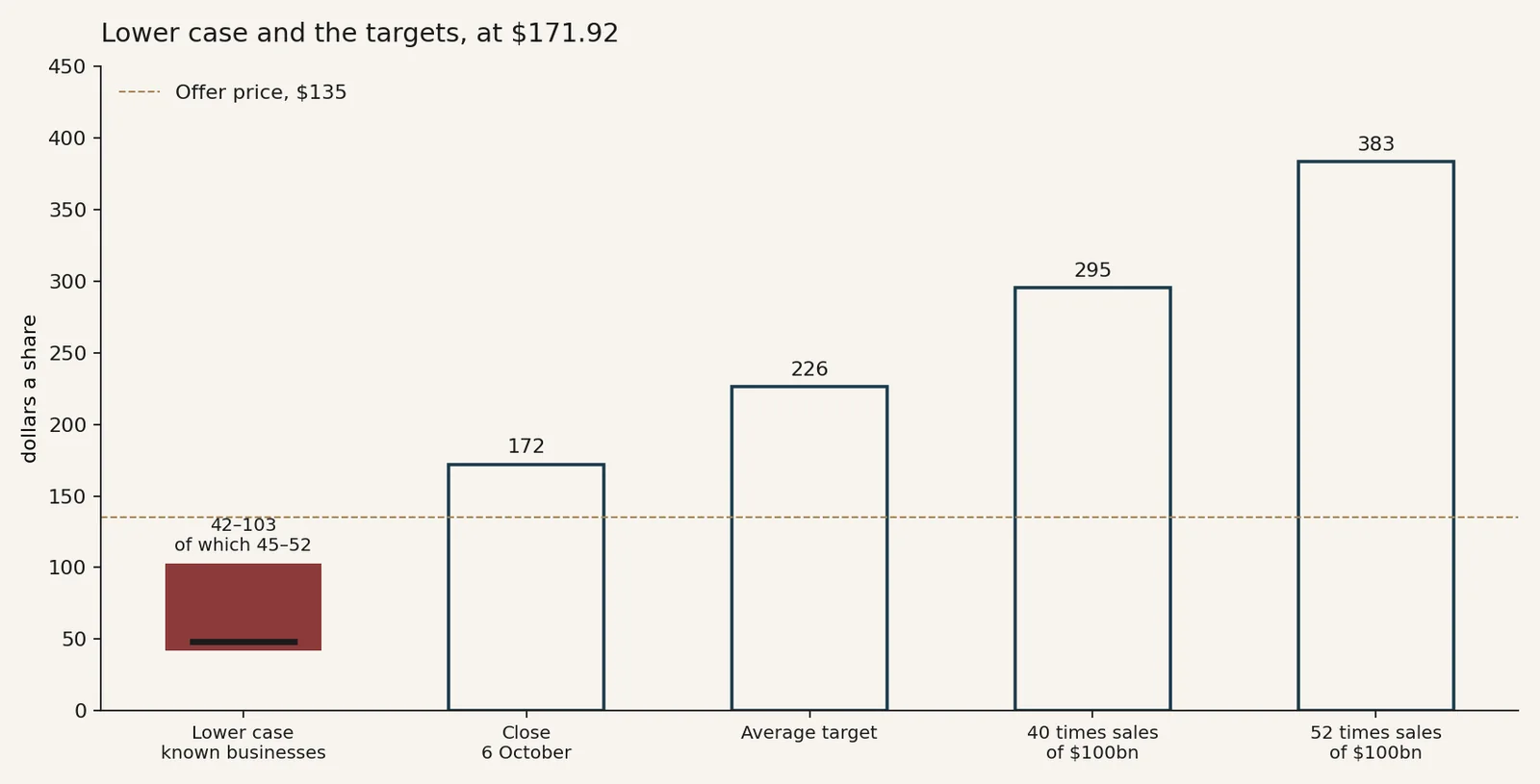
The case between delivery and a miss is the more likely of the three. Starlink revenue follows the plan, xAI revenue grows with the October contracts, but September xAI revenue does not exceed Starlink, and December annualised revenue does not reach $100 billion. In that case the shares return to the $135 to $170 range in which they have traded since listing, until the fourth-quarter report.
Now, after the report, or at the year end
A purchase now is at 52 times the analysts’ forecast. Musk has set a higher figure. It is his figure, not theirs. The November report is the first test. The year end does not contain the $100 billion number. If that annualised revenue exists, it appears in the fourth-quarter report, in February 2027. Until then a December price is a view, not an account.
The test comes twice. The first date is 17 November, or the day the company sets. The report will show the quarter, the split by business, and whether the October contracts have entered the backlog. It will not show September on its own. The second date is the February report, not 31 December.
For a position not yet open, the better course is to wait for the November report. Jonas wants a position built before flight 15, and called a possible catch of the ship the biggest positive catalyst since the offer. Grantham reads the same prospectus as a document later readers will laugh at. The flight can lift the shares without September xAI revenue having passed Starlink. The price is already 27 per cent above the offer, and it has been through $226. The upside to the average target is 31 per cent. If the multiple falls back to the businesses whose revenue is known, the downside is more than 40 per cent, to about $100, and more if the market prices only Starlink. That is not a symmetry on which to buy before the figures.
For a position already open, Jonas’s note is a reason not to cut before flight 15, not a reason to double. November is when the size is set, not the thesis. The thesis fails if xAI revenue does not approach Starlink, and if management pushes the $100 billion annualised revenue past December. It holds if the October orders are confirmed and no large contract is cancelled. The year end matters only as a second entry after the report, if the shares fall towards $135 to $150 without the contracts having worsened. Below the offer price, with Starlink intact, the unknown is for the first time priced below the price at which the shares were sold.
Frequently asked questions (FAQ)
When is the report, and what will it not split out?
Expected on 17 November 2026, after the close, and not confirmed. It will not separate September from October.
Who makes the operating profit?
Starlink. The other two businesses do not.
What did Musk claim for September, and what is on the page?
On 11 August he said AI revenue would pass the rest of the company that month. The second quarter had AI at $2.56 billion and the rest at $5.25 billion. September is not in the accounts.
What multiple is $171.92?
About 101 times revenue for the last twelve months, and about 52 times the analysts’ 2026 forecast. Jonas’s target is $300. Grantham called the offering the craziest IPO in the history of man.
When is the $100 billion figure due, if it comes?
In the fourth-quarter report, in February 2027, not on 31 December.
How many Starlink subscribers?
Twelve million at the end of June 2026, at $66 a month, down from $85.
Important notice
This article is for information and education only. It is not financial advice, an investment recommendation or professional advice of any kind. The views expressed are the author’s personal opinions and are not recommendations to buy, sell or hold securities, assets or investments. Investing involves substantial risk, including the possible loss of all capital. Past performance is not a guarantee of future results. Each reader should conduct independent research, consult a qualified financial adviser and weigh financial circumstances, risk tolerance and investment objectives before taking any decision. The author and borsite.net accept no liability for any loss arising from the use of the information in this article.
Leave a Reply
Трябва да влезете или да се регистрирате, за да публикувате коментар.