Nvidia -14%, Microsoft -2.8%. The November 20, 2026 selloff split AI companies into three groups with three very different risks. Here is who they are, what history says and what we are watching this week.
Българската версия на тази статия: Пазарът спря да пита дали AI работи. Сега пита кой плаща сметката
On Friday, November 20, 2026, the Nasdaq 100 fell 5.6% and the SOX chip index dropped 10.7%. Nvidia lost 14%, CoreWeave 12%, and Microsoft just 2.8%. The market did not punish artificial intelligence as a technology. It punished the companies whose revenue depends on other people’s capital spending, and those building capacity with borrowed money secured against the chips themselves.
In brief
- Chip suppliers fell the most (-12% to -14%), because they earn from other companies’ capex. Nvidia also had problems of its own: according to Reuters, the SEC is investigating its accounting.
- Debt-reliant companies such as CoreWeave are the most exposed to higher rates: CoreWeave’s interest expense is four times its operating income.
- Microsoft, Alphabet and Amazon fell the least (Meta, at -5.9%, was in the middle), but not because they pay for everything out of pocket. Amazon is spending 128% of its operating cash flow. The difference is that they borrow against huge, diversified businesses, not against GPUs.
What exactly happened on Friday
It was the Nasdaq 100’s worst week since March 2020 (-10.4%). The index closed 19.8% below its October 6 record, one step away from a bear market, and was more than 20% down during the session. The S&P 500 fell 3.7%, its seventh straight decline, and entered a correction. Bitcoin dropped below $60,000 for the first time since July.
Four blows in a single day:
- Nvidia. The stock was already down 6% before Reuters reported, citing two anonymous sources, that the SEC is examining potential accounting issues. It then closed at $125.53 (-14%), about 48% below its record. This comes a week after Jensen Huang’s resignation and just three days after a record quarter: revenue of $115.8bn and guidance of about $130bn for the next quarter. An SEC investigation does not in itself mean wrongdoing.
- Anthropic. The most anticipated AI IPO of the year (priced at $83) lost about 9% on its second day of trading.
- TSMC. New US export rules that took effect on November 19 affect orders from Chinese customers.
- Rates. The Fed raised rates to 3.75-4.00% in September, and the market is pricing a 94% to 97% chance of another hike on December 9. The US 10-year yield is around 4.9-5%. For a company that lives on refinancing, this is the most important number in this article.
Fear is at extreme levels: CNN’s Fear & Greed Index is at 10, the crypto index at 12, and the VIX closed at 35.9.
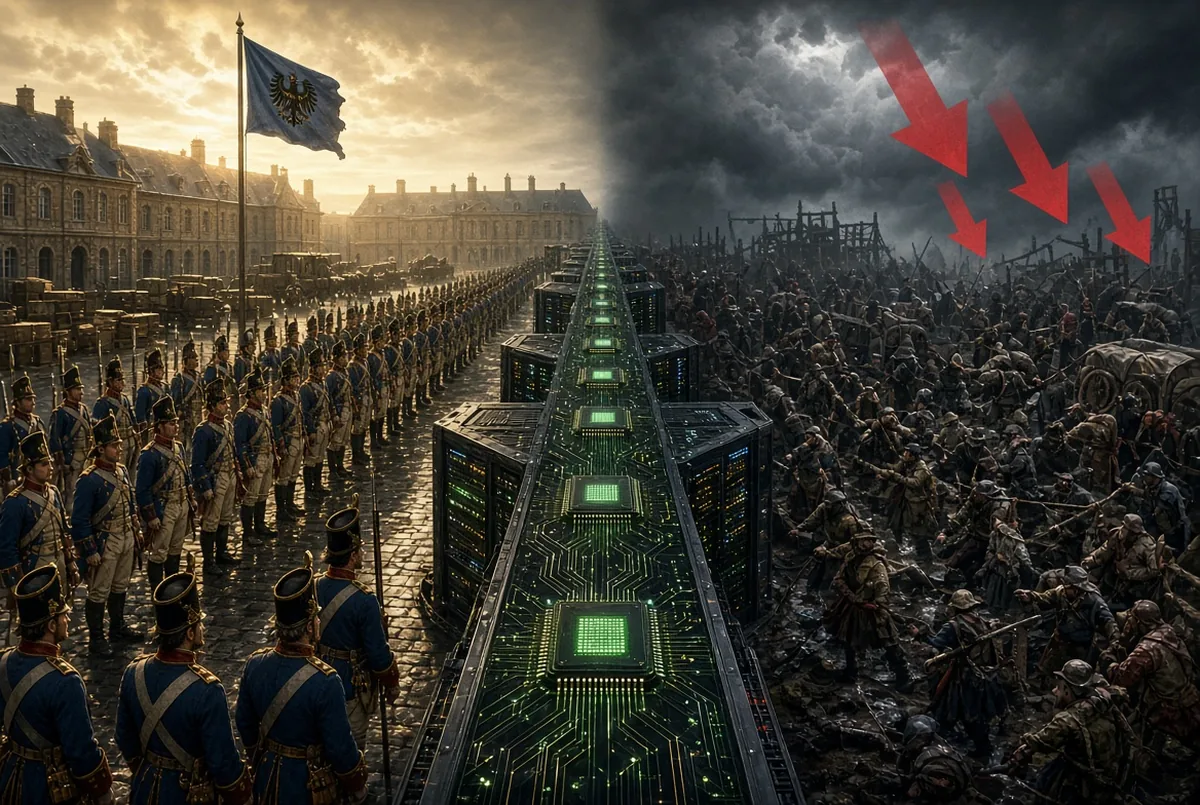
The Prussian lesson
Frederick William I funded his standing army from current state revenue, not from loans taken out at the moment of war. That is why his son could choose when and where to fight. Today the market is asking AI companies the same question: who can set their own pace, and who is forced to keep spending because the debt keeps accruing whatever the outcome.
The analogy does have one difference, and it matters. Prussia was a relatively closed system. Today’s AI supply chain works like communicating vessels: if one large customer slows down, orders fall at the suppliers and the builders at the same time.
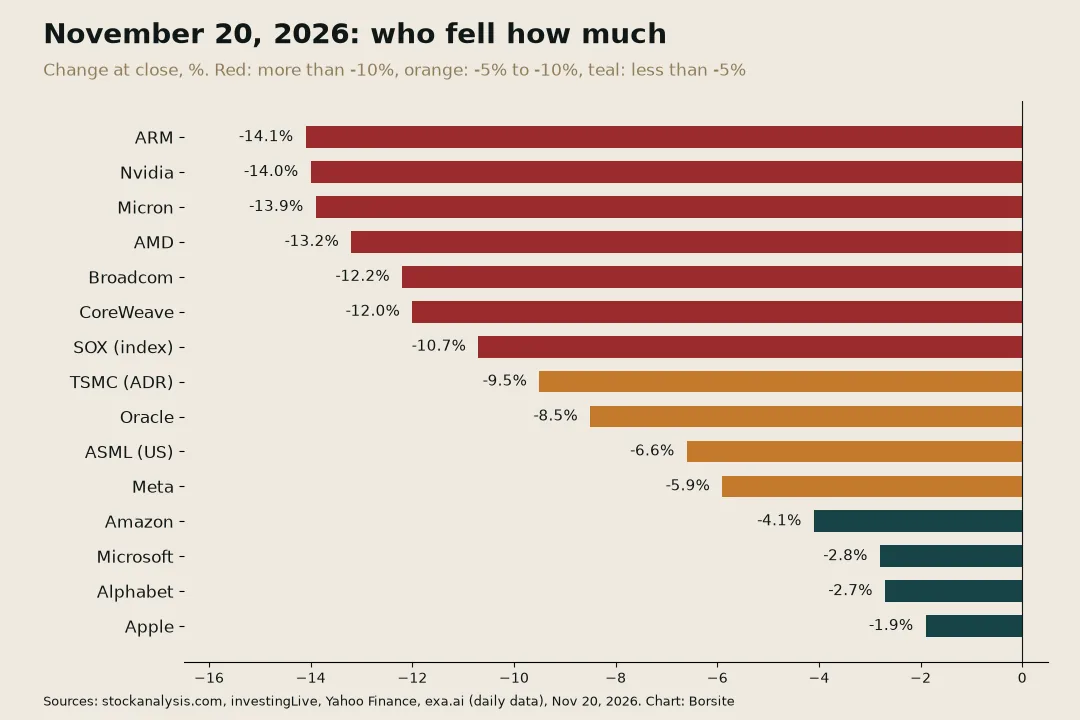
| Group | Company / index | Change on Nov 20, 2026 |
|---|---|---|
| Biggest decliners (more than -10%) | ARM | -14.1% |
| Nvidia | -14.0% | |
| Micron | -13.9% | |
| AMD | -13.2% | |
| Broadcom | -12.2% | |
| CoreWeave | -12.0% | |
| SOX | -10.7% | |
| Mid-range decliners (-5% to -10%) | TSMC (ADR) | -9.5% |
| Oracle | -8.5% | |
| ASML (US) | -6.6% | |
| Meta | -5.9% | |
| Smallest decliners (less than -5%) | Amazon | -4.1% |
| Microsoft | -2.8% | |
| Alphabet | -2.7% | |
| Apple | -1.9% |
Group 1: The suppliers. They earn from other people’s capex
ARM, Nvidia, Micron, AMD and Broadcom have no debt problem. Their revenue, however, depends on other companies deciding to keep spending. That is why, at the first doubt about capex, they fall first and hardest.
There is also a new and little-discussed risk here: the supplier becomes the lender. According to Anthropic’s prospectus, Broadcom has agreed to lend it up to $42bn to finance chip leases, and is buying about $1bn of shares in the IPO. When a supplier finances its own customer, the risk of a slowdown comes back onto the supplier’s balance sheet.
Group 2: AI on credit. They borrow against the chips themselves
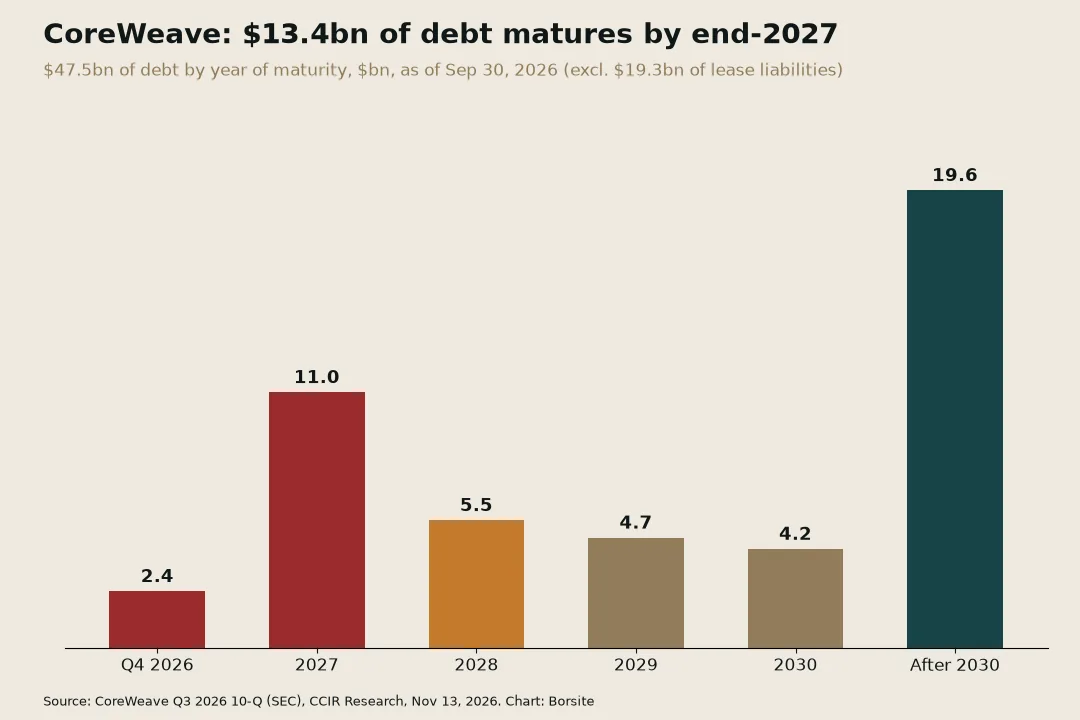
CoreWeave is the clearest example of a so-called neocloud, a cloud company that builds only AI capacity. As of September 30, 2026:
- its debt stood at $47.5bn, with a further $19.3bn of lease liabilities;
- third-quarter interest expense was $846m against operating income of $207m ($379m adjusted). Interest coverage is below one;
- $13.4bn of its debt (28%) matures by the end of 2027, and 40% by the end of 2028.
There is a stronger side, too. The contract backlog is $132.5bn, and the company expects about $9bn of customer prepayments in the next three months alone. But prepayments are an obligation to deliver in the future, and the customers are few and large. With rates around 5%, every refinancing costs more than the last one. That is why the market prices CoreWeave as a credit risk, not just an AI story. Oracle is in a similar, if lighter, position: it is funding its build-out with new shares and customer prepayments.
Group 3: The hyperscalers. They borrow too, but from a position of strength
The hyperscalers (Microsoft, Alphabet, Amazon, Meta) are the giants that buy most of the chips. The convenient story is that they pay for AI with their own money. Their third-quarter reports say otherwise.
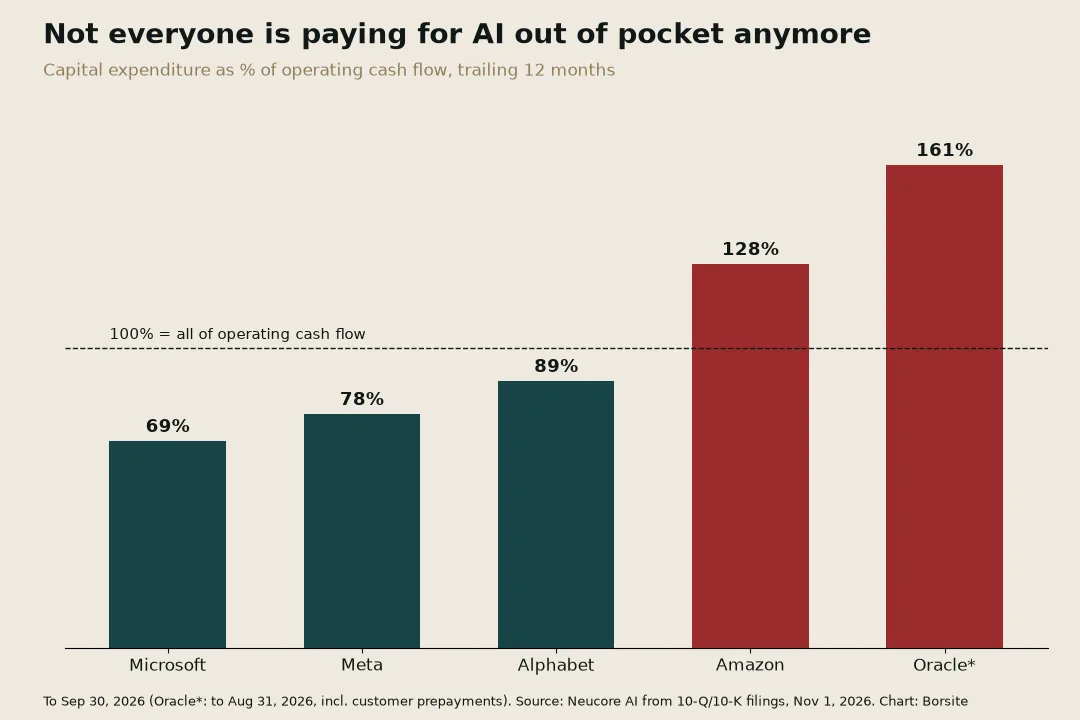
Over the 12 months to September 2026, capital expenditure was 69% of operating cash flow at Microsoft, 78% at Meta, 89% at Alphabet and 128% at Amazon. In the third quarter alone, Alphabet and Meta had negative free cash flow. Amazon’s long-term debt stands at $173bn, up from $66bn at the end of 2025. Alphabet has sold $28.7bn of new bonds and $12.4bn of new shares. Of the four companies, only Microsoft still pays for its capex entirely out of its own business.
So why did Microsoft, Alphabet and Amazon fall the least? Because they borrow against advertising, software, retail and cloud businesses with a backlog of more than $1.8 trillion, and with high credit ratings. Their demand is not weakening: Azure is growing 48%, Google Cloud has doubled and AWS is growing 39%. They can slow the pace without it affecting their obligations. This is the Prussian model, even if no longer in its pure form.
The hidden risk: how long a chip lives
This is the most important question for the years ahead. For accounting purposes, CoreWeave depreciates its GPUs over 6 years, and Alphabet its servers over about 6 years. Critics argue that a chip’s economic life is 3-5 years, because each new Nvidia generation devalues the previous one.
If the critics are right, today’s profits are overstated, and the debt-laden companies will have to refinance their obligations against an asset that is already worth less. For the hyperscalers it will not be an interest problem, but a return problem. A sign that this is already happening: Microsoft’s depreciation is growing 56% a year, while its revenue is growing 19%.
What history shows
From 1950 to 2025, the S&P 500 fell 3.7% or more in a single day 67 times. A year later, the median gain was 21.9%, and in 82% of cases the index was higher.
For the Nasdaq 100 the picture is darker. After days with a drop of 5.6% or more (42 cases since 1985), the median one-year return is -10.6%. The reason is that 30 of the 42 cases fell during the dot-com crash (2000-2002) and the financial crisis (2008), when the declines came in clusters. In the remaining 12 cases the median is +41%, but that is a small sample.
In other words, historically such days have more often come near the bottom than near the top. But “near” can mean another 10% lower. Today’s market is more concentrated and more interconnected, and rates are rising rather than falling. That is why I treat the historical medians as a guide, not a forecast. (Own calculations based on Yahoo Finance daily data.)
Three scenarios to mid-2027
This is my assessment, and it is subject to change or adjustment as the market situation develops.
- Bull case: the Fed hikes on December 9 but signals a pause; the hyperscalers confirm higher 2027 capex in their January and February reports; the Nvidia question is resolved without material restatements. The suppliers recover fastest.
- Base case: capex stays high, and so do rates. The market keeps sorting: Microsoft and the suppliers with the strongest balance sheets stabilize, while debt-laden companies stay under pressure at every refinancing.
- Bear case: the first hyperscaler announces lower capex, or the SEC finds material problems at Nvidia. Then everyone takes a hit, but the hardest and longest-lasting one falls on those with interest coverage below one.
What would invalidate the thesis: if companies like CoreWeave refinance their 2027 maturities at a lower cost and with longer terms, the dividing line of “who borrows against what” loses its meaning.
What we are watching this week and until December 9
- News from Nvidia: the SEC, interim CEO Colette Kress and the search for a permanent one.
- Bond prices and credit spreads at CoreWeave and Oracle. That is where we will see stress before it shows up in the shares.
- The 10-year yield around 5% and the Fed meeting on December 9.
- Thursday, November 26: US markets are closed for Thanksgiving; Friday is a shortened session with thin liquidity and sharper moves.
- Bitcoin around $60,000 and spot ETF outflows ($3.5bn in November through November 19, according to Farside).
What this means for the long-term investor
The market does not doubt that AI is advancing. Nvidia’s results show it is. The question is whose balance sheet will hold up if returns turn out lower than expected. When we assess an AI company after a drop like this, we look at three things: who pays for its capex and how (own cash flow or debt), what the borrowing is secured against (a diversified business or the chips themselves), and when it matures. Prussia won not just because it had an army, but because it could choose its moment. Today, few companies have that option.
Frequently Asked Questions (FAQ)
Why did Nvidia fall 14% despite record results?
Beyond the broad selloff, Reuters reported on November 20, 2026 that the SEC is examining potential accounting issues at the company. The stock was already down 6% before the news. An investigation does not mean proven wrongdoing.
Do the hyperscalers fund AI with their own money only?
Not anymore. Over the 12 months to September 2026, Amazon spent 128% of its operating cash flow, and Alphabet and Meta had negative free cash flow in the third quarter. Only Microsoft pays for the build-out entirely out of its own business.
Why is CoreWeave riskier than Microsoft?
Because it borrows against the chips themselves and contracts with a small number of customers, and its interest expense ($846m for the quarter) exceeds its operating income ($207m). With rates around 5%, every refinancing costs more.
Which three groups of AI companies did the selloff separate?
Chip suppliers (ARM, Nvidia, Micron, AMD, Broadcom) fell the most because they earn from other companies’ capex. Companies that rely on debt, like CoreWeave, are the most vulnerable to higher interest rates. Microsoft, Alphabet and Amazon fell the least because they borrow against a huge, diversified business rather than against GPUs.
What are we watching after the selloff?
News from Nvidia around the SEC, bond prices and credit spreads at CoreWeave and Oracle, the 10-year yield around 5% and the Fed meeting on December 9.
Disclaimer
This article is analysis and does not constitute investment advice. The author may hold positions in the assets mentioned. Investment decisions are personal and require your own research.
Sources
Reuters: Nvidia’s accounting is a focus of US SEC investigation (Nov 20, 2026)
Reuters: Tech leads global stocks rout (Nov 20, 2026)
Reuters (via Investing.com): Bitcoin falls below $60,000 (Nov 20, 2026)
Reuters: Broadcom to lend Anthropic up to $42 billion (Oct 1, 2026)
Anthropic, 424B4 prospectus (SEC, Nov 19, 2026)
stockanalysis.com: Nasdaq 100 plunges 5.6% (Nov 20, 2026)
investingLive: Nasdaq 100 posts worst week since March 2020 (Nov 20, 2026)
Investing.com: Nvidia suffers worst week since 2008 (Nov 20, 2026)
MarketBeat: TSMC and the new export rules (Nov 20, 2026)
Yahoo Finance: VIX historical data (Nov 20, 2026)
CoreWeave: Third Quarter 2026 results (Nov 10, 2026)
CoreWeave: Form 10-Q for the period ended Sep 30, 2026 (SEC)
CCIR Research: CoreWeave’s Q3 2026 debt, entity by entity (Nov 13, 2026)
Neucore AI: Past the Cash Line, the AI build-out after Q3 (Nov 1, 2026)
Cointelegraph: Bitcoin falls below $60K, ETF flows per Farside (Nov 20, 2026)
CoinMarketCap: Bitcoin below $60K, flows per SoSoValue (Nov 20, 2026)
CME FedWatch: Fed decision probabilities (Nov 20, 2026)
Coin Mood Index: Crypto Fear & Greed on Nov 20, 2026
Yahoo Finance: S&P 500 (^GSPC) daily data, own calculations (Nov 22, 2026)
Yahoo Finance: Nasdaq 100 (^NDX) daily data, own calculations (Nov 22, 2026)