


Brent closed near $110. September inflation already showed that the energy shock does not remain confined to the price of oil. On October 28 the Federal Reserve must say whether the temporary risk is already behind us.

Joseph Conrad wrote Heart of Darkness in 1899. The novel first appeared in a magazine and was published as a book in 1902. The plot is both simple and terrifying. Charlie Marlow is ordered by the company he works for to travel to Africa and bring back Kurtz, a trading agent and colleague sent into the interior of the Congo to collect ivory. The deeper Marlow advances into the jungle, the clearer it becomes that Kurtz is not merely a man who has broken the rules. He is a man who has crossed the point of no return. At the end of the novel Marlow finds him sick and dying. Kurtz’s last words - “The horror! The horror!” - do not explain what exactly happened. They only confirm that the threshold had been crossed long before Kurtz or the people around him suspected it existed.
In 1979 Francis Ford Coppola transferred the same story to Vietnam during the war. In the film Apocalypse Now Kurtz is a colonel in the U.S. Army Special Forces, sent deep into the jungle on a secret mission. Marlon Brando constructs the image of a man who long ago severed all ties with his past and no longer belongs to the world we know. He does not shout. He speaks quietly, almost in a whisper. The camera shows him in half-light, head shaved, bare-chested, knife in hand, surrounded by people who follow him as an idol. Brando does not portray madness. He plays a man who has seen the threshold and decided to remain on the other side. The film does not explain the moment when Kurtz ceases to be an officer, or even a man. It only shows that when Captain Willard finds him, that moment is already behind him and there is no way back.

The threshold is not felt at the moment it is crossed.
Oil above $110 is neither the Congo nor Vietnam. The Federal Reserve is not an isolated special-forces operative in the jungle. The Committee meets in public, publishes a statement, holds a press conference, and has another meeting with new projections in December. The analogy with Kurtz does not describe an irreversibility the institution does not possess. It describes the risk that the threshold will be crossed before anyone has said that it has already been crossed - and that risk is greater than the market currently acknowledges.
Key Figures Before the Federal Reserve’s October 28 Meeting
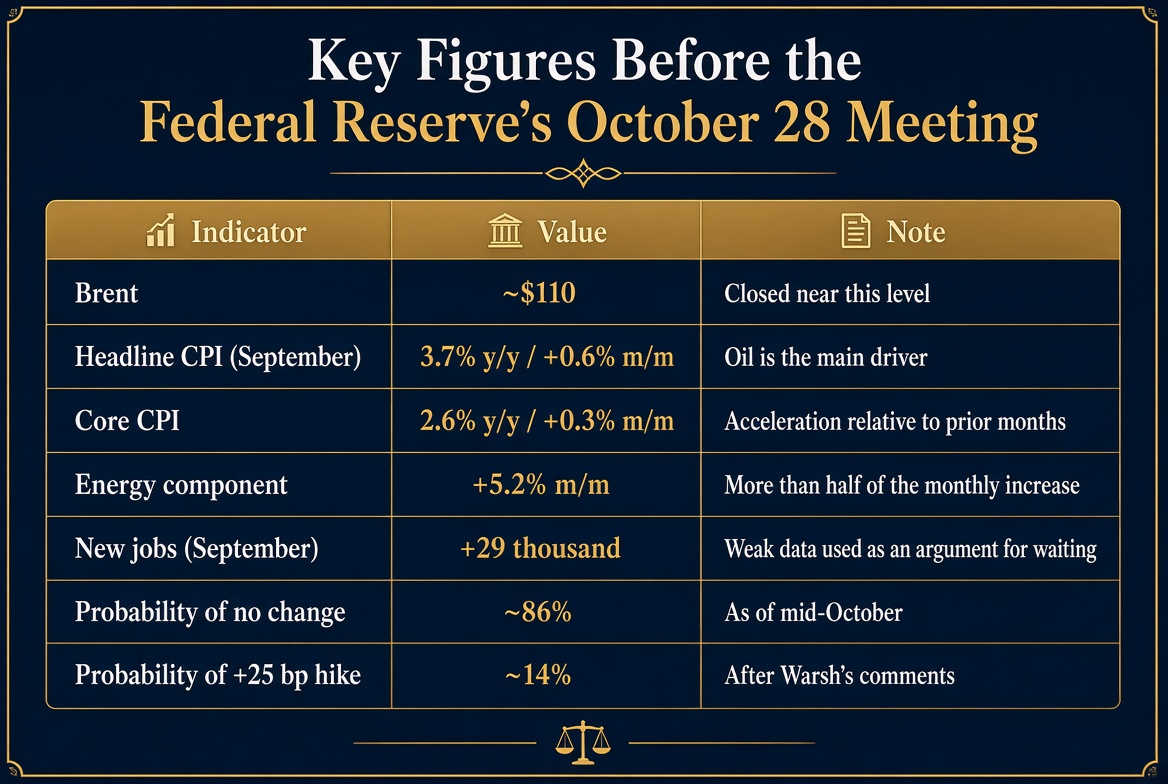
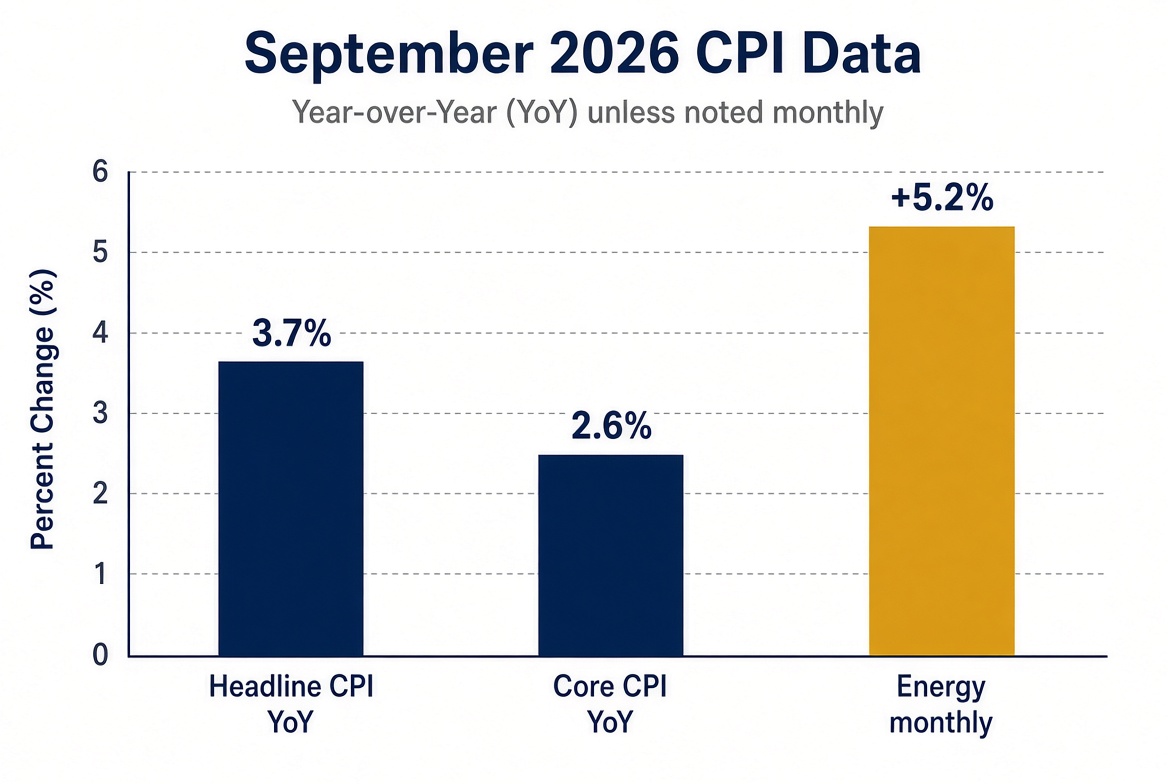
The September consumer price index showed that oil lifted the overall index by 0.6 percent for the month and brought annual inflation to 3.7 percent. Core inflation accelerated to 0.3 percent for the month and 2.6 percent on a year-over-year basis. The energy component jumped 5.2 percent. These numbers are no surprise to anyone who has been following the price of oil. The surprise is that part of the Committee still speaks of them as something that can be ignored until December.
The Fed does not target CPI. The 2 percent goal is measured by the personal consumption expenditures index, and the latest available data for it were softer. This provides a formal basis for waiting. At the same time, the September employment report showed only 29 thousand new jobs - a figure already being used as a shield against a hike. The problem is that both arguments look backward. The softer PCE reflects earlier months. The weak labor market may prove to be a lagging indicator if companies are already beginning to pass on higher energy costs and to revise wages for the coming year. Relying on yesterday’s data in order to postpone a decision about tomorrow’s risk is precisely the behavior the Kurtz analogy illuminates: the threshold is not felt at the moment we cross it.
Service prices show a more sustained monthly acceleration in the last two reports compared with the summer months. Short-term inflation expectations, measured by break-even yields and by the University of Michigan survey, have risen relative to levels at the beginning of the summer. Companies in transport and logistics are already raising tariffs. The more serious question is whether large employers are revising compensation budgets and whether industrial users are signing electricity contracts at prices that reflect oil above $105. While this happens only sporadically, the shock remains reversible. If it becomes a trend, the argument that it is temporary weakens significantly.
The geopolitical source of the premium makes waiting riskier. Traffic through the Strait of Hormuz has still not fully returned to pre-conflict levels. Part of the price above $105–110 is an insurance premium for the risk of a new supply disruption, not merely a reflection of the current spot balance. A recovery that would remove a substantial part of this premium would require a lasting return of a significant share of normal volumes through the strait - not a one-off increase, but a sustained normalization of flows. If this occurs within weeks, the Fed will have a stronger argument for calling the shock temporary. If the constraint continues for months and the premium remains embedded in the price, secondary effects have more time to feed into contracts, tariffs, and expectations before the Committee meets again with new projections.
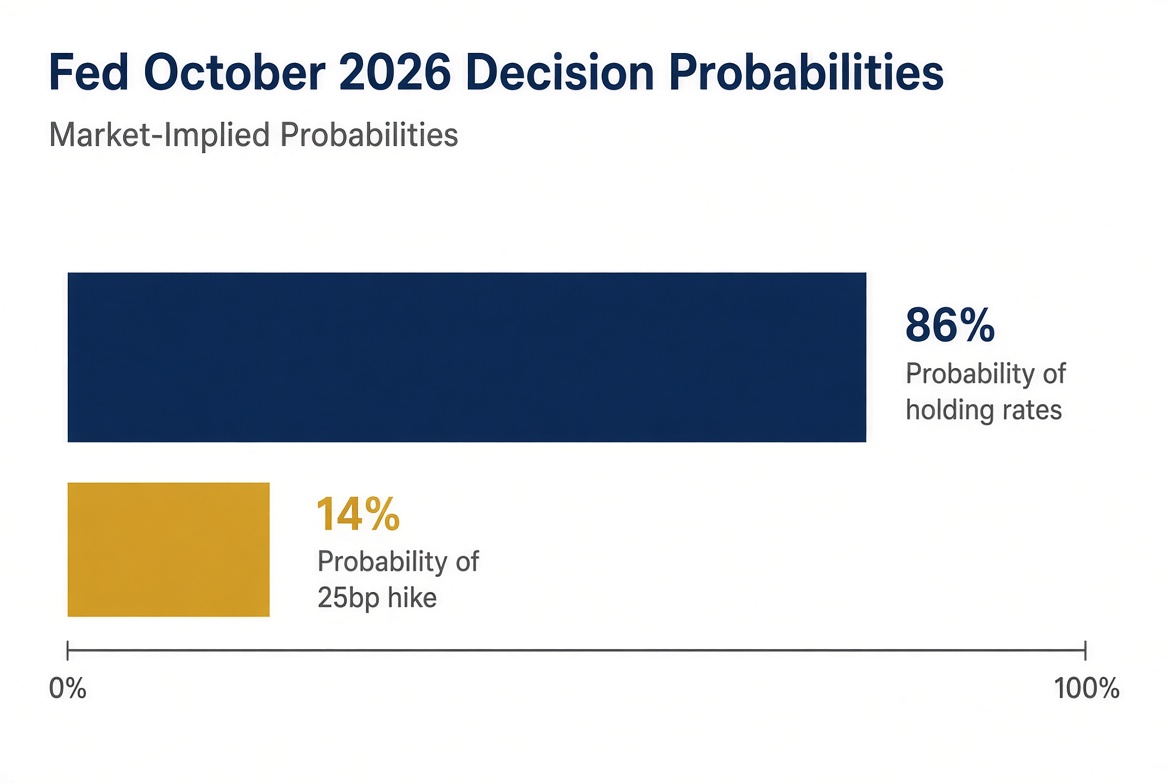
As of mid-October the market assigns roughly 86 percent probability to leaving the rate unchanged and about 14 percent to a 25-basis-point increase. These odds shifted quickly after the CPI and again after Warsh’s comments. The long end of the curve, however, is not waiting for the October decision. It is already pricing the probability that if the energy premium does not decline, the Fed will have to act in December or later. Higher long-term yields make every multi-year project more expensive and raise the cost of capital for investments whose returns depend on energy costs remaining predictable.
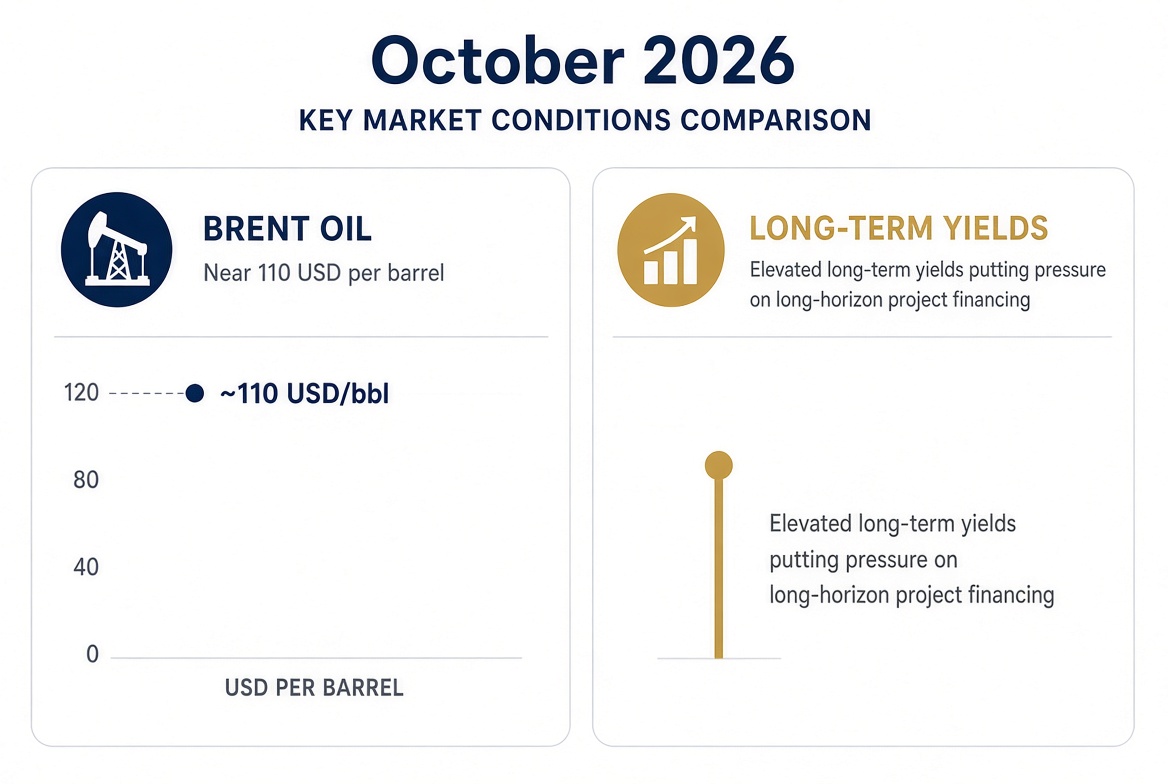
Data centers, whose capital expenditures are already large, pay for chips, for electricity, and for more expensive long-term capital. In states with a concentration of such projects, interconnection timelines for new capacity are significantly extended, and regional electricity prices are higher than the national average. To claim that the energy shock is a problem only for oil consumers is to ignore the fact that it is already affecting the cost of capital for the large investment cycle in artificial-intelligence infrastructure.
The Two Scenarios for the Federal Reserve’s October 28 Meeting
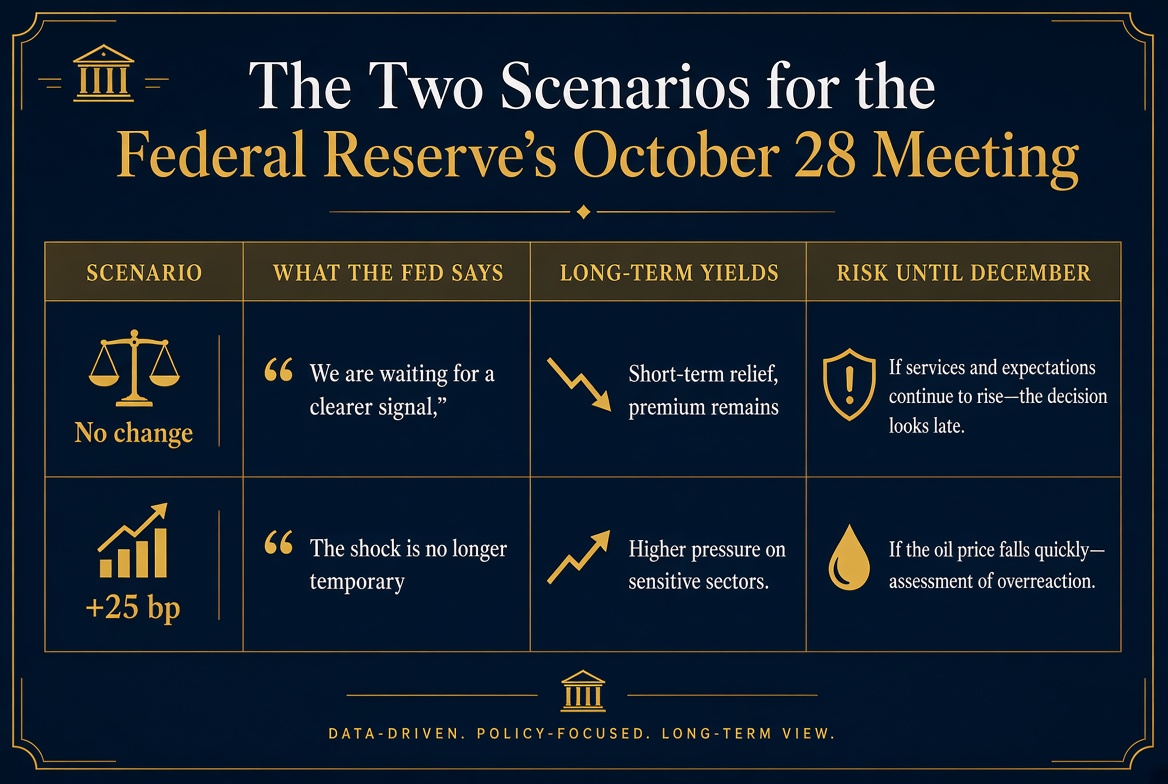
If the Fed leaves the rate unchanged, the market will take it as a signal that the Committee prefers to wait for clearer evidence of the inflation trend. Yields on short-term bonds may ease. The premium at the long end, however, will not disappear while the barrel price remains above $105–110. The Committee will have to explain why the lower PCE index and the weak labor market matter more than the rise in service prices and the fact that short-term inflation expectations are no longer at the levels of early summer. If by December services continue to rise, expectations remain elevated, or more companies begin to re-sign energy contracts at higher prices, the same decision will look already late.
If the Fed raises the rate by 25 basis points, this will be an acknowledgment that the argument for a purely temporary shock no longer holds. The risk is real: interest-sensitive sectors will feel the impact precisely when artificial-intelligence infrastructure is seeking chips, electricity, and financing. The increase will be justified only if the Committee sees that secondary effects are already priced in. If oil then falls quickly and inflation data cool, the same decision will be criticized as an overreaction. The problem is that the cost of error is not symmetric. Waiting and then discovering that the threshold has been crossed - that the moment for action has been missed - will cost far more in short-term inflation expectations and in long-term bond yields than acting and later correcting if the shock passes.
For investors the picture is, if anything, clearer than for the Committee. Companies with high energy intensity are already feeling pressure on margins. Data-center projects pay more expensive power and wait longer for interconnection, while the long end of the curve raises the cost of capital. If the Fed waits and oil remains high, the December meeting will have to deliver not only its new projections but also an explanation of why the signs that the energy shock is already transmitting into services and into expectations were not sufficient in October.
In Heart of Darkness Marlow finds Kurtz when he is no longer himself. In Apocalypse Now Willard reaches the colonel when he no longer belongs to the world we know. Brando does not portray a man who is still hesitating whether to return to civilization. His character has decided and has crossed to the other side. The Federal Reserve holds instruments Kurtz did not have - publicity, another meeting, the possibility of correction. But oil above $110 has already changed the conditions under which short-term inflation expectations return to the target. If the Committee waits without saying clearly why it believes services will not continue to rise, that inflation expectations will normalize, and that companies will not re-sign their electricity contracts at higher prices, the decision may look reasonable on October 28 and prove reckless in December. The horror described by Joseph Conrad is not in the threshold itself. It is in the possibility that the threshold can be crossed, and the moment for the Fed missed, while the institution is still explaining why it has time to wait.
Frequently Asked Questions on Oil Above $110 and the Federal Reserve’s October 28 Meeting
Why does the Federal Reserve look at oil if it targets the personal consumption expenditures index rather than CPI?
The Fed uses PCE because it better reflects actual consumption and is revised. September CPI, however, is the last complete report before the meeting and shows that the energy shock is not slowing. The Committee must judge whether this shock remains isolated or is already transmitting into services and into short-term expectations that later enter PCE as well. Softer earlier PCE data provide grounds for waiting, but they do not remove the risk that pricing-in has already begun before it appears in the next report.
What exactly should we watch between October 28 and the December meeting?
Three things. First, whether service prices continue to accelerate on a monthly basis. Second, whether short-term inflation expectations - both break-even yields and the University of Michigan survey - remain higher than levels at the beginning of the summer. Third, whether more companies begin to re-sign electricity contracts and revise compensation budgets. If all three move in the same direction, the claim that the shock is temporary becomes difficult to defend.
How do high oil prices and possibly higher interest rates affect data-center projects?
In two ways. The first is related to the grid and to electricity: extended interconnection timelines for new capacity and higher regional power prices. The second is related to financing: higher long-term yields raise the cost of capital for multi-year projects. Companies pay for both at the same time. The Fed’s waiting does not affect either of them.
What is the difference between the insurance premium in the oil price and the spot market itself?
The spot price reflects the current balance of supply and demand. The insurance premium is the additional price for the risk of a new supply disruption. If the premium dominates and supply can recover within weeks through a lasting return of a significant share of normal volumes, the Fed has a stronger argument for a temporary shock. If the constraint continues for months, that argument falls away.
Why is the Kurtz analogy useful if the Federal Reserve is not isolated like him?
Precisely because it is not isolated and can still miss the moment. Kurtz has no publicity and no second meeting. The Fed has both. The analogy does not claim that the Committee is in the same position. It shows that the possession of instruments does not guarantee that the right moment for action will be seized in time. It remains for us to watch the data and, on that basis, to forecast the Fed’s action on October 28.
Leave a Reply
Трябва да влезете или да се регистрирате, за да публикувате коментар.