

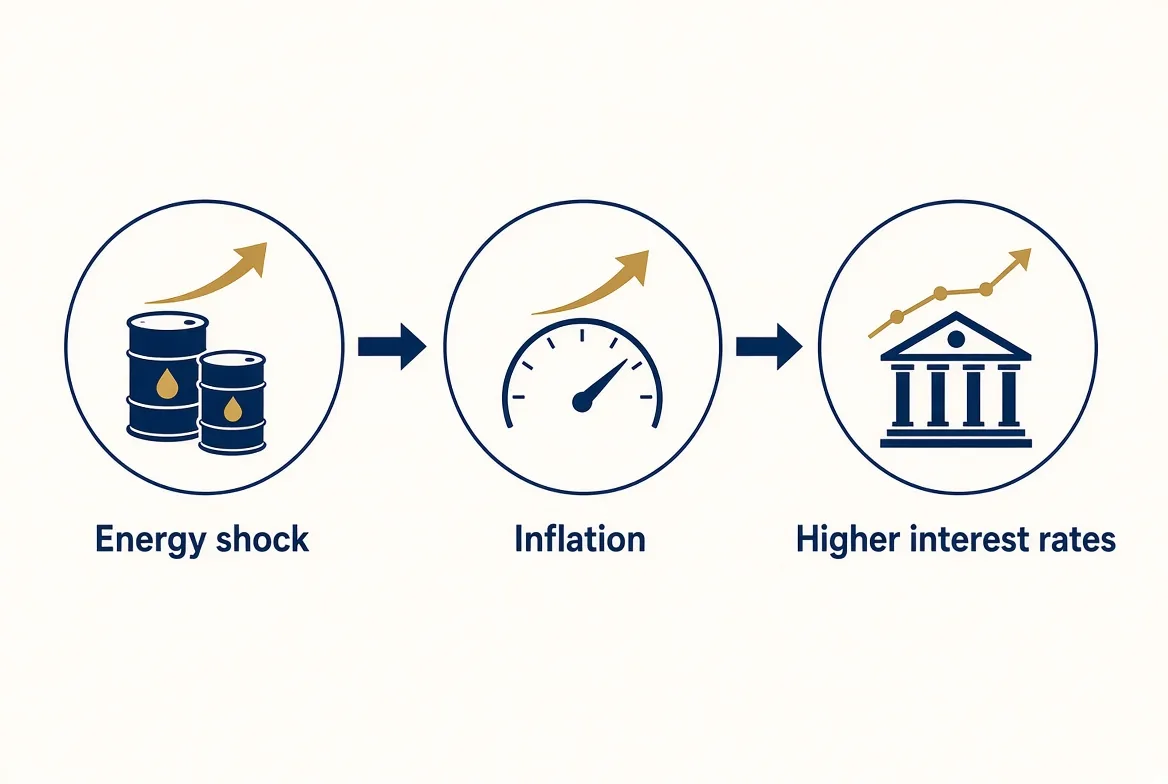
In the second half of the 1970s inflation in the United States spun out of control not because of a single event, but because of an accumulation of factors that fed one another. Inflation is the sustained rise in the general level of prices. When it accelerates, money loses purchasing power, and central banks usually raise interest rates to cool demand and limit further price increases. The two oil shocks - in 1973 after the Arab producers’ embargo and in 1979 after the Iranian revolution - sharply raised the price of energy and transmitted it through the entire economy. At the same time fiscal policy remained expansionary, and the Federal Reserve for a long time did not react decisively enough, partly because it feared recession and partly because inflationary expectations had already become entrenched. Workers demanded higher wages to offset the rise in prices, firms raised prices to cover higher costs, and the circle closed. By 1979 inflation had exceeded 11 percent on an annual basis, and long-term interest rates rose with it.
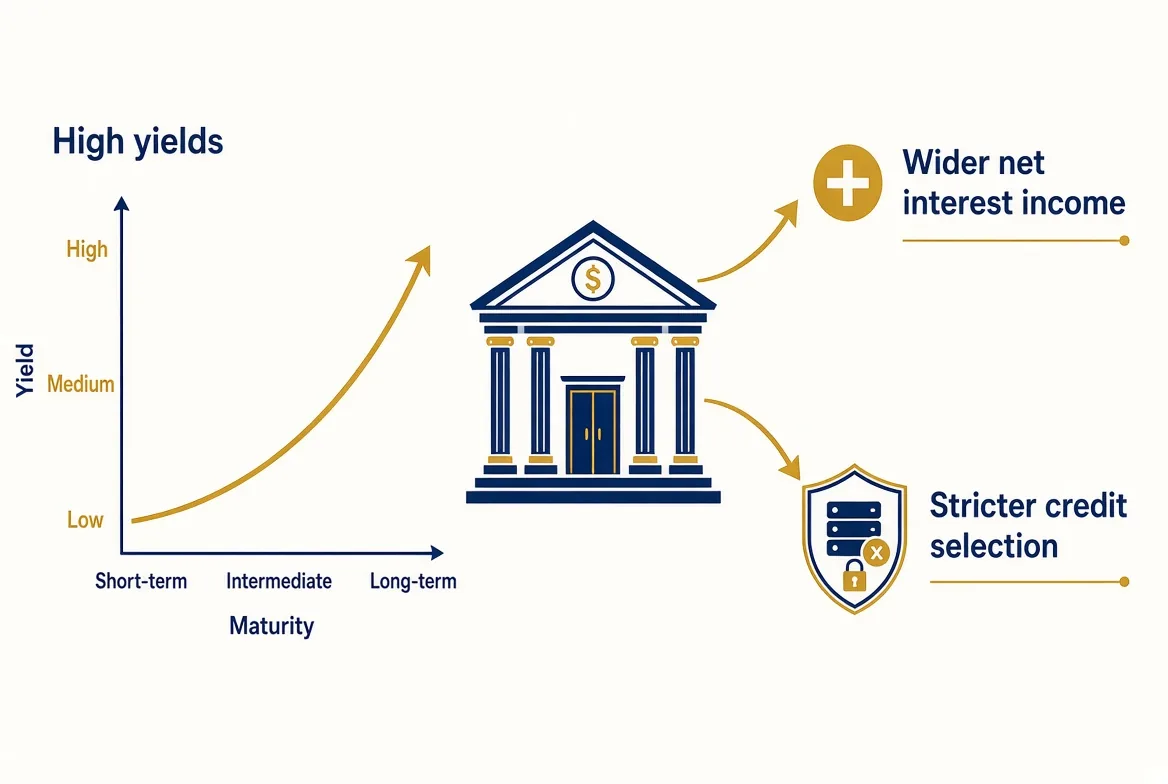
Paul Volcker took the chairmanship of the Federal Reserve in August 1979 with the clear task of breaking this circle. He did not limit himself to timid steps. The policy rate was raised aggressively, at certain moments above 19 percent, and the money supply was tightened. The aim was to convince markets, firms and households that inflation would not be tolerated. The cost was a severe recession in the early 1980s, high unemployment and a sharp jump in the cost of servicing debt. Banks reported in this environment in real time. High yields first widened their net interest income, because they could reprice loans faster than deposits. At the same time inflation data decided whether the Federal Reserve would continue to tighten or stop. Credit quality was watched closely, because more expensive debt and a weaker economy began to weigh on borrowers.
Today the situation is not identical and the differences are material. Inflation is not double-digit, the policy rate is nowhere near the levels of the early 1980s, and the economy is not in a deep recession. The yield on the ten-year U.S. Treasury note around 5.19 percent is high relative to recent years, but not extraordinary in a longer historical perspective. The similarity lies only in the mechanism: the market price of long-term money is transmitted into banks’ credit decisions, and inflation data decide whether this pressure will be reinforced or will ease. The Federal Reserve has already raised the rate in September, and most participants in the dot plot expect one more step by the end of the year. Brent crude is trading near $105 a barrel, and JPMorgan Chase, Goldman Sachs, Citigroup and Wells Fargo are reporting third-quarter results on the same day the market awaits the September consumer price index. The question these numbers will answer is not whether earnings will beat consensus by a few cents. It is whether the high long end of the yield curve is already turning from a market signal into a real increase in the cost of credit and a more cautious attitude toward financing artificial-intelligence infrastructure, or whether margins and portfolio quality are still holding. The previous article examined the off-balance-sheet commitments of the hyperscalers and SpaceX - the special-purpose vehicles, long-term lease contracts and commitments that have not yet entered the consolidated balance sheet. The focus now shifts to the lenders on the other side of these transactions. Public data on the precise size of bank exposure to financing data centers, chips or special-purpose vehicles in the artificial-intelligence sector are currently lacking, so the link remains one of principle and is subject to verification through commentary and provisions in the reports.
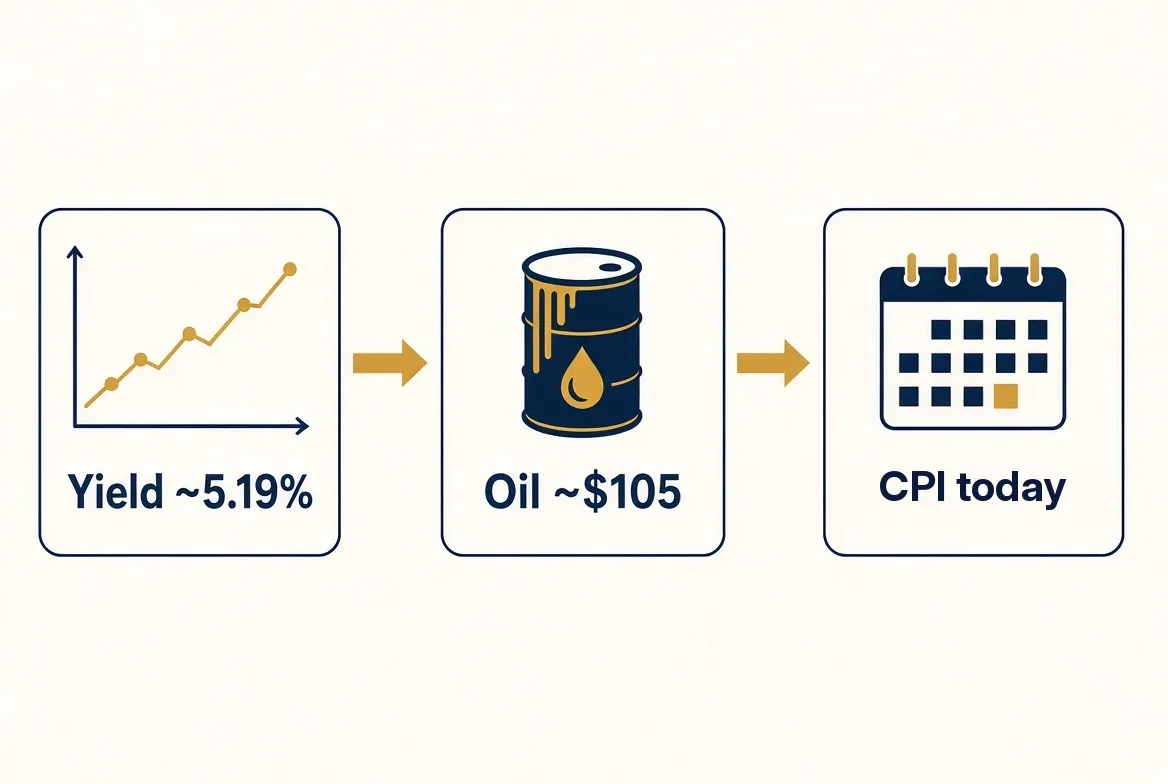
Energy prices, supported by tension in the Middle East, are keeping the headline inflation index elevated. In this environment banks are reporting a quarter in which net interest income should benefit from higher rates, but investment banking and trading are already feeling the higher cost of capital. Consensus for JPMorgan is around $5.90-$5.93 earnings per share on revenues near $51 billion; for Goldman Sachs estimates range more widely around $12.80-$13 on revenues of about $16.8 billion. These figures, however, make sense only if read together with guidance for the coming quarters and with commentary on credit risk.
Expected Results Ahead of the Bank Reports
| Bank | Expected EPS | Expected Revenues | Key Focus |
|---|---|---|---|
| JPMorgan Chase | $5.90-$5.93 | ~$51 billion | Net interest income and guidance |
| Goldman Sachs | $12.80-$13 | ~$16.8 billion | Trading and investment banking |
| Citigroup | ~$2.65 | ~$23.7 billion | Progress on restructuring |
| Wells Fargo | ~$1.84 | ~$22.3 billion | Net interest income |
For JPMorgan the important comparison is not only with consensus, but also with the cleaner result from the second quarter after non-recurring gains, which the bank itself identified as more representative of its current earning power.
Banks stand between savers and borrowers. They take deposits and extend loans. The difference between the interest they receive on loans and the interest they pay on deposits is called net interest income. When market yields rise, this margin usually widens if the bank succeeds in repricing loans faster than deposits. At the same time more expensive capital can reduce the appetite for new transactions and make credit selection stricter.
Results from the Bank Reports on 13 October
JPMorgan Chase: net interest income and guidance
The bank reported net income of $15.3 billion, or $5.57 per share. Non-recurring items are expenses or revenues that do not recur regularly and do not reflect the bank’s current ability to earn. JPMorgan reported losses from the revaluation of investment securities of $658 million ($0.18 per share). When these items are excluded, earnings per share are $5.75 - below consensus of around $5.90-$5.93. Revenues on a managed basis reached $50.9 billion, an increase of 8 percent year on year. Net interest income was $27.1 billion (up 13 percent), and excluding markets $24.7 billion (up 6 percent), supported by higher deposits, credit cards and corporate loans. Expenses reached $27.3 billion. Provisions for credit losses were $2.74 billion, with net charge-offs of $2.2 billion and a reserve build of $539 million. Average loans rose 10 percent year on year, average deposits 8 percent.
The bank raised its guidance for net interest income for 2026 excluding markets to around $97.2 billion and indicated a central scenario for 2027 of around $107 billion. These guidance figures assume continued growth in loan volumes and deposits. Jamie Dimon noted that the economy is being held up by business investment and consumption, but investment-banking activity had moderated during the quarter: fees rose 14 percent year on year but fell 8 percent versus the second quarter. This moderation raises the question whether more expensive capital is already reducing the appetite for large technology transactions and issuance. Markets rose 15 percent, with equities jumping 49 percent. Return on tangible common equity excluding non-recurring items was 21 percent. The shares initially fell more than 3 percent before the open, then recovered after the net-interest-income guidance. The price-to-earnings multiple on expected earnings for the next twelve months remains around 12-13 times.
Goldman Sachs: strong results from trading and investment banking
The bank reported $17.01 per share and revenues of $18.68 billion - significantly above consensus of around $12.80-$13 and $16.8 billion. Net income reached $5.29 billion, an increase of 29 percent year on year. Return on equity on an annual basis was 18.7 percent. Equity trading jumped 72 percent to $6.44 billion, supported by financing and volatility linked to energy prices and geopolitics. Fixed income, currencies and commodities were $3.47 billion, a decline of 1 percent. Investment-banking fees rose 21 percent to $3.22 billion, with advisory revenues reaching a record $1.65 billion. David Solomon described the environment as “complex,” but emphasized that clients continue to seek advice, execution and financing. The shares rose about 4 percent before the open. The price-to-earnings multiple on expected earnings remains around 14-15 times.
Wells Fargo: earnings above expectations, net interest income below them
The bank reported $1.87 per share on revenues of $21.87 billion. Earnings exceeded consensus of around $1.84, but revenues and net interest income remained below expectations. Net interest income was $12.52 billion, up 5 percent, but below consensus of around $12.63 billion. The bank cited the effect of lower rates on floating-rate assets, higher deposit costs and a decline in non-interest-bearing deposits. Average loans rose 11 percent year on year, average deposits also 11 percent. Provisions for credit losses were $1.03 billion. Charlie Scharf highlighted broad-based growth and a higher return on tangible common equity (16.3 percent for the quarter). The shares moved unsteadily and finished with a modest decline before the open.
Citigroup: earnings and revenues above consensus
The bank reported $2.85 per share on revenues of about $23.85 billion - above consensus of around $2.62-$2.66 and $23.7 billion. Net income reached $5.25 billion, an increase of 40 percent year on year. Investment-banking fees rose 9 percent year on year to $1.35 billion, but fell 13 percent versus the second quarter. Jane Fraser indicated that the bank expects to exceed its return target for the year and continues on the path toward a sustainable 14-15 percent. Return on tangible common equity for the quarter was 11.5 percent.
Comparison of Results from the Bank Reports
| Bank | Reported EPS | Revenues | Key Comment |
|---|---|---|---|
| JPMorgan | $5.57 ($5.75 adjusted) | $50.9 billion | NII holds; IB moderated |
| Goldman Sachs | $17.01 | $18.68 billion | Strong equities and IB |
| Wells Fargo | $1.87 | $21.87 billion | NII below expectations |
| Citigroup | $2.85 | ~$23.85 billion | Above expectations; IB slows QoQ |
Summary of the Bank Reports and What to Watch Ahead of CPI
Net interest income is holding at JPMorgan and widening thanks to volumes, despite higher yields. At Wells Fargo pressure from deposit costs is visible. Investment banking is mixed: Goldman beats strongly, while JPMorgan and Citigroup note a moderation of activity versus the second quarter. There are no clear signals of a sharp narrowing of credit or of higher premiums on technology transactions. Credit quality remains under control, without a surprising increase in provisions. These data confirm that for now margins are holding and the financing channel has not visibly narrowed. Today’s consumer price index at 3:30 p.m. Bulgarian time will show whether pressure on yields will intensify.
Three indicators will show whether yields above 5 percent are already changing banks’ behavior. The first is net interest income and guidance for it. At higher yields the margin between interest on loans and on deposits usually widens, but if competition for deposits intensifies or if demand for new credit cools, growth may turn out more modest than expected. If JPMorgan maintains or slightly raises its net-interest-income guidance, this will confirm that the margin is holding; if it lowers it or speaks of stronger competition for deposits, this will be a signal that higher yields are already being reflected in funding costs. The second is investment banking and market activity. JPMorgan had signaled growth in the mid-to-high teens for fees and for trading; Bank of America had expected a decline of at least 10 percent in investment banking. If the results confirm weaker activity, this will mean that more expensive capital is already reducing the appetite for issuance and transactions, including in the technology sector. The third is commentary on credit risk and on exposure to financing artificial-intelligence infrastructure - directly or through private credit and special-purpose vehicles. If banks begin to set aside larger provisions or to speak of higher premiums for this type of transaction, this will be a signal that the channel that has so far financed spending on chips and data centers is beginning to narrow. For now this remains a possibility that the reports can confirm or refute. Investment-grade credit spreads remain relatively stable so far, without a clear widening, which makes the thesis of a narrowing channel preliminary rather than already observed.
The September consumer price index, which is released today, will decide whether pressure on yields will intensify or ease. It is not a matter of predicting the number, but of seeing how the two possible outcomes change the picture. Consensus for the headline index is moving around 3.6 percent on an annual basis, and for core inflation around 3.1-3.2 percent. A number above consensus would reinforce expectations of another rate increase and would exert pressure on credit spreads to widen in the short term. A number below consensus would give the market grounds to ease part of the premium in yields and to limit the widening of spreads. If the energy component keeps the headline index near or above this threshold, and core inflation does not cool sufficiently, expectations of another rate increase will be reinforced and the long end will remain high. A cooler number below these levels will give the market grounds to ease part of the premium already priced in. In both cases the link with the banks is direct: higher yields support net interest income in the short term, but increase the risk of weaker credit demand and of higher funding costs for the banks themselves. For companies that rely on debt to build artificial-intelligence infrastructure the difference is even clearer. When the long end holds above 5 percent, project selection becomes stricter and spreads on investment-grade and private credit widen more easily. The question is not whether banks “believe” in the artificial-intelligence theme, but whether at current yields and spreads they are willing to take on more debt linked to chips and data centers, or are beginning to demand a higher premium.
The difference between the banks matters. JPMorgan and Bank of America have a stronger base of net interest income and a credit portfolio that can benefit from higher rates, provided quality is preserved. Goldman Sachs and Morgan Stanley are more sensitive to market activity and to investment-banking fees. If the results show that trading and transactions are holding up, the market will take it that high yields have not yet narrowed the financing channel. If warnings of weaker appetite or of higher provisions appear, selection will tighten - both at the banks and at the companies that rely on cheap debt for chips. History knows periods in which the long end of the curve remains high and credit does not stop immediately but becomes more selective: the early 1980s, 2022. The current configuration is not identical, but the mechanism of transmission from market yields to credit decisions is similar.
For the investor in equities the significance is the following. If the banks show that net interest income is holding and that there are no signs of strain in credit quality, the sector can receive support from higher rates, even though weaker investment-banking transactions will limit part of the growth. For those who follow the technology sector and spending on artificial intelligence, the question is whether the financing channel remains open at current yields or is beginning to require a higher premium. Today and tomorrow the results of Bank of America and Morgan Stanley will be seen, as well as the immediate reaction of yields after the release of the consumer price index. The movement of credit spreads and more detailed commentary on net interest income and on private credit will become clearer in the coming weeks. The criterion for observation is precisely this: if margins hold and spreads do not widen, the market can continue to finance the large infrastructure transactions. If signs of higher costs or of weaker appetite appear, selection will become sharper - both at the banks and at the companies that rely on debt to buy chips before revenues have arrived in full.
The reports and inflation will not give a final answer. They will show, however, whether high yields are still only a market price or are beginning to change actual lending and the willingness to finance the large outlays on artificial intelligence. If margins hold and there are no signs of strain, the market can continue to finance the spending. If warnings appear, selection will become sharper - both at the banks and at the companies that rely on cheap debt for chips. When the long end holds above 5 percent and energy keeps inflation elevated, the appetite for risk does not disappear. It is redistributed.
Frequently Asked Questions
Why is the September consumer price index so important right now?
Because it will show whether energy prices around $105 and tension in the Middle East are already turning into more persistent inflationary pressure, or whether core inflation remains under control. Consensus is moving around 3.6 percent for the headline index and around 3.1-3.2 percent for core inflation. A hotter number strengthens the expectation of another rate increase by the Federal Reserve and keeps the long end of the yield curve high. A cooler number gives the market grounds to ease part of the premium already priced into yields above 5 percent.
What does “net interest income” mean and why do we watch it in bank reports?
Net interest income is the difference between the interest the bank receives on loans and the interest it pays on deposits. At higher market yields this margin usually widens if the bank succeeds in repricing loans faster than deposits. If, however, competition for deposits intensifies or demand for new credit cools, growth may turn out more modest. Guidance for the coming quarters shows whether banks expect the margin to hold. Maintaining or a slight increase in guidance is a positive signal; a reduction or commentary about stronger competition for deposits is a signal of strain.
How do bank reports connect with the financing of artificial-intelligence infrastructure?
A large part of spending on chips and data centers is financed with debt - directly, through private credit or via special-purpose vehicles that remain off the balance sheets of the hyperscalers. Banks stand on the other side of these transactions. Public data on the precise size of this exposure are currently lacking. If higher provisions, stricter commentary on credit risk or signals of higher premiums on this type of financing appear in the reports, this will mean that the channel is beginning to narrow at current yields. Investment-grade credit spreads remain relatively stable so far.
How do JPMorgan and Bank of America differ from Goldman Sachs and Morgan Stanley in this environment?
JPMorgan and Bank of America have a stronger base of net interest income and a credit portfolio that can benefit from higher rates, provided quality is preserved. Goldman Sachs and Morgan Stanley are more dependent on investment-banking fees and on market activity. With more expensive capital the first two can compensate more easily, while the second two feel the decline in appetite for transactions more quickly.
What should we watch in the coming weeks to understand whether the pressure is intensifying?
Today and tomorrow the results of Bank of America and Morgan Stanley will be seen, as well as the reaction of yields after the consumer price index. The movement of investment-grade credit spreads and more detailed commentary on net interest income will become clearer in the coming weeks. If margins hold and spreads do not widen, the market can continue to finance the large infrastructure transactions. If signs of higher funding costs or of weaker appetite for new transactions appear, selection will become sharper - both at the banks and at the companies that rely on debt to buy chips before revenues have arrived in full.
Important notice
This article is for information and education only. It is not financial advice, an investment recommendation or professional advice of any kind. The views expressed are the author’s personal opinions and are not recommendations to buy, sell or hold securities, assets or investments. Investing involves substantial risk, including the possible loss of all capital. Past performance is not a guarantee of future results. Each reader should conduct independent research, consult a qualified financial adviser and weigh financial circumstances, risk tolerance and investment objectives before taking any decision. The author and borsite.net accept no liability for any loss arising from the use of the information in this article.
Leave a Reply
Трябва да влезете или да се регистрирате, за да публикувате коментар.