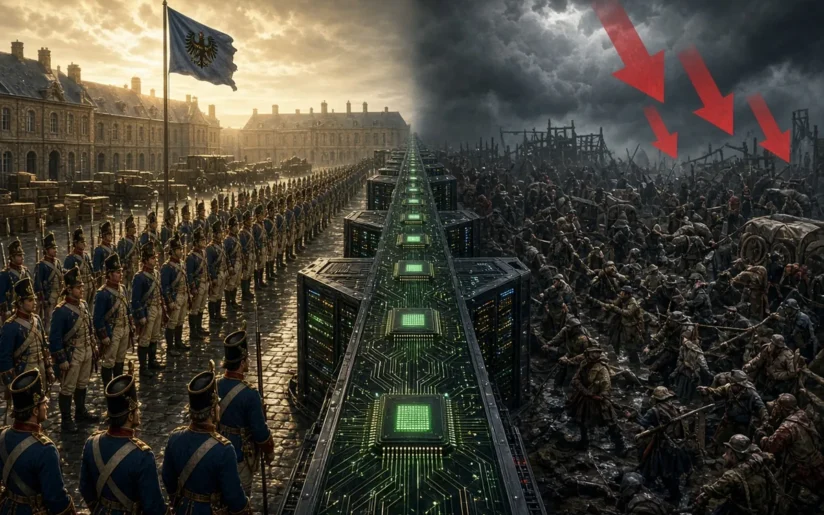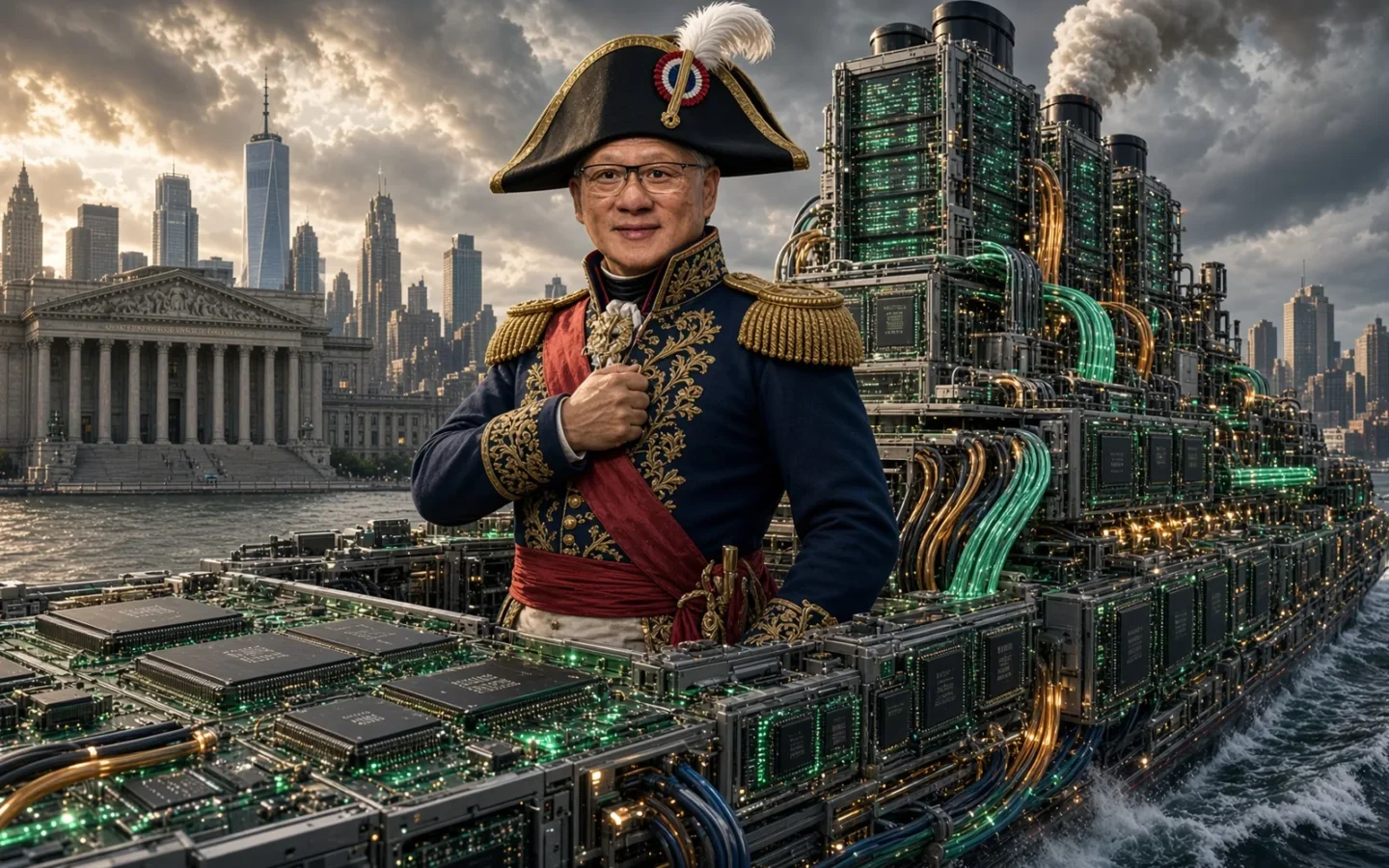
On March 1, 1815, Napoleon Bonaparte stepped ashore on the southern coast of France, at Golfe-Juan, after escaping from the island of Elba. In less than three weeks his army grew by the day, King Louis XVIII fled Paris, and on March 20 Napoleon entered the capital and took power again. Five days later Austria, Britain, Prussia and Russia formed a new, Seventh Coalition. On June 18, at Waterloo, came the final defeat. The Hundred Days ended with a second island, this time Saint Helena.
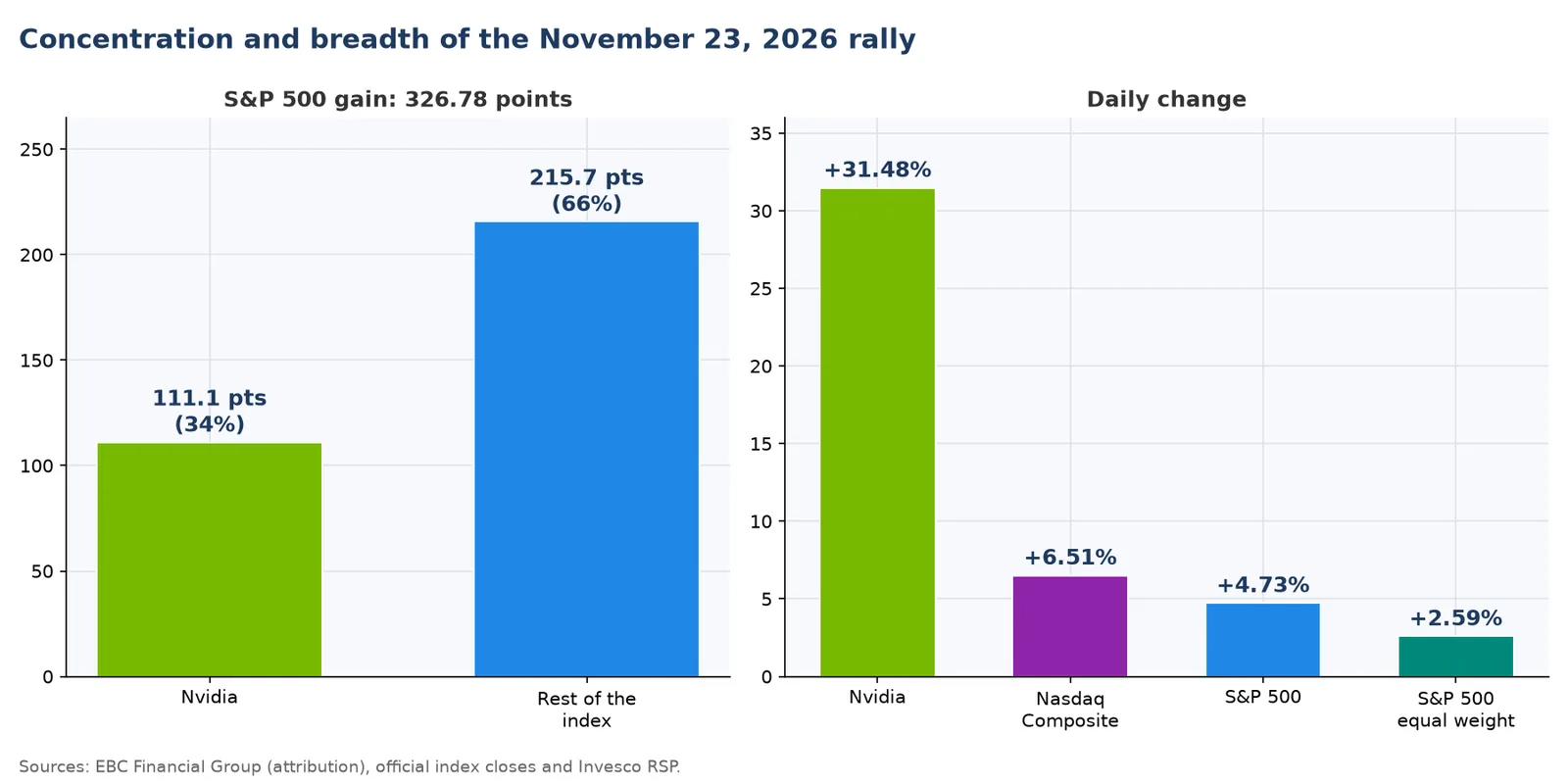
The market on November 23 behaved in a similar way. It handed Nvidia back about $952 billion of market value in a single session after Jensen Huang was reinstated as chief executive. The stock jumped 31.48% to $165.05, the Nasdaq Composite added 6.51% and the S&P 500 rose 4.73% to 7,237.17, the best day for both indexes since April 2025. Nvidia delivered about 34% of the S&P 500’s daily gain and lifted its weight in the index from 5.1% to 6.4% in one day. Yet the rally was not only about Nvidia: more than 80% of the companies in the index rose, and the equal-weight index gained 2.6%.
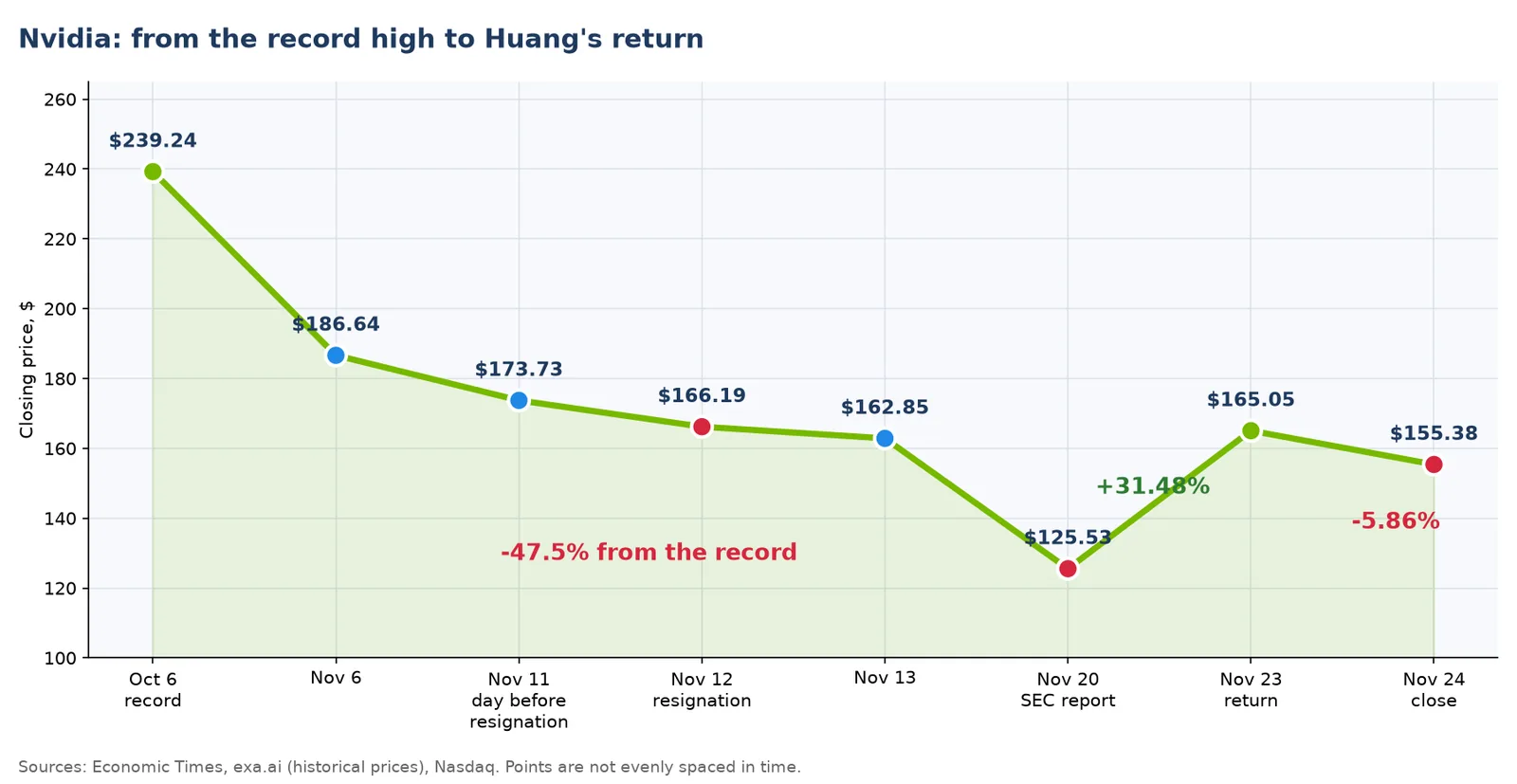
On November 24, part of the jump started to fade. Nvidia closed 5.86% lower at $155.38, and its market value fell by about $234 billion. The S&P 500 slipped 0.50% to 7,201.09, and the Nasdaq Composite fell 1.48% to 23,733.54. For now, the one-day rally looks like relief, not a verdict. Part of the move is also explained by positioning. With sentiment deeply bearish, the removal of the leadership question triggered short covering, as Goldman Sachs noted. That amplified the swing but did not change the fundamental questions.
| Metric | November 23 (close) | November 24 (close) | Note |
|---|---|---|---|
| Nvidia (stock) | +31.48% to $165.05 | -5.86% to $155.38 | Partial pullback |
| Nvidia (market value) | +$952bn, about $3.99 trillion | about -$234bn, about $3.75 trillion | About 35% below the October 6 record (at the November 24 close) |
| S&P 500 | +4.73% to 7,237.17 | -0.50% to 7,201.09 | Best day since April 2025 |
| Nasdaq Composite | +6.51% to 24,089.56 | -1.48% to 23,733.54 | Cooling off |
| Nvidia’s contribution to the S&P 500 | about 34% (111 of 326.78 points) | - | High concentration |
| Nvidia’s weight in the S&P 500 | from 5.09% to 6.39% | - | +1.3 pp in one session |
| S&P 500 equal weight (RSP) | +2.59% | - | Broad participation |
The Cost of Jensen Huang’s Absence and the Value of His Presence
On Monday the market priced, above all, the cost of Huang’s absence. From the November 11 close, the last day before the resignation was announced, to November 20, Nvidia lost about $1.16 trillion in market value, and the stock fell from $173.73 to $125.53. On November 23 it recovered about $952 billion of that. The number is rough, but it shows exactly what was being valued: not next quarter’s earnings, and not even the company as an institution, but the man who embodies it.
Historically, a one-day move in market value this large tied to a single person is rare. In an analysis of 22 earlier cases of a chief executive leaving during a scandal, the move on the day of departure was close to zero: a median of +0.1% relative to the market, with the largest drop being 8.5% at HP in 2010. Nvidia lost 4.0% relative to the S&P 500 on the day of the resignation, the second-largest drop in the sample. From October 28, the last close before the first report, to November 13 the stock fell 24.4%, but the SOXX semiconductor fund lost 14.2% over the same days, so part of the decline was sector-wide. More important is what comes next: in the year after the departure, the median stock in the sample trailed its market by 15.9%, and 16 of the 22 stocks underperformed.
A separate review of 15 departures of founders and defining leaders since 1985 reaches a similar conclusion: in 10 of the 14 cases with a full year of data, the stock trailed the S&P 500, by a median of about 21 percentage points. Both samples are small and are not statistical tests. Neither covers a case in which the leader comes back after 11 days.
Huang’s case stands out not in its direction but in its scale. The market is not used to putting such a high price on a key person at a company of this size. The fact that it did says less about Huang himself and more about how concentrated the AI trade has become in a single firm.
The historical comparisons, however, understate the systemic nature of this case. Most earlier episodes involved companies that did not carry a 5-6% weight in the S&P 500 and were not a key supplier of critical infrastructure to the entire technology sector. With Nvidia, the effect is transmitted not to a single stock but to the valuations and financing of a broad range of players.
| Period | Median of the 22 cases | Nvidia |
|---|---|---|
| Day of departure, relative to the market | +0.1% (largest drop: HP, -8.5%) | -4.0% vs. the S&P 500 |
| From first report to departure, relative to the market (13 cases with a gap) | -13.6% | -17.7% vs. the S&P 500 |
| 12 months after departure, relative to the market | -15.9% (16 of 22 underperformed) | No data: Huang returned after 11 days |
What Did Not Change: Nvidia’s Business
While the market was pricing Huang, the business looked the same as before the scandal. On November 17, without Huang, Nvidia reported third-quarter revenue of $115.8 billion for fiscal 2027, up 103% from a year earlier. Gross margin was 74.8%, net income $65.3 billion and free cash flow $43.8 billion for the quarter alone. The fourth-quarter outlook is $130 billion in revenue, plus or minus 3%, and the quarter includes an extra week. For next fiscal year, interim chief executive Colette Kress projects revenue growth of 75%.
There are also two signals that deserve our attention. The gross margin outlook for the fourth quarter is 71-72%, lower than the current level. And the 10-Q quarterly report, which Nvidia usually files on results day, has not been filed yet. The company says it will file it “in the coming weeks”, and the legal deadline is December 4.
This is where the most important correction lies in how we should look at the valuation. At $165.05, Nvidia trades at about 11 times expected earnings for the next 12 months. On November 20, at $125.53, the multiple was about 8.4 times, while AMD traded at about 29 times. This is not the valuation of a company whose risks the market is ignoring. It is a valuation in which the discount for political, regulatory and management risk is already large. The question is not whether the market is pricing the risk, but whether the discount is big enough.
| Metric | Value | Note |
|---|---|---|
| Revenue | $115.8bn | +103% year on year |
| Gross margin | 74.8% | Q4 outlook: 71-72% |
| Net income | $65.3bn | +105% year on year |
| Earnings per share | $2.70 | $2.68 excluding one-off items |
| Free cash flow | $43.8bn | For the quarter |
| Q4 revenue outlook | $130bn ±3% | Includes an extra week; excludes data center compute products in China |
| Price to expected earnings | about 11x at $165.05 | 8.4x at $125.53 (Nov 20) |
| 10-Q report | Not filed | Deadline: December 4 |
The National Security Risk Around Nvidia That the Market Keeps Pricing
The least clarified element remains national security risk. Huang’s resignation was announced on November 12 after revelations of extramarital affairs, including one with Alice Huang, a Chinese businesswoman and former Megaspeed executive who is accused of having ties to Beijing. The board said it had received input from senior levels of the US government and, based on that input, was confident that Huang’s reinstatement poses no national security risk. President Trump said: “We gave them assurances, at least with everything we know.” No conclusion has been published. That does not close the matter.
At least six processes remain open:
- a committee of independent directors is continuing its investigation into whether Huang was the target of a foreign intelligence effort;
- according to Reuters, the Securities and Exchange Commission (SEC) is examining potential accounting issues at the company;
- Huang is due to testify before the Senate Banking Committee at a public hearing on December 3, and is also expected to answer questions from the House Foreign Affairs Committee;
- on November 23 the US added to its trade blacklist Megaspeed, Alice Huang’s former employer, and Alibaba’s Singapore subsidiary;
- the company and Huang face a shareholder lawsuit alleging that the relationship with Alice Huang was concealed;
- according to Reuters, after Huang’s resignation some customers in China cancelled or delayed orders, putting billions of dollars in revenue at risk.
National security risk in this case has three separate components. The first is the risk of new export restrictions that would affect access to the Chinese market. The second is the risk of a formal investigation of Huang himself and potential consequences for his ability to run the company. The third is the risk of lost trust among institutional customers and government counterparties, even without new formal measures. Of the three, the most important for the valuation in the coming months is the first, export restrictions, because it has a direct and measurable effect on growth. The other two act more slowly and are harder to quantify. The loss of trust, however, may prove more persistent: if the investigations last more than a year, the effect on institutional relationships could exceed the short-term effect of export restrictions.
China matters to Nvidia again. In the third quarter, customers headquartered in China and Hong Kong generated $11.05 billion, or 9.5% of revenue, almost four times the $2.97 billion of a year earlier. For the first nine months of the fiscal year the share is 8.0%. Before export controls were tightened it was above 20%. The fourth-quarter outlook excludes revenue from data center compute products in China. If the investigations lead to new restrictions, the loss is not just 9.5% of revenue. It is a loss of growth that recent quarters have shown to be real. At about 11 times expected earnings, the market already prices in part of this scenario, but not its worst version.
| Period | Revenue from China and Hong Kong | Share of revenue |
|---|---|---|
| Fiscal 2022 (to January 2022) | $7.11bn | 26.4% |
| Fiscal 2023 (to January 2023) | $5.79bn | 21.4% |
| Q3 of fiscal 2026 | $2.97bn | 5.2% |
| Q3 of fiscal 2027 | $11.05bn | 9.5% |
| First 9 months of fiscal 2027 | $23.48bn | 8.0% |
| Q4 fiscal 2027 outlook | Excludes data center compute products in China | - |
The Board, the White House and the Limits of Corporate Governance at Nvidia
The board changed its position within days. On November 17, chair Harvey Jones, appointed on November 12 as the first board chair in the company’s history, said on the earnings call that the board does not intend to reinstate Huang. On Sunday, November 22, President Trump publicly called for his return. According to the Form 8-K, the same board reinstated Huang that very day, unanimously, and the decision was announced on Monday morning. This shows where power really sits at a company that is systemically important to US technology policy. If the board has no real choice once the price collapses, shareholders revolt and the White House calls, then the standard rules of corporate governance no longer describe how decisions are made at firms of this size. Investors in other large technology companies now have to treat political intervention as a permanent factor in valuations, not as an exception.
There is, however, another interpretation. The market may have concluded that political risk fell precisely because of the White House’s intervention. If the administration sent a clear signal that it wants Huang in the job and sees no national security risk, then the one-day rally reflects not only relief at the founder’s return but also a partial pricing-in of lower risk. This possibility does not cancel the other questions, but it explains why part of the market was willing to restore so much value so quickly.
The Impact of Interest Rates on the AI Sector
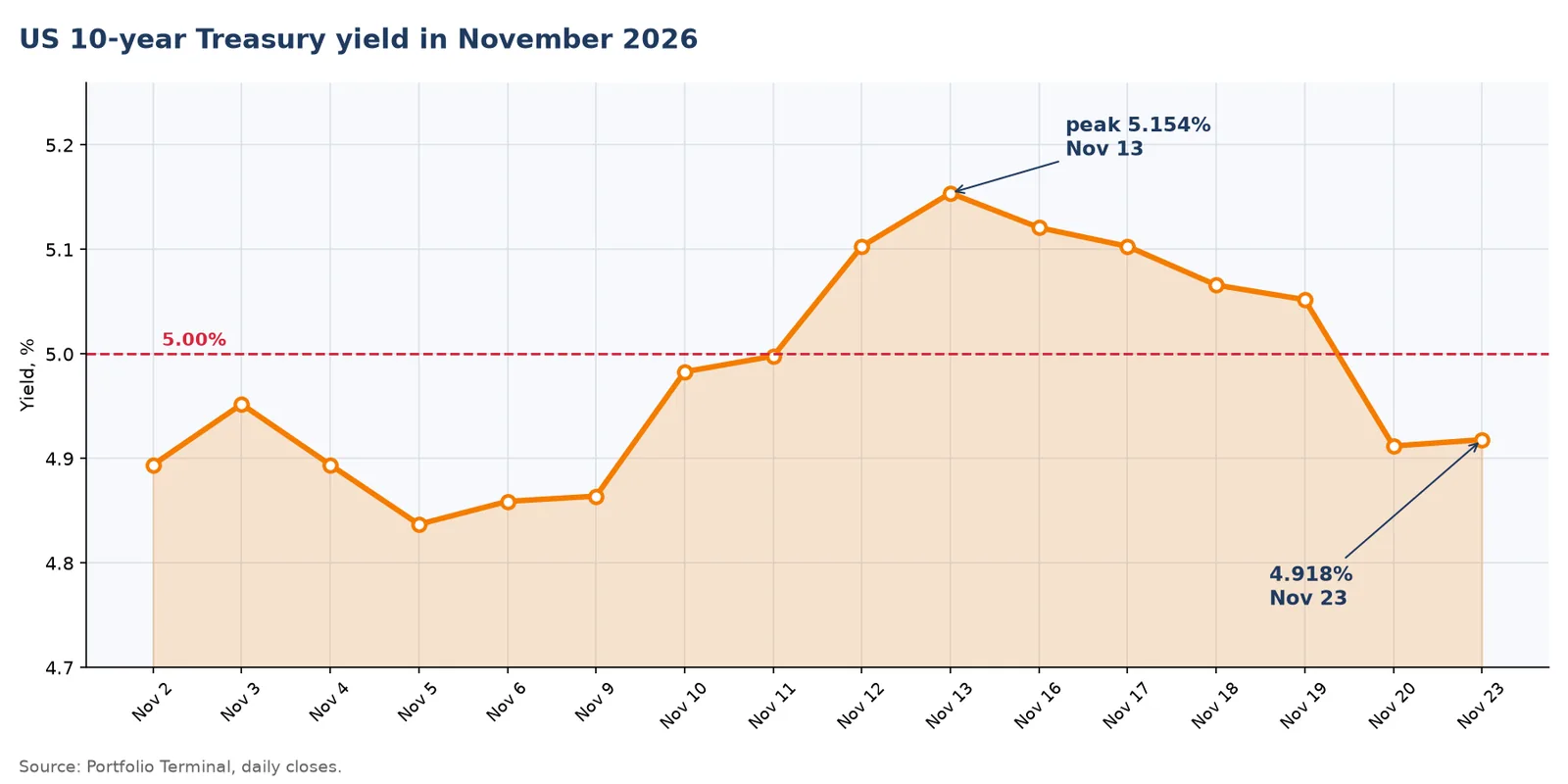
The 10-year US Treasury yield closed at 4.918% on November 23, after reaching 5.154% on November 13. Long-term rates have actually eased from the peak. The pressure comes from short-term rates: fed funds futures price in a more than 95% probability that the Fed raises rates by 0.25 pp on December 9. On Wednesday, November 25, the October PCE inflation data and the second estimate of GDP for the third quarter are released. The market can accept the founder’s return and at the same time refuse to accept that it changes the path of interest rates.
| Date | 10-year yield | Context |
|---|---|---|
| November 5 (lowest close of the month) | 4.837% | Before the Huang scandal |
| November 13 (highest close) | 5.154% | Peak of the period |
| November 20 | 4.912% | Down 0.14 pp in one day |
| November 23 | 4.918% | Almost unchanged |
| November 25 | - | October PCE and second estimate of Q3 GDP |
| December 9 | - | Fed decision; the market expects a 0.25 pp hike |
Interest rates affect the AI sector through two separate channels. The first is the discount channel. A large part of the present value of growth companies comes from cash flows expected to materialize years from now. A higher risk-free rate raises the required return and lowers the present value of those flows, even when earnings forecasts are unchanged. A simple illustration with the Gordon growth model: if the gap between the required return and long-term growth is 4 pp, a 0.5 pp increase in the required return cuts fair value by about 11%; with a 6 pp gap, the effect is about 8%. This is a calculation of the principle, not a forecast. With Nvidia, however, the discount channel is weaker than for most growth companies, because at about 11 times expected earnings the price rests mainly on near-term rather than distant profits.
The second channel is the cost of capital. Large technology companies no longer fund most of their data center spending from operating cash flow alone. According to Morgan Stanley, credit markets will finance more than half of the roughly $3.8 trillion in projected hyperscaler spending (the largest cloud service providers) over 2026-2028. This year Amazon, Alphabet, Meta, Microsoft and Oracle issued more than $370 billion in bonds through November 4 alone. Morgan Stanley strategist Vishwanath Tirupattur argues that with returns on invested capital of 25-50%, which the bank estimates for already-built AI computing infrastructure, a rise in financing costs from 5% to 6% or even 7% is not a major impediment. The bank also stresses that credit spreads are near multidecade lows and that the bigger constraint is access to capital, not its cost.
For weaker players the picture is different. CoreWeave’s bonds trade at yields above 16%. For such companies, higher rates do not just compress valuations; they call into question whether the next phases of the buildout can be financed at all. And these companies are Nvidia’s customers.
| Metric | Value | Note |
|---|---|---|
| Total projected spending | about $3.8 trillion | 2026-2028, per Morgan Stanley |
| Share financed by credit markets | over 50% | Per Morgan Stanley |
| Return on already-built AI computing infrastructure | 25-50% | Depending on the business model, per Morgan Stanley |
| Bonds issued by the five largest in 2026 | over $370bn | Through November 4, LSEG data |
| CoreWeave bond yields | above 16% | Example of a weaker issuer |
The effect is not uniform. Companies with high operating margins, strong free cash flow and access to investment-grade debt can absorb a moderate rise in rates without halting their programs. Companies that rely on external financing at wider spreads, or carry large off-balance-sheet commitments (leases, guarantees, energy contracts), are more vulnerable. The Federal Reserve devoted a section to the topic for the first time in its Financial Stability Report: large technology companies, including Nvidia, have more than $3 trillion of undiscounted off-balance-sheet commitments, including more than $1 trillion in leases that have not yet commenced and more than $2 trillion in take-or-pay contracts and residual value guarantees. The Fed’s concern is that strong companies are thereby supporting projects with weaker credit profiles and could absorb losses if AI demand disappoints.
| Channel | Mechanism | Sensitivity | Example |
|---|---|---|---|
| Discount | A higher risk-free rate lowers present value | High for distant growth, lower for Nvidia (about 11x earnings) | +0.5 pp gives -8% to -11% at a 6 to 4 pp gap (illustration) |
| Cost of capital | More expensive and harder debt financing | Low for the largest, high for weaker players | $3.8 trillion, over 50% with debt; CoreWeave above 16% |
| Off-balance-sheet commitments | Guarantees and leases for weaker projects | Hidden, surfaces in a disappointment | Over $3 trillion, per the Fed |
Concentration is now measurable. Nvidia delivered a third of the S&P 500’s daily gain and lifted its index weight by 1.3 percentage points in one session. When one company carries such a share of the index’s move, the other names in the AI trade become dependent not only on its results but also on the news around its founder.
Three Scenarios for Nvidia and the AI Sector
The first scenario is that the investigations do not lead to new restrictions and the market operates under current conditions. The second is that new facts or new export restrictions emerge and the trillion-dollar gain of November 23 proves to be temporary. The third, and most likely, is that the investigations drag on for months without a clear outcome. This is the most likely scenario because at least three of the processes (the SEC, the board committee and the congressional hearings) have no deadline, and none can be resolved before the 10-Q report. In that case the market has to live with constant pressure on the stock, not because it expects a specific loss but because the question cannot be closed. Added to this is the macroeconomic dimension: a Fed rate hike and a move in the 10-year yield back above 5% would keep pressing on valuations across the sector and raise financing costs for Nvidia’s weaker customers.
The third scenario would close under three specific conditions. The first is a timely and clean 10-Q report by December 4. The second is an official conclusion from US authorities or from the board committee that there are no grounds for new restrictions. The third is a sustained move in the 10-year yield below 4.5%. Until one of these happens, the pressure remains active.
For an investor with a horizon of several months, the scenarios can have a price dimension. At about 11 times earnings and a price of $165.05, the market is assuming expected earnings per share of about $14.9 over the next 12 months. If that holds, and the multiple moves between the November 20 level and half of the three-year average (about 30 times), the fair range is wide. This is not a forecast, but a way to see how much of the outcome is already priced in.
| Scenario | Probability | Price at EPS of about $14.9 | What would confirm it |
|---|---|---|---|
| 1. No new restrictions | Lower | about 15x: about $224 | Clean 10-Q, board committee conclusion, Q4 near $130bn |
| 2. New facts or restrictions | Medium | about 9x: about $134, with risk to earnings as well | New export measures, SEC findings, delayed 10-Q |
| 3. Continued pressure | Highest | about 11-12x: about $164-179 | Investigations continue without resolution, the Fed hikes |
The calculations are illustrative: a scenario multiple times implied expected earnings (8.4x at $125.53 per CNBC). They are not a price forecast.
Napoleon’s Hundred Days show something markets often rediscover too late and at a high cost. Restoring one man can bring back power and value quickly. It does not, however, restore the conditions under which that power was sustainable. Napoleon raised an army and entered Paris, but the coalition against him formed at once, and France’s resources were exhausted. Waterloo did not come because he returned. It came because his return did not change the balance of forces around him.
With Nvidia, the situation is similar in structure, but the analogy is about risk, not a forecast of the outcome. The market restored almost a trillion dollars in one session, but left open the questions around national security risk, accounting, concentration and interest rates. If the market accepts that the White House can influence personnel decisions at systemically important companies, this should show up as a political risk premium not only at Nvidia but also at other large technology names. The difference from Napoleon is that Nvidia enters this battle with a business growing more than 100% a year and a valuation that is already below the S&P 500 average.
The trillion dollars in market value came back in a single session. Part of it is already starting to evaporate. The price the market put on one man remains high precisely because the questions around him are not yet settled, and the whole sector’s dependence on one company is no longer temporary. The Hundred Days ended at Waterloo not because Napoleon returned, but because his return did not change the forces working against him. The market is now judging whether, at Nvidia, those forces have changed or have merely been postponed.
Frequently Asked Questions About Nvidia, Jensen Huang and the AI Sector
Why did the market give Nvidia back almost a trillion dollars in one day?
Because it priced the cost of Huang’s absence. On November 23 the stock rose 31.48% to $165.05 and added about $952 billion in market value. The next day investors refocused on the open investigations, the congressional hearings and the expected Fed rate hike.
Is Nvidia stock expensive after the rally?
On expected earnings, no. At $165.05, Nvidia trades at about 11 times expected earnings for the next 12 months, compared with about 29 times for AMD. The low valuation reflects a discount for political and regulatory risk, not a weak business: revenue grew 103% in the latest quarter.
How real is the national security risk around Huang?
It is real, because the investigations are not over. The board relies on input from the administration, but there is no conclusion. The SEC is examining the accounting, Huang will testify before the Senate on December 3, and Megaspeed was added to the trade blacklist on November 23.
How dependent is Nvidia on China?
In the third quarter, China and Hong Kong generated $11.05 billion, or 9.5% of revenue, almost four times more than a year earlier. The fourth-quarter outlook excludes revenue from data center compute products in China.
Why do interest rates matter for the AI sector?
Because higher rates reduce the present value of distant earnings and raise the cost of the debt that funds at least half of the roughly $3.8 trillion in data center spending over 2026-2028. The strongest companies can absorb this, but Nvidia’s weaker customers, such as CoreWeave, already pay more than 16% on their bonds.
Which scenario for Nvidia is most likely?
Continued pressure: the investigations run for months without a clear outcome. The scenario would close with a clean 10-Q by December 4, an official conclusion to the investigations and a 10-year yield sustainably below 4.5%.
Important notice
This article is for information and education only. It is not financial advice, an investment recommendation or professional advice of any kind. The views expressed are the author’s personal opinions and are not recommendations to buy, sell or hold securities, assets or investments. Investing involves substantial risk, including the possible loss of all capital. Past performance is not a guarantee of future results. Each reader should conduct independent research, consult a qualified financial adviser and weigh financial circumstances, risk tolerance and investment objectives before taking any decision. The author and borsite.net accept no liability for any loss arising from the use of the information in this article.
Sources
- Nvidia: announcement of Huang’s reinstatement, November 23, 2026
- Nvidia: Form 8-K, November 22, 2026
- Nvidia: results for the third quarter of fiscal 2027
- Nvidia: supplemental financial information, Q3 FY2027
- Nvidia: 10-K for fiscal 2023
- Reuters: Huang’s return, November 23, 2026
- Reuters: the SEC is examining Nvidia’s accounting, November 20, 2026
- Reuters via Investing.com: premarket trading on November 24, 2026
- CNBC: Nvidia in premarket trading, November 24, 2026
- Yahoo Finance: Nvidia historical prices (November 24, 2026 close)
- Nasdaq: Nasdaq Composite (November 24, 2026 close)
- CNBC: seven weeks of declines and valuation, November 20, 2026
- EBC Financial Group: Nvidia’s contribution to the S&P 500
- StockAnalysis: Nvidia data
- Motion and Madness: 22 scandal departures
- Commons Capital: 15 founder departures
- NPR: the earnings call on November 17, 2026
- TechCrunch: the delayed 10-Q
- Morgan Stanley: credit markets and AI infrastructure
- Reuters via Investing.com: record bond issuance
- Fortune: the Fed’s Financial Stability Report
- CNBC: CoreWeave bond yields
- Portfolio Terminal: 10-year Treasury yield, November 2026
- Investing.com: Fed Rate Monitor
- BEA: release schedule
- Waterloo Association: timeline of the Hundred Days