Financial data are from Nvidia’s report of November 17, 2026, for the quarter ended October 25, 2026. Market data are as of the US market close on November 18.
Bulgarian version of this article
The Headless Horseman and the Sound of Hooves
Do you remember Mayne Reid’s famous novel “The Headless Horseman”? In it, a planter’s family arrives in Texas, the daughter falls in love with a young Irish cowboy, and everyone is drawn into a web of suspicion, pursuit and bloodshed. At the heart of the story is a mysterious rider who roams at night without a head. He spreads fear and keeps everyone on edge until it finally emerges that behind the seemingly supernatural figure lies a very concrete, human truth: a crime that the horseman himself helps to uncover.
A few quick parallels bring us back to the present. Nvidia is still riding at full speed: record revenue, the fastest production ramp of a new product in its history and commitments worth hundreds of billions. At the same time, the head that for years was the most visible and recognizable part of the company is gone. The market sees the silhouette and hears the sound of hooves in the numbers and the guidance, but it is not entirely sure who will hold the reins after Colette Kress’s interim leadership, or what lies in the darkness behind the commitments, the guarantees and the questions around China. As in the novel, the initial dread comes from what cannot be seen, not from the forward movement itself. And as in the novel, the answers are in the horseman himself, that is, in the numbers from the report.
Key takeaways
- Revenue was $115.8 billion (+103% year on year) against expectations of $109.1 billion. Adjusted earnings per share were $2.68 against $2.48.
- Fourth-quarter guidance is $130 billion ±3%, above the consensus of about $125 billion. Gross margin, however, is expected to fall to 71-72%.
- Supply and capacity commitments rose to $390 billion from $279 billion in a single quarter. Total future commitments are $518 billion, and guarantees carry a maximum exposure of $118 billion.
- The board will not bring back Jensen Huang. Colette Kress remains interim CEO until a permanent one is chosen.
- The post-earnings guidance includes no data-center revenue from China.
Revenue, margins and earnings versus expectations
Before the report, the consensus was for revenue of about $109.1 billion (LSEG), against the company’s own guidance of $108 billion ±2%, and for adjusted earnings per share of about $2.48. The company reported revenue of $115.8 billion, growth of more than 100% year on year (103%) and about 20% quarter on quarter. The data center segment brought in $107.6 billion, up 110% year on year. Adjusted earnings per share were $2.68, and GAAP earnings per share were $2.70 (CNBC, Nvidia). Net income reached a record $65.3 billion.
GAAP gross margin was 74.8%, slightly below 75.0% in the previous quarter, because of the start of Rubin production. Adjusted gross margin was 74.9% against an expected 74.1% (Reuters). The more important number, however, is in the guidance: for the fourth quarter, the company expects a gross margin of 71-72%. That shows how much the ramp of the new architecture costs at a time when memory is getting more expensive.
Table 1. Nvidia’s key financials for the third quarter of fiscal 2027
| Metric | Q3 FY2027 | Q2 FY2027 | Expectations / guidance | Result |
|---|---|---|---|---|
| Revenue | $115.8bn | $96.2bn | $109.1bn (LSEG); guidance $108bn ±2% | Above expectations |
| Data center | $107.6bn | $89.0bn | n/a | 93% of revenue |
| GAAP gross margin | 74.8% | 75.0% | guidance 74.0% ±0.5 pts | Slightly above guidance |
| Adjusted gross margin | 74.9% | 75.0% | 74.1% (LSEG) | Above expectations |
| GAAP operating income | $77.5bn | $63.7bn | n/a | +22% vs. Q2 |
| GAAP net income | $65.3bn | $59.7bn | n/a | Record |
| GAAP EPS | $2.70 | $2.46 | n/a | Includes +$1.8bn from equity investments |
| Adjusted EPS | $2.68 | $2.22 | $2.48 (LSEG) | Above expectations |
| Revenue, Q4 guidance | $130.0bn ±3% | - | about $125bn (LSEG) | Above expectations |
Since the start of fiscal 2027, Nvidia no longer excludes stock-based compensation from its adjusted (non-GAAP) measures, so adjusted EPS for Q2 has been restated to $2.22. Sources: Nvidia, CFO commentary; LSEG via CNBC and Reuters.
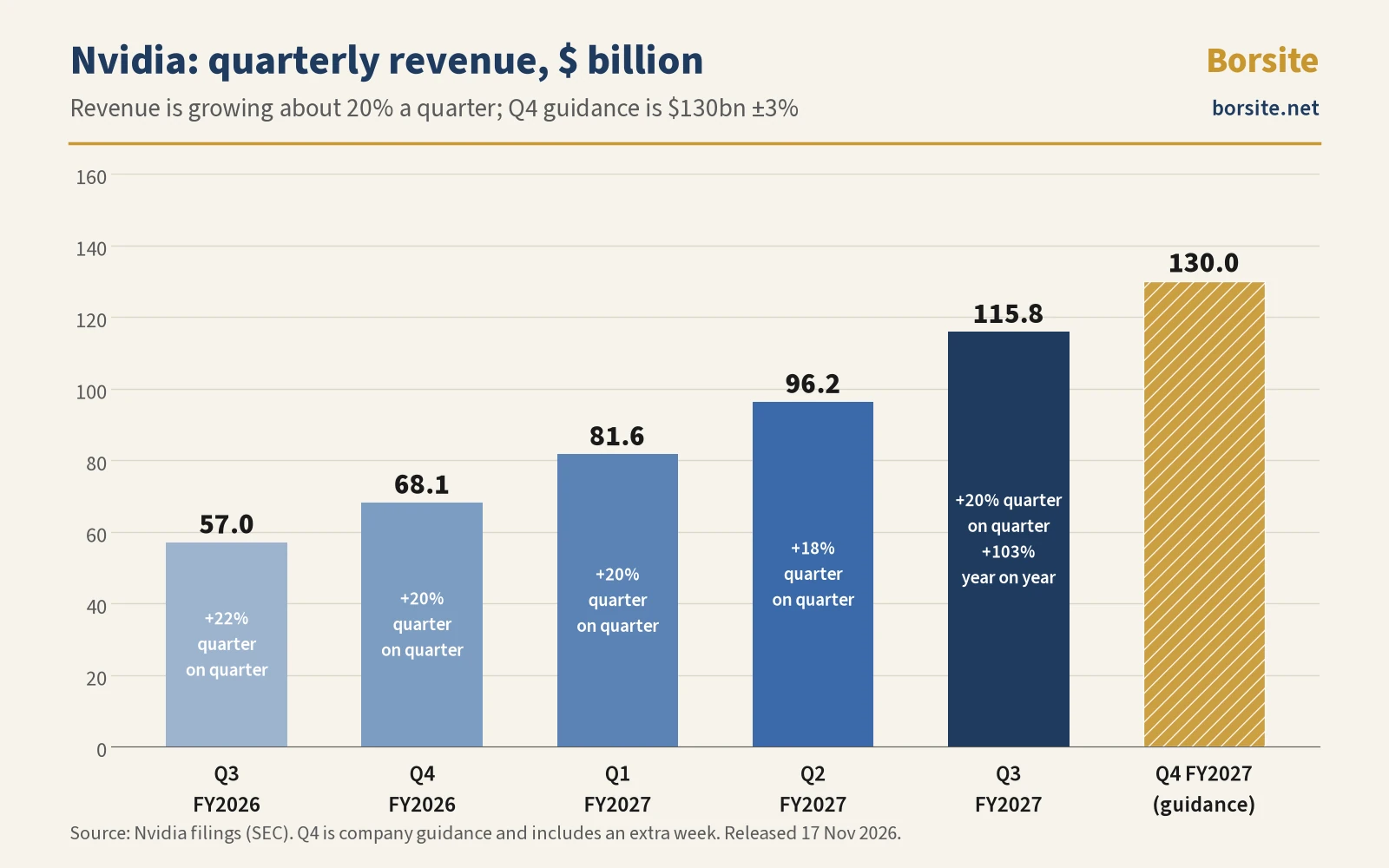
Operating expenses are rising, but more slowly than revenue: up 9% quarter on quarter, to $9.2 billion. Operating income was $77.5 billion (+22%), and the operating margin was about 67%, a very high level. For the fourth quarter, however, the company expects operating expenses of about $11.0 billion.
Net income grew only 9% quarter on quarter, against 22% growth in operating income. The difference comes from equity investments. Impairments in the private investment portfolio (about $1.8 billion) show that the volatility of market valuations is already feeding into results. They were, however, offset by $2.8 billion of gains on publicly traded shares, and the total net effect was a gain of $1.8 billion. That is why GAAP earnings per share are above adjusted EPS. For comparison, net gains on equity investments in the previous quarter were $7.8 billion.
The guidance: $130 billion and no China
For the fourth quarter, Nvidia expects revenue of $130 billion ±3%, against a consensus of about $125 billion according to LSEG. The quarter has one more week than usual, which also helps the comparison. The guidance assumes no revenue from data-center compute products in China, even though in the third quarter the company shipped $2.4 billion of Hopper products there. On November 16, the US Commerce Department announced a change that would also ban the leasing of Nvidia chips to Chinese companies (CNBC).
One of the main questions before the report was whether, without Huang, the company would keep its forecast of 70% growth in fiscal 2028. Colette Kress raised it to about 75%. “We felt very confident that we could say 75% year-over-year growth for fiscal 2028,” she told CNBC.
Colette Kress in charge: who holds the reins
On November 12, Jensen Huang resigned as president, chief executive officer and board member (Nvidia). The resignation followed revelations of extramarital relationships, including with Chinese businesswoman Alice Huang, whose ties to Chinese intelligence services are being examined by US intelligence agencies (Reuters). I covered the case in detail in my analysis of the Jensen Huang scandal.
Colette Kress, Nvidia’s CFO since 2013, is interim CEO and also remains CFO until a permanent successor is chosen. Harvey Jones, former CEO and executive chairman of Synopsys, is the first board chair in the company’s history. At the start of the call with analysts, he said the board had unanimously accepted the resignation and does not intend to bring Huang back as CEO. The board has hired executive search firm Heidrick & Struggles and will consider internal and external candidates, but has not set a timeline (Reuters). On the day of the report, the board also created a national security and export control committee, which will meet at least once a quarter (CNBC).
Kress summed up the situation by saying “from a business standpoint, it’s business as usual” and ended the call with “We’ve got this.” The call, however, lasted about 50 minutes, shorter than usual, and questions about Huang’s departure were not allowed (Reuters). According to the Wall Street Journal, the US Securities and Exchange Commission (SEC) is also investigating Nvidia after the resignation. The SEC declined to comment (Reuters).
Nvidia’s $390 billion in commitments, guarantees and circular financing
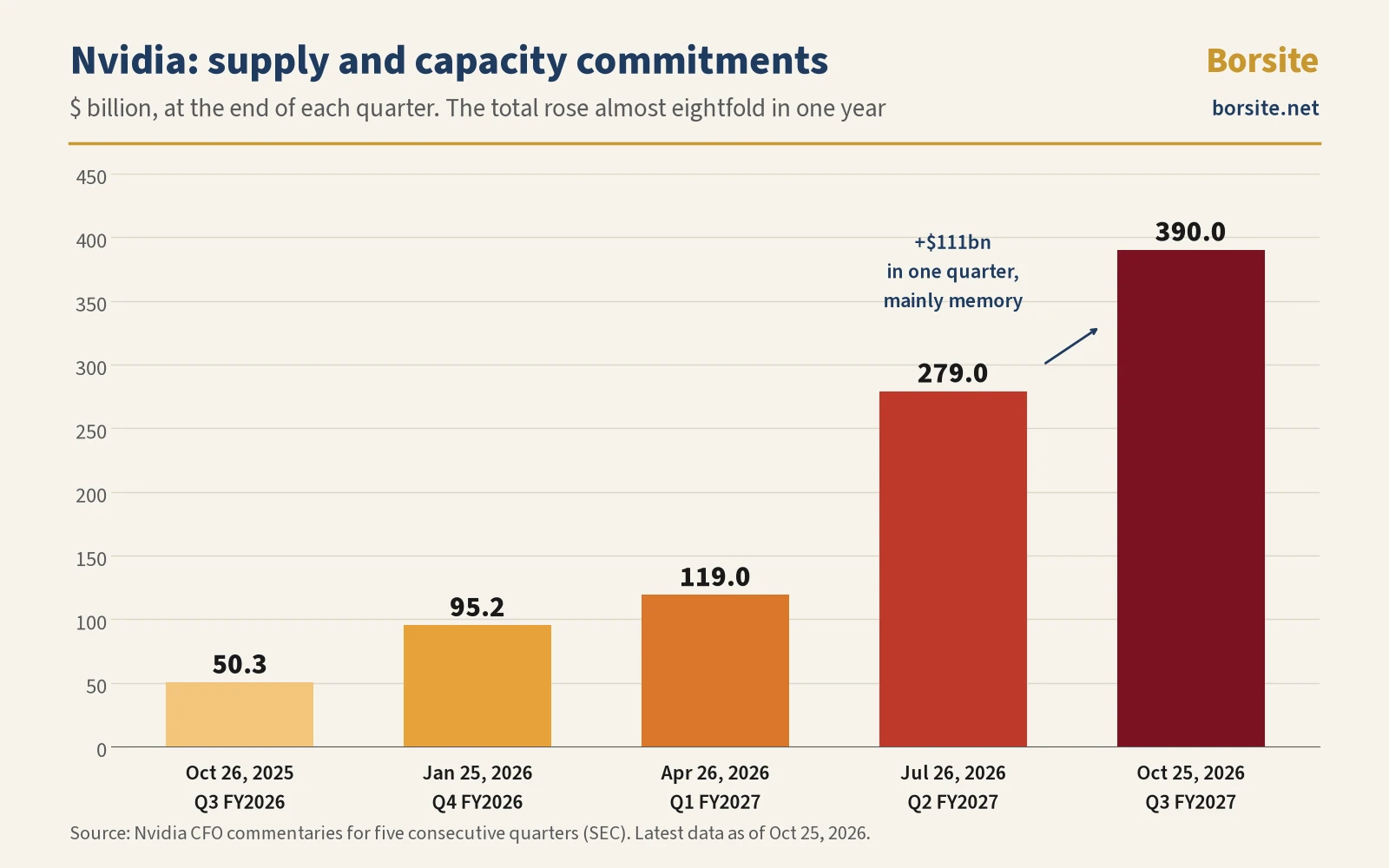
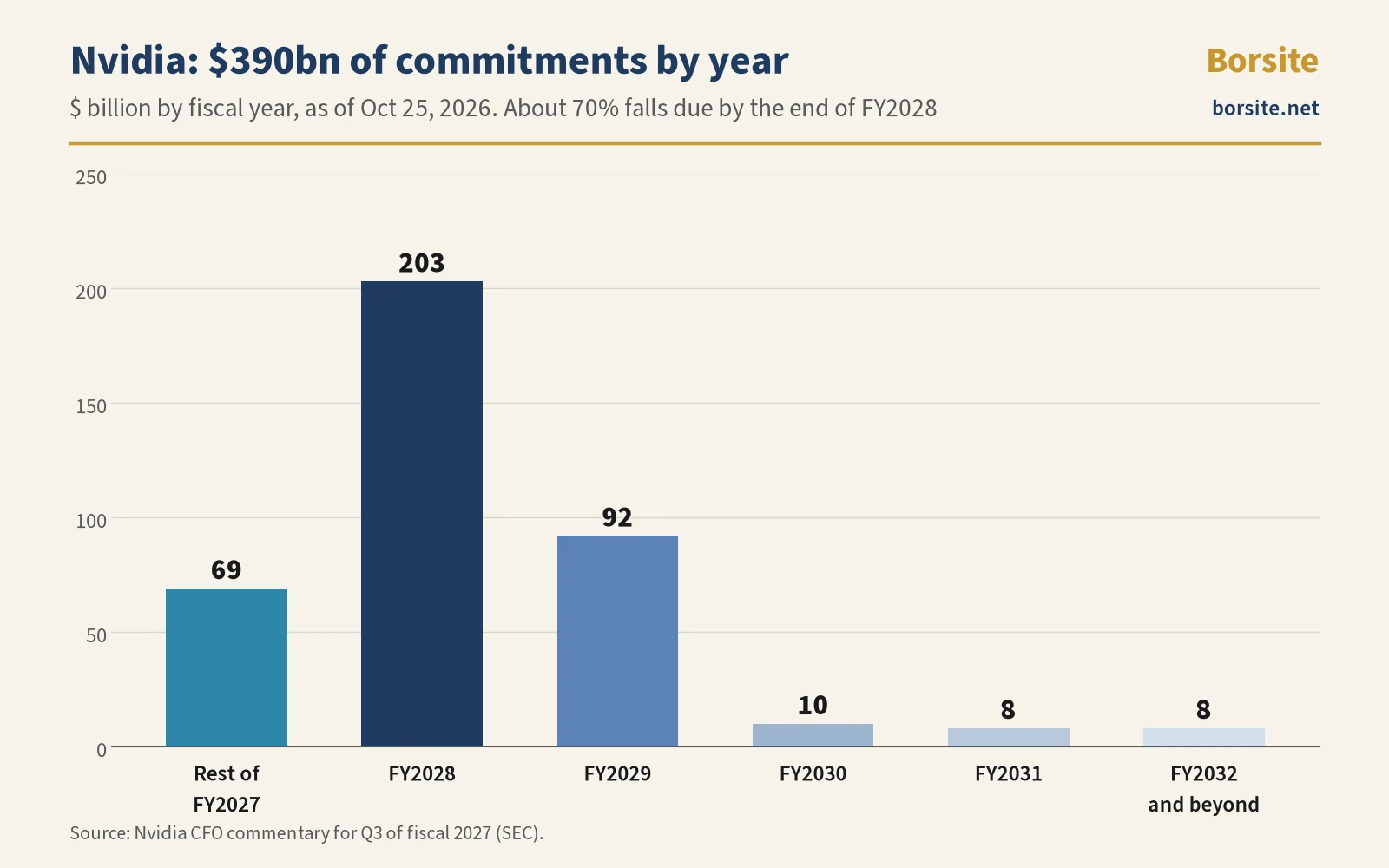
The most significant structural change is in commitments. Supply and capacity agreements rose to $390 billion from $279 billion in just one quarter, mainly for multi-year memory purchases. A year earlier, at the end of October 2025, the total was $50.3 billion. Of the $390 billion, $69 billion falls due by the end of fiscal 2027 (the end of January 2027), and $203 billion in fiscal 2028.
Table 2. Nvidia’s main commitments and guarantees as of October 25, 2026
| Type of commitment | Amount ($bn) | Note |
|---|---|---|
| Supply and capacity | 390 | Up from 279 a quarter earlier; mainly memory |
| Cloud agreements and leases | 102 | 28 for cloud services and 74 for data center leases that have not yet commenced |
| Equity investments | 20 | Mainly in AI model labs and companies that finance infrastructure |
| Capital expenditures | 6 | By the end of fiscal 2027 |
| Total future commitments | 518 | Sum of the rows above |
| Neocloud agreements | 32 | Conditional: take effect only once financing is secured and capacity is put into service; down from 36 a quarter earlier |
| Guarantees (maximum exposure) | 118 | 105 for SB Energy’s campus in Ohio, to be leased to OpenAI; 9.5 for energy and systems; 3.5 for neocloud companies |
Source: Nvidia, CFO commentary on the results for Q3 of fiscal 2027
The topic of circular financing now comes with concrete numbers. Neoclouds are the specialized AI cloud companies, such as CoreWeave and Nebius, that buy Nvidia chips and often depend on its support. Agreements with them total $32 billion. The largest guarantee is credit support of up to $105 billion for SB Energy’s PORTS-Pike campus in Ohio, which will run only Nvidia infrastructure, leased to OpenAI on 20-year leases. This guarantee takes effect in phases, building by building, with the first expected in fiscal 2029. So far, Nvidia has not paid anything under its guarantees.
Accounts receivable rose to $81.0 billion, and days sales outstanding were 64, compared with 60 a quarter earlier. The company attributes this to the timing of Rubin shipments and to extended payment terms on large contracts with investment-grade customers. Two direct customers account for 18% and 17% of receivables, respectively (CNBC). Inventories rose to $39.7 billion from $31.6 billion. Kress promised Nvidia would be “disciplined in how we commit capital,” but when asked whether it had changed its approach to neoclouds, she replied: “Is it new? No. Have we changed anything? No.” (Reuters).
Cash flow remains strong. Free cash flow for the quarter was $43.8 billion, and the company returned a record $28.1 billion to shareholders through buybacks and dividends. In September, the board increased the buyback program by $150 billion, and the company plans to use the remaining $227.3 billion by the end of fiscal 2028. Cash and marketable securities fell to $53.5 billion from $56.6 billion.
The stock’s reaction
On Tuesday, November 17, Nvidia closed the regular session at $155.46 (-0.44%) (Yahoo Finance, Investing.com). After the report, the stock rose in extended trading, with sources putting the gain at between 3% and almost 5% (CNBC, Reuters). Since the start of November, the stock is down about 24% (CNBC), and its market capitalization is about $3.8 trillion, roughly $2 trillion below the peak in early October (Reuters).
At the close of the regular session on Wednesday, November 18, Nvidia shares fell 2.89% to $150.96, a fifth straight losing session, despite the beat on expectations (CNBC, Yahoo Finance). The S&P 500 lost 0.2% to 7,323.63 points, while the Nasdaq Composite gained 0.4% to 24,429.88 points (AP, Reuters). The SOX semiconductor index ended slightly higher, up 0.1% at 9,652.80 points (Wall Street Journal, Yahoo Finance).
Strong numbers are not enough to turn market sentiment around immediately. The company has beaten revenue expectations for 17 consecutive quarters (Reuters), but investors want to know who the permanent CEO will be, answers on the regulatory questions and signals that the engineering team is staying.
Conclusion
In Mayne Reid’s novel, the headless horseman turns out to be not a supernatural being, but a trail that leads to the truth. When the truth comes to light, it does not remove the dangers of the terrain, but it changes the way the characters move across it. The situation at Nvidia is similar. The company keeps moving forward at impressive speed and with a product the market still craves. At the same time, it is now riding with a heavier load: multi-year memory commitments, guarantees to customers of up to $118 billion, rising receivables and closer scrutiny from Washington on national security and exports to China.
The question that remains open is whether this is simply a horseman who has temporarily lost his visible head but keeps his direction and strength, or whether it has already turned into something else: a machine moving on momentum, with a growing risk that the load of commitments and uncertainties will change the rhythm of the ride. The quarter’s numbers show that the horse is still galloping. Whether the terrain ahead remains the same as before Jensen Huang’s resignation is a question the market is still trying to answer.
Frequently asked questions
What is the real risk from the $390 billion in commitments?
The risk is real, but it is not unconditional. Much of the amount is for multi-year memory purchases and is tied to expected demand: $69 billion falls due by the end of fiscal 2027 and $203 billion in fiscal 2028. The company cites a condition under which commitments can be reduced or canceled for its agreements with neocloud companies ($32 billion), not for supply. For supply itself, the company cites no such condition, so if demand weakens, the risk stays mainly with Nvidia.
Why did the stock rise only moderately after a strong report?
Because the numbers answered the question about demand, but not the question about leadership. The market is still waiting for the name of a permanent CEO, and China is excluded from the guidance. Add to that the lower gross margin in the guidance and the broader pressure on AI-related stocks.
What does the 71-72% gross margin guidance mean?
A decline of about 3 percentage points from 74.8% in the third quarter. It coincides with the production ramp of Vera Rubin and with high memory prices. That is still a very high margin, but it shows that growth is becoming more expensive.
Who will be Nvidia’s new CEO?
It is not yet known. The board has hired Heidrick & Struggles and is considering internal and external candidates, without setting a timeline. Until then, Colette Kress is interim CEO and remains CFO. Board chair Harvey Jones said Huang will not be brought back.
How large is Nvidia’s exposure under guarantees?
The maximum exposure is $118 billion as of October 25, 2026. Of that, $105 billion is for SB Energy’s campus in Ohio, linked to OpenAI, $9.5 billion for energy and systems, and $3.5 billion for neocloud companies. The campus guarantee takes effect in phases, from fiscal 2029, and so far Nvidia has not paid anything under guarantees.
Related analysis
- Jensen Huang and Nvidia: The Facts, the Risks, and What We Still Don’t Know
- The Two Faces of the Cycle: CoreWeave, Applied Materials, Capex and Debt
- The AI Stock Selloff in November 2026: Lost Value, Leverage and What Comes Next
- AMD and Qualcomm: Two Different Paths Through the AI Cycle
- The Absurd Scale of AI Spending and the Cost of Financing It
Newsletter
A free weekly newsletter on markets, assets and geopolitics, every Saturday. Subscribe here.
Disclaimer
This material is analytical and educational. It is not a personal investment recommendation and not a call to buy or sell securities. Markets are volatile; valuations carry uncertainty; the data are as of the dates indicated. Do your own research and, if needed, consult a licensed adviser.
Sources
1. Nvidia - press release on results for Q3 of fiscal 2027, Nov 17, 2026 https://www.sec.gov/Archives/edgar/data/1045810/000104581026000088/q3fy27pr.htm
2. Nvidia - CFO commentary for Q3 of fiscal 2027, Nov 17, 2026 https://www.sec.gov/Archives/edgar/data/1045810/000104581026000088/q3fy27cfocommentary.htm
3. Nvidia - CFO commentary for Q2 of fiscal 2027, Aug 26, 2026 https://www.sec.gov/Archives/edgar/data/1045810/000104581026000073/q2fy27cfocommentary.htm
4. Nvidia - CFO commentary for Q1 of fiscal 2027, May 20, 2026 https://www.sec.gov/Archives/edgar/data/1045810/000104581026000051/q1fy27cfocommentary.htm
5. Nvidia - CFO commentary for Q4 of fiscal 2026, Feb 25, 2026 https://www.sec.gov/Archives/edgar/data/1045810/000104581026000019/q4fy26cfocommentary.htm
6. Nvidia - CFO commentary for Q3 of fiscal 2026, Nov 19, 2025 https://www.sec.gov/Archives/edgar/data/1045810/000104581025000228/q3fy26cfocommentary.htm
7. Nvidia - CEO transition announcement, Nov 12, 2026 https://www.sec.gov/Archives/edgar/data/1045810/000104581026000082/nvidiaannouncesceotransiti.htm
8. CNBC - Nvidia’s report, LSEG, fiscal 2028 guidance, national security committee, Nov 17, 2026 https://www.cnbc.com/2026/11/17/nvidia-nvda-earnings-report-q3-2027.html
9. Reuters (StreetInsider) - Q4 guidance versus LSEG, Heidrick & Struggles, extended-trading reaction, Nov 17, 2026 https://www.streetinsider.com/Reuters/%E2%80%8BNvidia+forecasts+quarterly+revenue+above+estimates+in+first+report+since+Huang%E2%80%99s+exit+as+CEO%E2%80%8B/27364029.html
10. Reuters (Investing.com) - the analyst call and the neocloud agreements, Nov 18, 2026 https://www.investing.com/news/stock-market-news/business-as-usual-nvidias-kress-passes-first-test-as-board-slams-door-on-huang-5034739
11. Reuters (Investing.com) - analysis on Huang’s successor, Nov 18, 2026 https://www.investing.com/news/stock-market-news/analysisnvidias-numbers-impress-but-investors-fret-over-ceo-succession-5035070
12. Yahoo Finance - NVDA price history https://finance.yahoo.com/quote/NVDA/history/
13. Investing.com - NVDA quote, close on Nov 17, 2026 https://www.investing.com/equities/nvidia-corp
14. Mayne Reid, “The Headless Horseman” - plot and characters https://en.wikipedia.org/wiki/The_Headless_Horseman_(novel)