Information is as of 10 November 2026, 10:36 Sofia time. Market data are as of the close of U.S. markets on 9 November.
Mark Antony and Cleopatra at Nvidia
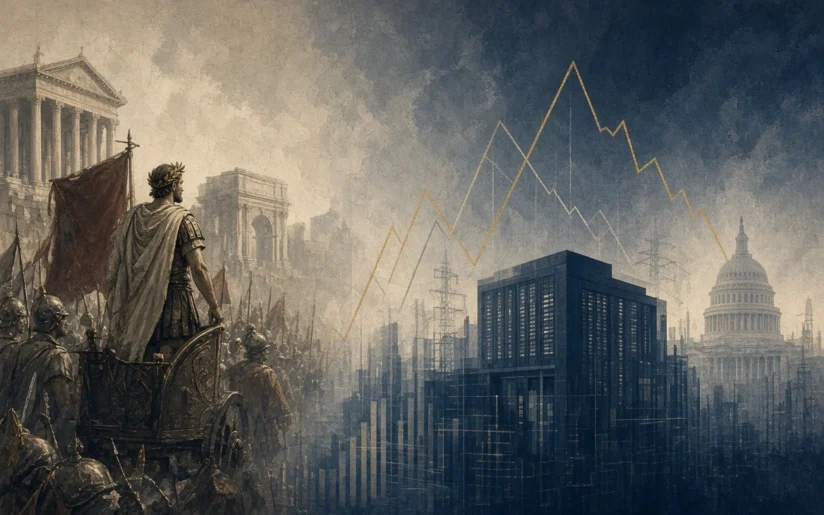
Mark Antony was one of the most powerful men in Rome. After Caesar’s assassination he was part of the ruling Triumvirate, commanded legions and political capital, and could shape the future of the Republic. Then Cleopatra entered the scene. The relationship with the Egyptian queen was not just an affair. It pulled him away from Rome, from his alliance with Octavian and from his marriage to Octavia. Antony began making decisions that, in the eyes of the Roman Senate, looked like betraying the interests of the empire in favor of an eastern ruler. He was accused of giving away Roman territories, adopting an eastern style of rule and placing his personal relationship above the interests of the state.
The consequences are well known. The civil war ended with defeat at Actium. Antony lost his army, his legitimacy and his life. Cleopatra died as well. Octavian remained the sole master of Rome and turned the Republic into an empire. Antony was not killed in battle. The reasons for his fall were many, but one of the heaviest was that he allowed his closeness to a woman tied to a foreign power to become a weapon in the hands of his opponents. Octavian used it skillfully: in 32 BC he read Antony’s will before the Senate to show that Antony was now more Egyptian than a citizen of Rome.
This story offers us the timeless classical pattern: a man of exceptional power and influence allows a personal vulnerability that his opponents turn into a crushing political argument. The analogy is not a verdict. It does not claim there was espionage, nor that the outcome is predetermined. Today this plot is playing out on an entirely different stage. Whether it leads to similar consequences depends on facts that have not yet been established.
In Brief
- On 8 November 2026 Jensen Huang admitted in a letter to employees that he had not been faithful to his wife. The same day Nvidia’s board launched an independent investigation. The letter does not name Alice Huang as part of a love triangle. The link to her comes from reporting by The New York Times and the Financial Times.
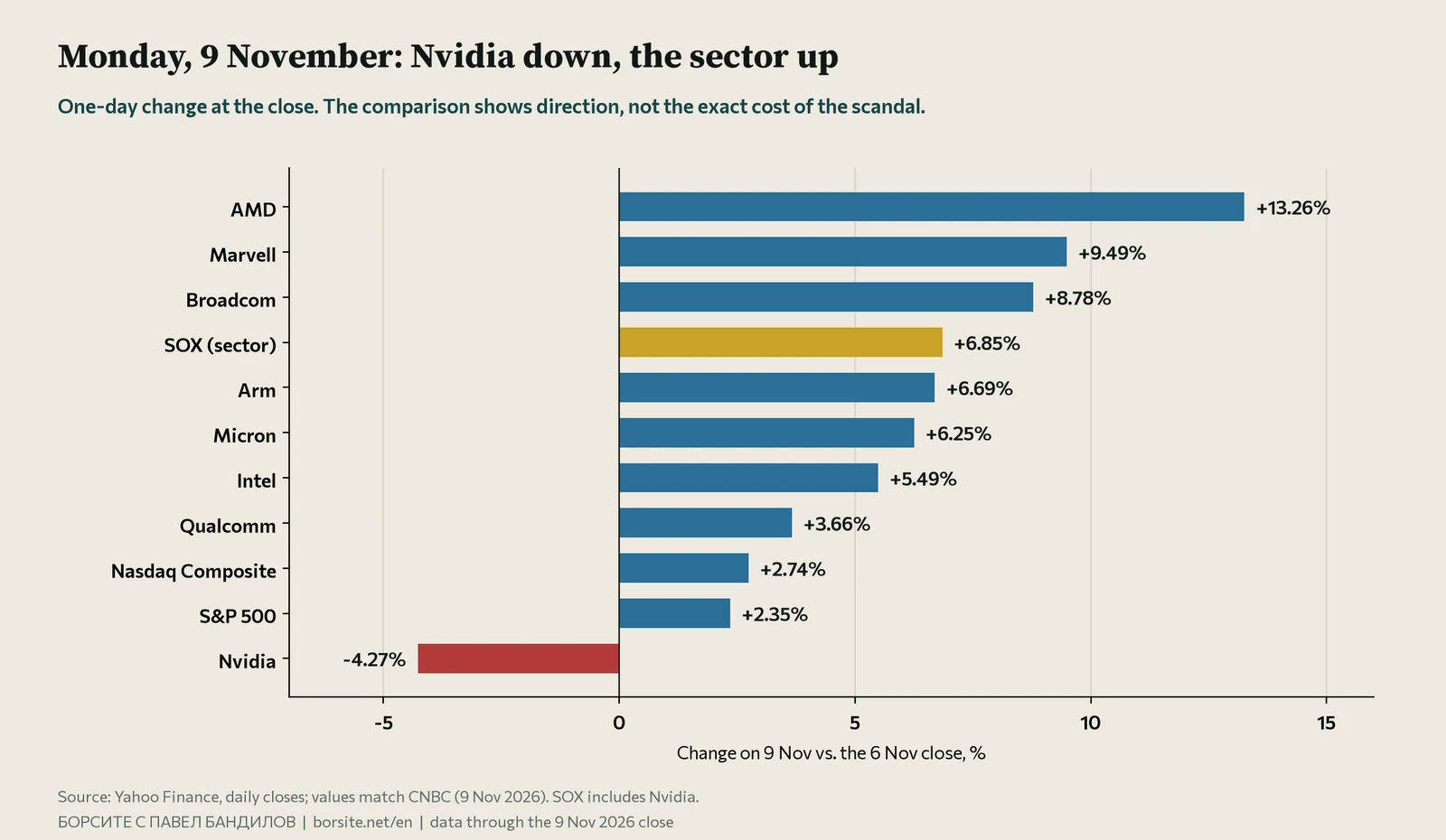
- On Monday, 9 November, the stock fell 4.27% to $178.67, while the SOX semiconductor index rose 6.85%.
- President Trump says the FBI is looking into the case. Three committees of the House of Representatives have asked Huang for a closed briefing on 18 November. A day earlier, on 17 November, Nvidia reports its third fiscal quarter.
- There is no public evidence that secrets were leaked. The risks that are already real are three: dependence on one person, confidence in governance and political pressure for tighter export controls.
Key Uncertainties as of Today
Three questions remain unanswered and determine how serious the case is: whether the relationship with Alice Huang led to the transfer of sensitive information or to influence over decisions; what the board’s independent investigation, the FBI review and the criminal investigation into Megaspeed will establish; and whether U.S. authorities will use the case to tighten export controls. According to media reports, U.S. agencies consider Alice Huang an asset of China’s Ministry of State Security. There is still no public evidence of this, and Beijing rejects the claims.
Timeline of the Main Events
Table 1. Timeline of the main events and their nature.
| Date | Event | Nature |
|---|---|---|
| March - November 2023 | Alice Huang becomes controlling shareholder and managing director of Megaspeed; around November 2023 she leaves the director post | Corporate records, per C4ADS and Reuters |
| June 2024 and May 2025 | Huang is photographed with Alice Huang at events in Taiwan | Public footage |
| June 2024 - February 2026 | A Megaspeed-linked Malaysian company imports at least $4.8 billion of equipment with Nvidia technology | Trade records, per NYT |
| August 2025 | Nvidia’s general counsel writes to the officials investigating Megaspeed | Media report (NYT, 9 Nov 2026) |
| 9 October 2025 | NYT: the U.S. and Singapore are examining Megaspeed | Media report |
| 13 May 2026 | Culper Research publishes a report and discloses a short position in Nvidia | Claims of a short seller |
| 29 October 2026 | NYT: Huang is the target of a Chinese intelligence operation, Alice Huang is under surveillance | Media report |
| 5 November 2026 | Three House committees request a closed briefing on 18 November | Official document |
| 6 - 7 November 2026 | NYT on a memo: Alice Huang was recruited by Chinese intelligence; FT: the relationship was romantic | Media report |
| 8 November 2026 | Huang’s letter and the board’s independent investigation | Official statements |
| 9 November 2026 | The stock falls 4.27%; NYT on the transfer of the Megaspeed case; class action; Trump on the FBI | Market data, media, court filing |
Sources: Reuters, NYT (via TechCrunch, The Verge and Business Times), El País, U.S. House of Representatives, Nvidia, Courthouse News.
The story brings to light problems that were visible months earlier: China risk and chip diversion, the extreme concentration of power in one person with no publicly named successor, and the company’s political vulnerability at exactly the moment export controls are being fought over.
Who Is Alice Huang and What Did She Have Access To
Alice Huang (Huang Le), according to Caixin, is about 42, a Chinese citizen and not related to Jensen Huang. A profile in a Chinese fund database credits her with a career in television and finance (HSBC Private Bank, CITIC Securities). Her finance career is supported by data from Shanghai-based Hexi Investment reviewed by Reuters. Her television work is not confirmed: the New York Post reports that Hunan TV has never heard of her.
According to the research group C4ADS, cited by Reuters, in March 2023 Alice Huang became the controlling shareholder of Megaspeed International, and according to Singapore records she was also managing director. Around November 2023 ownership passed to another company and she left the director post. When exactly her involvement in the business ended is unclear. A Megaspeed employee, quoted anonymously by Culper, claims she is still among the company’s leaders today, which has not been confirmed.
According to trade records cited by NYT, a Megaspeed-linked Malaysian company imported at least $4.8 billion of equipment containing Nvidia technology between June 2024 and February 2026. This is not direct Nvidia revenue from Megaspeed: the servers were assembled and sold by partner manufacturers. According to Culper, $4.0 billion of the $4.6 billion imported by the Malaysian company Speedmatrix between December 2024 and January 2026 came from Aivres, formerly Inspur Systems. The purchases came after Alice Huang left the director post and, as El País notes, there is no public evidence that she personally directed them.
On 29 October NYT reported that U.S. agencies had watched Alice Huang for at least a year and feared she was gathering information about Nvidia’s plans and about Huang’s efforts to persuade the administration to allow sales of more powerful chips to China (TechCrunch). On 6 November the paper added that, according to a memo circulated among senior administration officials, she had been recruited by China’s Ministry of State Security (The Verge, Business Times). Nvidia responds that meetings with customers are part of a chief executive’s job and that regional customers receive routine business information, not sensitive trade secrets. China’s foreign ministry calls the claims “purely a groundless accusation, slander, and a smear.” No charges have been brought against Huang or Nvidia.
The alternative explanation the board and the company rely on is that the relationship was personal and did not lead to the transfer of sensitive information or to influence over corporate decisions. This remains a hypothesis that the independent investigation will test.
Culper Research’s Warning of May 2026
On 13 May 2026 Culper Research published a report claiming that Nvidia has a significant China problem and disclosed that it is betting on a fall in the stock. The main claims are:
- Despite the company’s statements that its China business fell to zero after the April 2025 restrictions, Culper estimates that more than 20% of computing-chip revenue for fiscal 2026 was still linked to Chinese demand through intermediaries in Southeast Asia and illegal diversion.
- Megaspeed is the largest buyer in the region and, according to the report, was secretly funded by Alibaba through front companies. Its balance sheet jumped from about $33 million at the end of 2023 to about $3 billion a year later, mainly from refundable deposits from an unnamed source.
- Huang maintains an uncomfortably close relationship with Alice Huang, with the report citing public photographs and anonymous employees.
These are the claims of a short seller who profits when the stock falls. They have not been confirmed by an independent source and cannot establish what the actual share of revenue tied to China is. Culper relies on corporate documents, trade data and anonymous sources. The report is getting more attention now because it intersects with media reports of intelligence suspicions and with the Megaspeed investigation. It is also possible that it is an aggressive thesis connecting public data without evidence of intent.
The Chip-Diversion Investigation and the General Counsel’s Contact
Megaspeed is under review by the Bureau of Industry and Security at the U.S. Commerce Department over suspicions that it helps Chinese companies get around export restrictions. The first major report was by NYT in October 2025. In December 2025 Bloomberg reported discrepancies between data on Megaspeed’s chips in Southeast Asia and the actual size of its data centers.
On 9 November 2026 NYT reported that in August 2025 Nvidia’s general counsel Tim Teter wrote to the officials leading the investigation and cited permission from senior official Jeff Kessler. The officials declined a meeting and forwarded the correspondence to Kessler, who told them to work strictly by the book. Some of the officials still believed the contact could taint the case, and Nvidia has not been ruled out as a possible subject of the investigation. The Justice Department asked the Commerce Department to halt its own investigation, and the case became a criminal one (The Next Web, via NYT, NBC News). The case has not been closed. Nvidia explains its contacts with the authorities as a wish to answer questions, pass on information from the field and seek guidance.
These are media reports based on sources, not facts established in court. One possible explanation is that the contact was a standard legal defense of a customer relationship. The conflict-of-interest question remains relevant, however: the chief executive had a personal relationship with a former executive of a customer that was under investigation for diversion. The board’s independent investigation and the criminal proceedings will have to establish whether these threads are connected.
On 9 November an Nvidia shareholder filed a class action in federal court in San Jose against the company and Huang. The suit claims the company misled investors by describing its relationship with Megaspeed as ordinary without disclosing the personal connection. To win such a suit, the plaintiff must prove a materially false statement or omission, intent and a causal link to the loss. Suits like this are often filed after a large drop in a stock and are at an early stage.
Huang’s Apology
The full text of the letter of 8 November:
I owe my family and all of you an apology.
I was unfaithful to my wife. My actions hurt her and our children. There is no excuse for what I did. I am deeply sorry.
Throughout my life, my family has given me love and support. They deserve my honesty and loyalty. Instead, I let them down and damaged the life we built together. I take full responsibility for what I did and the hurt I caused, and I accept the criticism that comes with it.
To my wife and family: I love you. I know an apology cannot undo what I have done. I hope our family will heal and that, over time, I can earn back your trust.
To my colleagues at NVIDIA, including those I have worked alongside for decades, and to our board, partners, and shareholders around the world: you deserve better from me. Leading NVIDIA is the privilege of my life. My responsibility is to serve you and be worthy of your trust. I have fallen short of that responsibility. I am fully committed to NVIDIA and will work to earn back your confidence.
Regarding the national security concerns raised in news reports, NVIDIA’s Board of Directors has initiated an independent investigation. I support the investigation and will cooperate fully. I love our country and our company. I am committed to protecting NVIDIA and supporting America’s national security. I am proud and grateful to be an American.
My family bears no responsibility for my choices. I do. Please give them privacy.
Jensen
The board’s statement says the investigation is being led by a committee of independent directors with outside independent counsel, that the board “has no reason to believe that either national security or NVIDIA secrets were compromised,” and that it has confidence in Huang and his team.
How the Stock Reacted
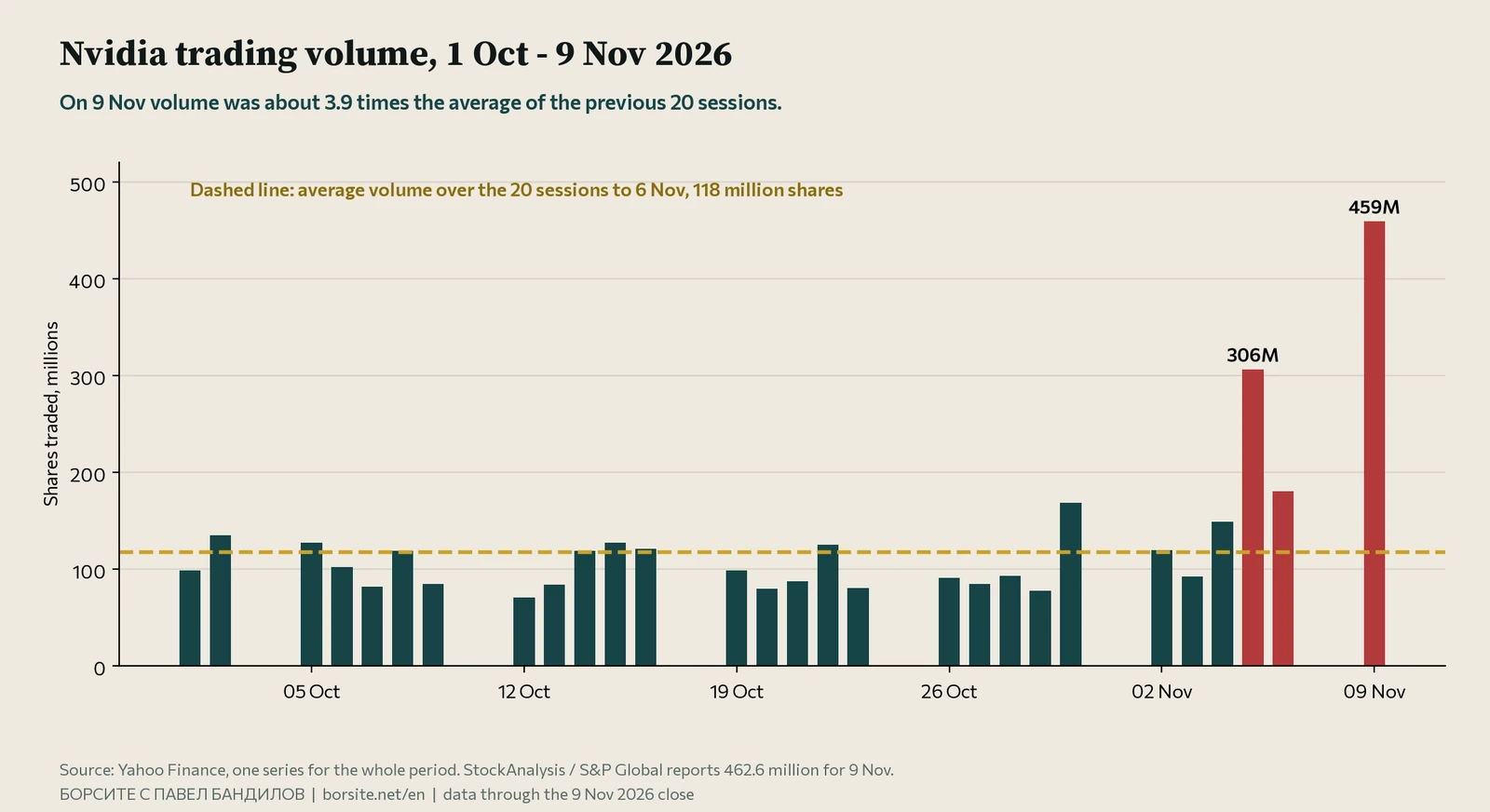
On Friday, 6 November, Nvidia closed at $186.64, with a market capitalization of about $4.51 trillion. On Monday, 9 November, the first session after the letter, the stock fell 4.27% to $178.67, and the intraday low was $170.24 (StockAnalysis). Market capitalization shrank by about $192 billion to about $4.31 trillion. About 459 million shares changed hands, nearly four times the average of the previous 20 sessions.
Table 2. Nvidia stock and the SOX index: the October high and 6 - 9 November 2026.
| Metric | Closing high (6 Oct) | 6 Nov 2026 | 9 Nov 2026 |
|---|---|---|---|
| Nvidia, closing price | $239.24 | $186.64 | $178.67 |
| Nvidia, daily change | +0.14% | +2.78% | -4.27% |
| Nvidia, intraday low | $238.93 | $185.22 | $170.24 |
| Nvidia, market capitalization | about $5.78 trn | about $4.51 trn | about $4.31 trn |
| SOX, closing points | 13,217.82 | 9,390.25 | 10,033.93 |
Market capitalization is calculated with 24.15 billion shares outstanding (StockAnalysis). The intraday high on 6 Oct was $243.37. Sources: StockAnalysis / S&P Global Market Intelligence, Yahoo Finance.
Two clarifications matter for the analysis. First, it was not a bad day for the sector. The SOX index rose 6.85%, AMD 13.3%, Broadcom 8.8% and Marvell 9.5% (CNBC). The divergence shows that the market punished Nvidia specifically. It is not, however, a precise measure of the cost of the scandal: SOX includes Nvidia itself, stocks have different sensitivity to the market, and after the heavy week the rebound in the others had reasons of its own.
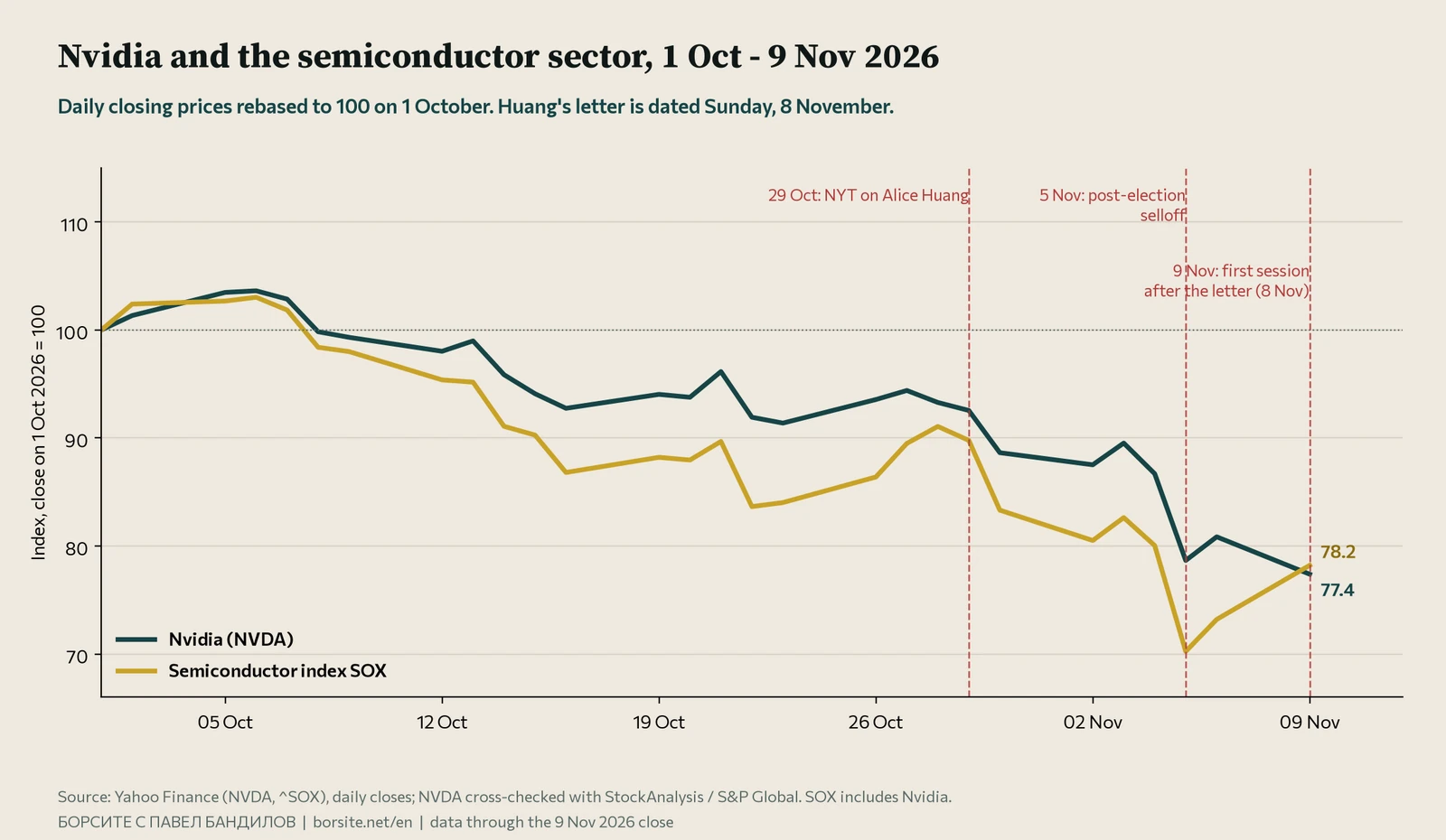
Second, much of the decline from the October high came before the scandal. The highest close was $239.24 on 6 October. By 29 October, the day of NYT’s first report on Alice Huang, the stock was already 10.7% lower. On 5 November it fell 9.26% in a sector-wide selloff: SOX lost 12% after the Democrats’ big win in the midterm elections and fears of stricter rules for data centers (Reuters). From 1 October to 9 November Nvidia lost 22.6% and SOX 21.8%. Through Friday Nvidia did better than the sector, and the divergence against it came on Monday. From the October high the company has lost about $1.46 trillion in market capitalization, but only part of that loss can be tied to the scandal.
What Investors and Analysts Say
Reactions split between personal support for Huang and a clear line between a personal scandal and a possible national security risk. These are opinions, not data.
Bill Ackman (Pershing Square) wrote on X that Huang is “an incredible human” and that “even incredible humans make mistakes,” and called for support for him and his family. In a follow-up post he clarified: “I am not suggesting he gets a free pass.” If this is more than an affair, he wrote, it is obviously a real problem: “I am hoping for a simple affair, not a risk to our national security” (New York Post).
Shaun Maguire (Sequoia Capital) said Huang “did something incredibly dumb” and called it bad for America, but added “my guess is there was no bad intention” and “I believe Jensen is irreplaceable for America’s AI leadership.” Elon Musk replied to his post with “I agree” (Business Insider).
Gary Black (The Future Fund) is more skeptical. He wrote on X: “I doubt Jensen Huang will be able to remain as $NVDA CEO. This could put short-term pressure on the stock of the second most valuable company in the world. He has no natural successor within the company.” Huang has not committed any crime or tort, Black added, but scrutiny of his conduct and judgment will likely “result in his removal” by the board. He does not see long-term impairment of value, but expects many portfolio managers to cut their Nvidia positions in the coming weeks because of uncertainty over who could succeed Huang (Benzinga).
Dan Ives (Yorkville Ives) wrote: “This is a black eye moment for Jensen and will spark multiple congressional inquiries at a minimum and will create an overhang” (Business Insider). In his view investors are factoring in that Huang will stay, with “a small chance he ultimately is removed or steps aside,” and he called talk of replacing him “comedy” (CNBC). Chris Weston (Pepperstone) sees the roughly 4% drop as a hit to sentiment, not a vote of no confidence: if investors genuinely believed Huang was on his way out, “it would be an absolute bloodbath, to be honest” (NDTV Profit, via Reuters).
Mohamed El-Erian described the case as a serious key-person risk and wrote that it is doubtful markets have priced it correctly (Fortune). Stacy Rasgon (Bernstein) summed it up: “Nvidia is not an ordinary company and Jensen is not an ordinary CEO; he is Nvidia” (Reuters).
There are sharper voices too. Dmitri Alperovitch, co-founder of CrowdStrike, believes the affair put Huang in a “classic position” for blackmail. Chris McGuire of the Council on Foreign Relations accuses the Commerce Department of knowing about Megaspeed and still opposing tighter controls. Congressman Michael McCaul called for an immediate pause on shipments of advanced AI chips to China (Business Insider). On the other side, analyst Anshel Sag (Moor Insights) expects the story to fade quickly.
Corporate governance experts are divided as well. Jeffrey Sonnenfeld of Yale says he finds it hard to imagine Huang staying in the job, while Charles Elson asks why he did not take leave during the investigation (Axios). According to the same report, on the Kalshi prediction market the chance that Huang leaves the post before 1 January 2029 trades at around 53%. That probability is based on bets, not a forecast, and covers departure for any reason. Some of the analysts cited by Reuters do not expect the investigation to lead to a resignation.
There is no information yet on changes in the positions of the largest passive holders (Vanguard, BlackRock). Their quarterly filings with the SEC come out with a delay of up to 45 days, so such data will only be visible next year.
Key-Person Risk: Succession and Governance
Succession
Huang has run Nvidia since he founded it in 1993. According to LSEG data cited by Reuters, he owns about 3.6% of the shares, and the company has no shares with different voting rights. This means the board can replace him. The structure is vertical: by various estimates, between 50 and 60 people report directly to Huang (Semafor, New York Post).
Huang himself said on Lex Fridman’s podcast in March 2026 that he is known for not believing in succession planning. His explanation is that instead of a formal plan he constantly passes his knowledge on to the team (recording and quote). In the annual report for fiscal 2026 the company itself flags the risk: “we are highly dependent on the services of our longstanding executive team. Failure to ensure effective succession planning, transfer of knowledge, and smooth transitions involving executives and key employees could hinder our strategic planning, execution, and long-term success.”
Nvidia has no publicly named successor. It is unclear whether the board has a plan for handing over leadership. According to Axios, CFO Colette Kress is mentioned as a possible interim figure, but analysts do not see her as a natural successor to Huang as a visionary. Operating processes (existing contracts, production, deliveries) can continue in the short term without him. In the medium term, however, strategic decisions, negotiations with large customers and political capital in Washington are heavily concentrated in him.
Governance
Succession is a question about the future; governance is a question about the present: who oversees the chief executive. Semafor notes that the average tenure of the directors on the board is almost 15 years, about twice the S&P 500 average, and that the board has no current or former chief executives of S&P 500 companies and no one with national security experience.
Huang’s two children, Madison and Spencer, and his son-in-law Nico Caprez work at Nvidia, the WSJ reports. According to the annual proxy statement cited by Fortune, their pay is comparable to that of colleagues in similar positions, they are not part of senior management and they do not report directly to their father. Huang himself says that if his children want the job, they have to earn it. This is not a violation, but it sharpens the question of how independent the board is from the founder.
The Political and Export Context
Huang has actively lobbied for easing the restrictions (H20, later H200 in exchange for a share of revenue for the U.S. government). This lobbying has a commercial logic: in the annual report, revenue from customers headquartered in China and Hong Kong for fiscal 2026 is $19.7 billion. There is no public evidence that his position was influenced by the personal relationship. But after the scandal his word on the subject carries less weight, and opponents of easing now have a ready argument.
The political picture has changed quickly and in several directions:
- The chairmen of three House committees (Moolenaar, Mast and Crawford) asked Huang for a closed briefing on 18 November on his contacts with Alice Huang and on how Nvidia protects itself from espionage. He has to confirm attendance by 11 November (the letter).
- According to NYT, cited by Reuters, Trump had been informed about the relationship and took no action. On Sunday he called Huang “an honorable guy,” and on Monday he said: “I know the FBI is looking into it” and “I think that he’ll be in good shape.”
- After the 3 November midterm elections the Democrats won control of Congress, CNBC reports. House Democratic leader Hakeem Jeffries called for the defense bill to include restrictions on chip sales to China (Reuters).
Even without evidence that secrets leaked, the very fact that the person lobbying for sales to China had a personal relationship with a woman U.S. agencies came to suspect gives both parties arguments for tighter export controls. The link between the lobbying and the personal relationship remains under investigation.
How the Risk Could Hit Revenue, Profit and Valuation
Revenue. In the second quarter of fiscal 2027 Nvidia reported revenue of $96.2 billion, of which $89.0 billion came from data centers. Guidance for the third quarter is $108 billion plus or minus 2%, and the company explicitly states that it is not assuming any data center compute revenue from China. In other words, the direct China business is already out of the guidance.
The question is what remains in it through third countries. In the annual report Nvidia states that revenue by region is based on the headquarters of its direct customers and that “the end customer and shipping location may be different from our customers’ headquarters location.” Public data do not allow a calculation of what share passes through Southeast Asia and through channels that could prove vulnerable. Culper claims that more than 20% of compute revenue for fiscal 2026 is linked to Chinese demand through intermediaries. The company disputes this, and the claim is unconfirmed. Culper also notes that in 2025 Nvidia changed its method from billing address to customer headquarters, which removed the separate line for Singapore. The company explains the change as giving a more accurate picture of where its customers are.
Profit. Nvidia’s gross profitability is about 75%. This means that about three quarters of every lost dollar of revenue is gross profit, while operating expenses do not fall at the same pace. So even a small drop in sales hits the profit level hard. If new rules also affect contracted sales to cloud providers in Malaysia, Singapore or Thailand, the effect will be larger than if they are limited to gray channels.
Valuation. Key-person risk and doubts about governance rarely hit revenue right away. They work through valuation: the market pays less for each dollar of future earnings while the uncertainty lasts. On consensus estimates cited by StockAnalysis, the stock trades at about 15 times expected earnings. That does not automatically mean it is cheap. A low multiple can reflect expectations that growth will slow, especially after the elections and the doubts about the pace of data center construction, or estimates that have yet to be cut.
What May Actually Have Happened
It is not necessarily about technical secrets (Nvidia says customers do not receive them). The more realistic risks, according to analysts, are:
- soft intelligence: customer relationships, priorities, timelines, internal sentiment;
- influence over Huang’s position when lobbying;
- an inside view of how the company assesses and manages diversion risk.
The board says it has no reason to believe secrets were compromised. That is the company’s position, not a conclusion. The independent investigation has yet to test it.
The Strongest Case for Holding the Position
An honest analysis must also present the opposite scenario in its strongest form.
- The direct China business is already out of the company’s guidance. According to Culper, which cites Commerce Secretary Howard Lutnick’s April 2026 testimony to the Senate, China itself blocked purchases of the H200. If China is walking away from Nvidia anyway, tighter controls mainly hit gray channels, not core revenue.
- The board says it has no reason to believe secrets leaked. There are no charges against Huang, and China denies the claims.
- According to the company, demand comes from the hyperscalers and from a growing number of AI labs, and the Vera Rubin platform is already in full production. In the annual report about 69% of revenue for fiscal 2026 comes from customers headquartered in the U.S.
- Even Gary Black, who expects Huang’s removal, does not see long-term impairment of value.
- The market reaction has been moderate so far: a 4.27% one-day drop, and since 1 October Nvidia has moved almost in line with the sector.
Concerns about serious damage to the company will ease if the board’s investigation ends quickly and publicly without uncovering anything, if on 17 November the company confirms strong demand outside China, and if Congress does not pass new restrictions on sales to third countries. They will grow if evidence of influence over decisions emerges, if the Megaspeed case shows that Nvidia knew about diversion to other customers, or if new rules hit legitimate sales in Southeast Asia.
Scenarios and Investment Implications
Instead of percentages and time frames that cannot be backed by data, the scenarios here are described as conditions and signals. Export risk is a separate layer that can sit on top of any of them.
Scenario 1: the investigation closes quickly without material findings. The investigation ends with no evidence of compromise or influence, and Huang stays. The discount for key-person risk shrinks but does not disappear, because the succession question is now on the table. Signals: a public summary of the findings, Huang attending the briefing with no new revelations, a strong earnings report.
Scenario 2: prolonged uncertainty. The investigation drags on, congressional inquiries continue and the Megaspeed case produces new details. Portfolio managers cut exposure, and the stock stays under pressure even without a change in leadership. Signals: a postponed briefing, new media reports, news about the FBI.
Scenario 3: Huang is removed or steps down. The board decides the risk is too great. The lack of a publicly named successor makes the transition harder. Short-term operating resilience is there; strategic and political resilience is not guaranteed. Signals: forced leave, an interim leader, a search for an outside candidate.
Export risk: tighter political control. Export controls tighten or oversight of third countries increases, regardless of the outcome of the investigation. This affects companies like Megaspeed and others like it. Signals: language in the defense bill, new Commerce Department rules, charges in the Megaspeed case.
When the Risk Counts as Realized
The risk will count as realized if the investigation finds influence over lobbying or commercial decisions, if the criminal proceedings against Megaspeed reveal systematic diversion with Nvidia’s knowledge or assistance, or if Congress imposes new restrictions that directly hit existing channels. As long as none of these conditions is met, the story remains in the realm of elevated risk and uncertainty, not established harm.
Red Flags and Opportunities
Red flags
- Dependence on one person: confirmed by the company’s structure and its own risk factors. There is no publicly named successor.
- Governance: long director tenure and strong founder influence over the board.
- Structural China risk: Culper’s warning and the Megaspeed investigation now intersect with the personal relationship. How closely they are connected remains under review.
- Political risk: Huang’s credibility as a lobbyist has been damaged, and the new majority in Congress is more inclined toward restrictions.
- Trust: the company’s initial explanations that the relationship was ordinary now look incomplete. The general counsel’s contact with the investigators raises questions about compliance oversight.
- Competitors: AMD, Broadcom and the hyperscalers’ own chips could win customers if the uncertainty around Nvidia drags on.
Opportunities
- If the investigation ends quickly and without material findings, and demand for AI chips stays strong, the decline may prove temporary.
- A clearer separation between private life and corporate decisions, stronger internal controls and the announcement of a succession plan could strengthen governance in the long run.
- For longer-horizon investors, the 17 November report will show whether the business remains strong. If it confirms the guidance, the conversation will return to valuation and governance rather than the company’s survival.
What to Watch
Table 3. Upcoming dates and events.
| Date | Event | Why it matters |
|---|---|---|
| 11 November | Deadline for Huang to confirm the congressional briefing | First signal of whether he will appear in person |
| 17 November, around 23:20 Sofia time | Third fiscal quarter results; the analyst call is at 00:00 on 18 November | Demand, guidance, comments on the investigation |
| 18 November | Closed briefing before the three committees | New questions and possible leaks |
| No set date | Results of the board’s investigation and the FBI review | The key factor for Scenarios 1-3 |
| No set date | The criminal investigation into Megaspeed | Whether Nvidia knew about diversion |
| From January 2027 | The new Congress | New restrictions on chips and third countries |
Sources: Nvidia (earnings call announcement), the three committees’ letter, Reuters, CNBC.
The Public Reaction
Social media reacted in its own way. One of the most widely shared posts on X was a crude joke that Huang had popped the AI bubble, and it got millions of views. The market answered with numbers, the networks with irony.
All Is Fair in Love and War
Antony did not lose because he was a weak general. He failed also because he allowed his personal relationship to become a political argument against him. The Romans did not need proof that Cleopatra was a spy in the modern sense of the word. It was enough that the relationship had cut him off from his allies, cast doubt on his decisions and handed his opponents a weapon that Octavian used without hesitation.
Similar logic can work today, but the outcome is not predetermined. Whether the Nvidia board’s investigation finds a transfer of information or ends without such findings, one change has already happened: Jensen Huang is no longer simply the founder and face of the biggest company in artificial intelligence. He is a man whose personal relationship with a woman U.S. agencies, according to American media, came to suspect has called into question his judgment, his lobbying efforts and the company’s ability to manage the risk coming from China. It is now much harder to argue that his position is the same as before. The question is no longer only whether he betrayed his wife. The question is whether he has put at risk the institution he built and the position America entrusted to him in the technology race with China. The answer depends on facts that are yet to be established.
For investors, the next two weeks matter more than all the commentary so far: the 17 November report, the 18 November briefing and the first signals from the investigation. The internet has already given its version of the story. The market is still waiting for its own.
Frequently Asked Questions
Is there evidence that Jensen Huang passed secrets to China?
So far there is no publicly presented evidence that Huang passed on technical secrets or classified information. The board says it has no reason to believe national security or the company’s secrets have been compromised. U.S. intelligence, according to media reports, regards Alice Huang as an asset of the Chinese services, but no public evidence of this has been presented. The board’s investigation and the FBI review are ongoing. The difference between “no public evidence” and “no risk” remains significant.
Will Jensen Huang be removed as chief executive?
The company says he continues to lead and that the board has confidence in him. Opinions are divided: Gary Black and Jeffrey Sonnenfeld doubt he will stay, while Dan Ives and Chris Weston do not expect a change. The answer will depend on whether the investigation finds influence over decisions or a leak of information. The lack of a publicly named successor makes any change more painful for the stock.
What is the real China risk for Nvidia?
The risk is twofold. On one hand, the company is subject to export controls and political pressure, and its guidance already excludes sales of data center compute products in China. On the other hand, according to Culper’s claims and media reports, part of Chinese demand went through intermediaries such as Megaspeed, which is now the subject of a criminal investigation. Public data do not allow an estimate of what share of revenue passes through such channels.
How did major investors react?
Reactions from public figures and active managers are divided. Bill Ackman and Shaun Maguire expressed support for Huang, but Ackman explicitly said that if it is more than an affair, the problem is real. Gary Black doubts Huang will stay but does not see long-term impairment of value. There are no data yet on changes in the positions of the largest passive holders.
What should investors watch from here?
Five things: the 17 November report; the 18 November congressional briefing; the outcome and duration of the board’s investigation and the FBI review; developments in the Megaspeed case; and how Congress and the administration respond on export controls. If these factors stay under control, the decline may prove temporary. If any of them escalates, pressure on the stock will intensify regardless of operating results.
Subscription
If you want the next market analyses in English, subscribe at borsite.net/en. The blog publishes three timely market articles a week.
Disclaimer
This material is general analysis and education. It is not personal investment advice and not a call to buy or sell securities. Third-party claims, media reports, intelligence assessments and lawsuits are presented as such and are not established facts. Markets are volatile; valuations carry uncertainty; data are as of the stated dates. Do your own research and consult a licensed adviser if needed.
Sources
1. Nvidia - Jensen Huang’s letter to employees, 8 Nov 2026 https://nvidianews.nvidia.com/news/a-message-to-our-company
2. Nvidia - statement from the Board of Directors, 8 Nov 2026 https://nvidianews.nvidia.com/news/statement-from-nvidia-board-of-directors
3. Nvidia - third-quarter earnings call announcement, 28 Oct 2026 https://investor.nvidia.com/news/press-release-details/2026/NVIDIA-Sets-Conference-Call-for-Third-Quarter-Financial-Results/default.aspx
4. Nvidia - results for the second quarter of fiscal 2027, 26 Aug 2026 https://nvidianews.nvidia.com/_gallery/download_pdf/6a8f4ad73d6332b41f76ab70/
5. Nvidia - annual report (10-K) for fiscal 2026, SEC https://www.sec.gov/Archives/edgar/data/1045810/000104581026000021/nvda-20260125.htm
6. U.S. House of Representatives - briefing request, 5 Nov 2026 https://chinaselectcommittee.house.gov/media/press-releases/moolenaar-mast-and-crawford-seek-briefing-from-jensen-huang-on-ties-to-chinese-intelligence-asset
7. Culper Research - NVIDIA: The China Problem, 13 May 2026 https://culperresearch.com/wp-content/uploads/2026/05/Culper_NVDA_5-13-2026.pdf
8. Reuters - Trump: the FBI is looking into the case, 9 Nov 2026 https://www.investing.com/news/economy-news/nvidias-outofhour-shares-fall-as-firm-probes-ceo-jensen-huang-5010476
9. Reuters - profile of Alice Huang, 10 Nov 2026 https://www.investing.com/news/stock-market-news/alice-huang-chinese-businesswoman-tied-to-nvidia-ceo-went-from-finance-to-chips-5014096
10. El País - Alice Huang, 9 Nov 2026 https://english.elpais.com/economy-and-business/2026-11-09/alice-huang-the-suspected-chinese-spy-at-the-center-of-the-nvidia-controversy.html
11. New York Post - profile of Alice Huang, 29 Oct 2026 https://nypost.com/2026/10/29/tech/high-flying-past-of-alleged-spy-with-close-relationship-to-nvidia-tycoon-jensen-huang-tv-banking-and-billions/
12. TechCrunch - via NYT, 29 Oct 2026 https://techcrunch.com/2026/10/29/u-s-investigated-chinese-spy-plot-aimed-at-nvidia-ceo/
13. TechCrunch - the memo, 7 Nov 2026 https://techcrunch.com/2026/11/07/chinese-exec-was-recruited-to-spy-on-nvidia-ceo-according-to-us-intelligence-memo/
14. The Verge - via NYT, 7 Nov 2026 https://www.theverge.com/tech/1029338/nvidia-ceo-jensen-huang-china-spy
15. Business Times - NYT text, 8 Nov 2026 https://www.businesstimes.com.sg/companies-markets/telcos-media-tech/china-recruited-singapore-based-executive-spy-nvidia-ceo-jensen-huang-us-intelligence
16. The New York Times - Megaspeed, 9 Oct 2025 https://www.nytimes.com/2025/10/09/technology/nvidia-chips-china-megaspeed.html
17. The Next Web - via NYT on the Megaspeed case, 9 Nov 2026 https://thenextweb.com/news/megaspeed-probe-commerce-nvidia-lawyer-justice-department-nyt
18. NBC News - the transfer of the case, 9 Nov 2026 https://www.nbcnews.com/tech/tech-news/nvidia-investigation-justice-fbi-commerce-jensen-huang-alice-china-rcna608397
19. Courthouse News - the class action, 9 Nov 2026 https://www.courthousenews.com/nvidia-shareholder-sues-over-ceos-undisclosed-affair-with-purported-spy/
20. CNBC - the stock reaction, 9 Nov 2026 https://www.cnbc.com/2026/11/09/nvidia-jensen-huang-chinese-spy-investigation.html
21. Business Insider - investor views, 9 Nov 2026 https://www.businessinsider.com/nvidia-investigation-jensen-huang-affair-smart-people-2026-11
22. New York Post - Ackman and Musk, 9 Nov 2026 https://nypost.com/2026/11/09/business/bill-ackman-elon-musk-back-nvidia-ceo-jensen-huang-after-affair-with-alleged-chinese-spy/
23. Benzinga - Gary Black, 8 Nov 2026 https://www.benzinga.com/markets/tech/26/11/63021460/gary-black-jensen-huang-nvidia
24. NDTV Profit, via Reuters - Chris Weston, 9 Nov 2026 https://www.ndtvprofit.com/markets/nvidia-sinks-5-as-jensen-huang-affair-row-deters-investors-is-stock-carnage-on-cards-12302954
25. Axios - corporate governance, 9 Nov 2026 https://www.axios.com/2026/11/09/jensen-huang-nvidia-ceo-chinese-spy
26. Axios - succession, 9 Nov 2026 https://www.axios.com/2026/11/09/nvidia-jensen-huang-succession-plan
27. Fortune - Huang’s family at Nvidia, 9 Nov 2026 https://fortune.com/2026/11/09/what-is-nvidia-ceo-succession-plan-jensen-huang-son-in-law-nico-caprez/
28. Semafor - Nvidia’s board, 9 Nov 2026 https://www.semafor.com/article/11/09/2026/with-a-weak-board-and-no-successor-nvidia-confronts-a-governance-crisis
29. Reuters - the post-election selloff, 5 Nov 2026 https://www.investing.com/news/stock-market-news/ai-datacenter-stocks-slip-as-democratic-sweep-clouds-expansion-plans-5003196
30. Lex Fridman Podcast #494 - quote on succession, 23 Mar 2026 https://korrents.com/k/he-does-not-believe-in-succession-b4b3e1
31. StockAnalysis / S&P Global - NVDA price history https://stockanalysis.com/stocks/nvda/history/
32. StockAnalysis / S&P Global - NVDA statistics https://stockanalysis.com/stocks/nvda/statistics/
33. Yahoo Finance - daily data for SOX and the stocks https://finance.yahoo.com/quote/%5ESOX/history/